All species › Passerines › Thrushes › American robin
American robin | Turdus migratorius
Roodborstlijster | Zorzal robín
In North America this is the bird of every lawn, the exact counterpart of our Blackbird; in Europe it is one of the most wanted vagrants of all. Unlike the Catharus thrushes, which vanish into dune scrub for a couple of days after a gale, the American robin behaves here much as it does at home: it finds a garden with holly or hawthorn berries, sometimes stays for weeks, and lets several hundred people look at it. That is why most British records fall in December, January and February.

Voice
The song is a cheerful, run-together series of short whistled motifs with a marked up-and-down pattern, cheerily cheer-up cheerio, in phrases of two to five notes with brief pauses; it sings early in the morning and long into dusk. The alarm is a sharp, insistent tut-tut-tut that can accelerate into a rattle, often combined with a high thin seee. There is also an odd whinnying, chattering chuk-chuk-chukkerrr when excited. Vagrants in Europe are fairly vocal: the sharp tut-tut-tut is usually the first thing a garden birder notices.
No freely licensed recording is available for this species yet.
Identification
A big thrush, about Blackbird-sized but slimmer, longer-tailed and more upright. The upperparts are plain slate-grey, the head blackish in the male and greyer in the female. Two features register at once: the white eyelids, which show as a short line above and below the eye and give the face a startled look, and the white throat with heavy black streaking, sharply cut off from the colour below. The entire breast, belly and flanks are deep brick-red to orange-red, and that colour ends abruptly at white undertail coverts and a white belly stripe between the legs. The bill is yellow with a dark tip, the legs dark. In flight it shows white tips to the outer tail feathers and a pale grey to greyish-white underwing. First-autumn birds have creamy tips to the greater coverts and dark scaling across the orange. On the ground it runs in short sprints with abrupt stops, then stands upright and tilts its head to listen at the turf — exactly as a Fieldfare does on wet pasture.
Confusion species
There is no real confusion species in Europe, but three traps. The first is Fieldfare, which at range also seems to show a grey head on a dark back; it has a grey rump against a chestnut mantle, a yellow, black-spotted breast rather than a uniform orange underside, and a brilliant white underwing that flashes on take-off. The second is a female Blackbird in poor light, which can look vaguely rufous on the breast but lacks the slate-grey upperparts, the white eyelids and the streaked throat. The third is the confusion with European robin that the name invites: that bird is a quarter of the weight, carries orange up onto the throat and forehead, and has nothing of a thrush's carriage. Among the Asian vagrant thrushes that can appear in the same months, one comes close because it too carries orange below; there, though, the orange is confined to the flanks, with a white belly, a bold white supercilium and a pale eye-ring, and the bird is smaller and more finely marked. The rest of the Asian thrushes all show a clear supercilium or a black-marked throat and lack the even brick-red running all the way onto the belly.
Habitat
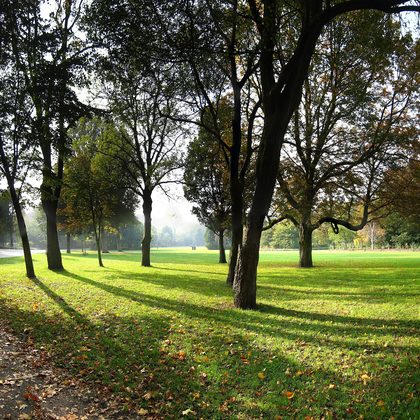
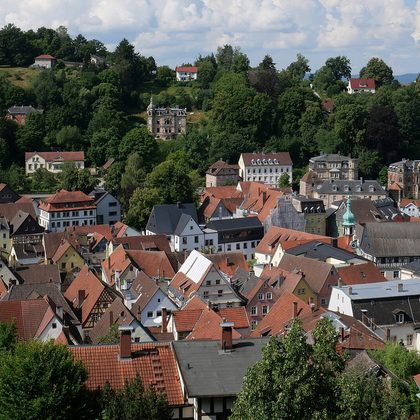
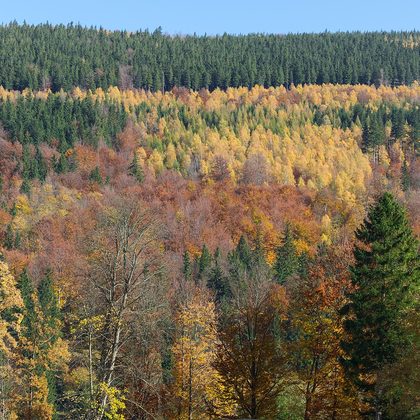
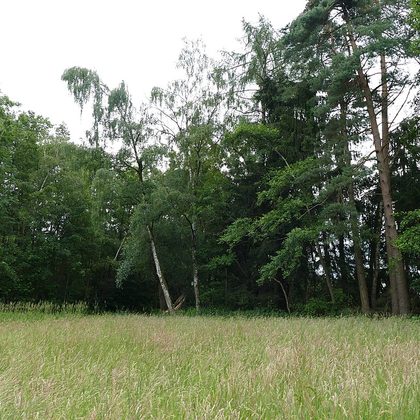
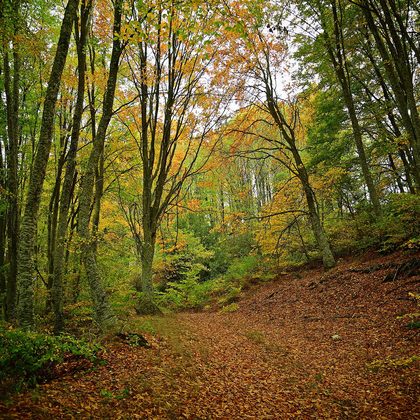
In North America almost anywhere trees and short vegetation meet: lawns, gardens, parks, cemeteries, orchards, field edges and hedgerows, plus open broadleaved and mixed woodland, woodland edge and clear-fell, up into the conifer forest of the boreal zone and the mountains. Feeds by walking on short vegetation for earthworms and insects and switches entirely to fruit in winter, when large flocks gather in berry-rich scrub and orchards. In Europe, accordingly, the vagrants usually end up in gardens, orchards and hedges with holly, hawthorn, ivy or rowan.
Where the bird is most at home, classified with EUNIS — the European standard for habitats.
Range and movements
Breeds from the treeline in Alaska and Canada south into Mexico, and is one of the most abundant birds on the continent across that whole span. Northern birds winter in the southern United States and Mexico; in the south of the range it is resident. In Europe there are around forty records in Britain and Ireland, with Cornwall, the Isles of Scilly and Devon accounting for a third, plus records in Iceland and the Azores. The seasonal spread is the striking thing: where most American passerines arrive in October, the peak here is December to February, when a bird that arrived unseen earlier gives itself away in a garden. The Netherlands has one accepted record, on 27 April 2014 in the Noordhollands Duinreservaat near Heemskerk.
Where and when to look
You rarely find this one yourself; you travel to it. Watch the rarity news in December and January and expect the bird to stay for days or weeks, because an American robin that has found a good berry bush does not leave it in a hurry. On site the usual garden etiquette applies: stay on the road, leave the residents in peace, and look at first light, when the bird sits highest in the bush. If you want to find your own, walk the coastal villages of Cornwall, southern Ireland or Scilly in the first half of November after a hard westerly blow, and listen for a sharp tut-tut-tut from a garden with rowan or holly.
Conservation status
Not globally threatened, and with a population of several hundred million one of the most abundant birds in North America; numbers have risen over the last fifty years. It was not always so: in the 1950s and 1960s the spraying of elms with DDT against Dutch elm disease killed American robins in huge numbers as they ate the poisoned earthworms, and those dead birds on suburban lawns supplied the image for Rachel Carson's Silent Spring. Since the DDT ban the species has recovered completely; West Nile virus causes local mortality without reversing the trend. For the region of this guide it is a vagrant and nothing else. Old records need care, though: American robins were released in England around 1909, and many reports from those years concern escaped or liberated birds. Modern records, with the right date and the right weather behind them, are accepted as genuinely wild.