All species › Passerines › Chats and flycatchers › Black scrub robin
Black scrub robin | Cercotrichas podobe
Zwarte waaierstaart | Alzacola negro
A wholly sooty-black bird with legs too long and a tail far too long, which it flicks up at every step, lays over its back and opens like a fan. Anyone meeting it for the first time in the acacia scrub of the Arava thinks of Africa — rightly so: this is a Sahel bird that has bred on the northern side of the Red Sea only since the 1980s. In this region it occurs nowhere but the southern Arava and around Eilat.

Voice
The song is a series of short, clear and surprisingly musical fluted motifs, two or three notes each, alternating with dry rattles and a hoarse chrrr; it sounds looser and more hurried than rufous-tailed scrub-robin and jumps pitch more often. It sings from the top of an acacia or a tamarisk, and sometimes in a short dancing song flight with the tail spread. Calls: a hard, short chek and a plaintive, nasal cheeeh. Most song from March to May, early in the morning and in the last hour of light.
No freely licensed recording is available for this species yet.
Identification
Slim, long-legged and long-tailed, standing upright and moving over bare ground in light running hops. The whole plumage is dull sooty black, with a slightly browner cast to the wings; the bill is black and pointed, the eye dark, and a narrow, often barely visible pale line runs above the lore. The tail is long and graduated and carries clear white tips to the outer feathers, matched by white tips to the undertail coverts; both show the moment the tail is spread. The legs are long and black. The sexes look alike in the field; young birds are duller and faintly scaled.
Confusion species
Rufous-tailed scrub-robin is the only relative in the area and behaves almost identically — the same cocked, fanned tail, the same running gait — but the colours are opposite: that bird is sandy brown above and creamy white below, with a broad white supercilium and a warm rufous tail, while black scrub robin is black from bill to tail and carries no pale head or underpart markings at all. Where the two meet in the Arava, body colour settles it in a second. Nothing else in Israel is a black chat with that tail: blackstart is grey with a black tail and much shorter legs, and white-crowned wheatear has a white rump, white tail sides and, in adults, a white crown. Tristram's starling is nearly twice the size and shows an orange wing patch.
Habitat
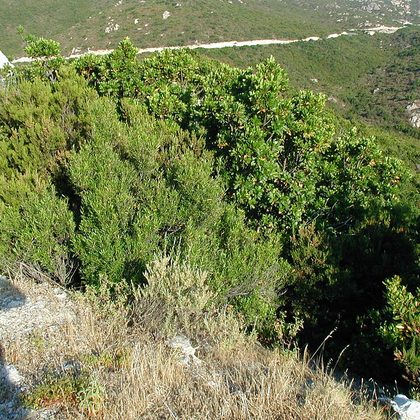
Acacia scrub and acacia savanna in the wadis of the hot, hyper-arid Arava, and tamarisk scrub along the dry river beds around them. Alongside that — and in Israel often above all — the greenery people have planted: hedges, bougainvillea, thorn bushes and gardens of the kibbutzim, date plantations, nurseries and the margins of irrigated plots at Yotvata, Samar, Lotan and Eilat. The bird feeds on foot over bare, hot ground beneath the bushes, picking insects off the surface; cover into which it can vanish is never far away.
Where the bird is most at home, classified with EUNIS — the European standard for habitats.


Range and movements
Native to the Sahel and Sudan zone, from Mauritania and Senegal east to Sudan and Eritrea, and on down the Red Sea through western Arabia. Within this region it is confined to Israel and the adjoining corner of Jordan: it appeared near Eilat in the 1970s and has bred regularly in the southern Arava since the 1980s, spreading north since then to roughly the latitude of Hatzeva. The population is small and local, at most a few hundred pairs, and vagrants beyond it are rare. It occurs nowhere else in the region.
- Resident
- Passage
- Migration direction
- dark = core range, pale = thinly spread
Where and when to look
The field edges and gardens of Yotvata and Samar in the southern Arava, between March and May and in the first hour after sunrise. Drive slowly along the hedges and watch for a black bird running across the sandy track with its tail cocked before it disappears under a bush; stop and wait, because it will be back on the same open patch within a few minutes. By midday it is forty-five degrees there and the bird sits motionless in shade — nothing is seen or heard. Around Eilat, the birding parks and the acacia wadis north of town are worth the time.
Conservation status
Not globally threatened (IUCN: Least Concern): the Sahel range is vast and the species is locally common there. For Israel the case is different. This is a small population at the extreme northern edge of the range, in one narrow valley, and it leans heavily on kibbutz irrigation and planting. If that greenery goes — a change of crop, hedges cleared, a plot allowed to dry out — the bird goes with it. Set against that, the natural acacia scrub of the Arava is itself under pressure: falling groundwater is killing old acacias and few young ones come on to replace them. Israel therefore maps the species as a scarce breeder, monitored but not actively managed.