All species › Passerines › Chats and flycatchers › Rufous-tailed scrub-robin
Rufous-tailed scrub-robin | Cercotrichas galactotes
Rosse waaierstaart | Alzacola rojizo
A long-tailed, long-legged chat of dry vineyards, olive groves and almond orchards, which lifts its broad rufous tail over its back and fans it open again and again, like someone waving a flag. It arrives late and leaves early, and in Spain — its European stronghold — it has all but disappeared within a single lifetime. North of the Mediterranean it is a rare vagrant.

Voice
The song is loud, full and strikingly slow: short clear fluted motifs repeated two or three times and then followed by a silence, more like a thrush than a warbler — choo-choo-choo... tree-tree... choo-wee. It sings from the top of a bush, a post or a wire, and also in a short song flight, climbing on slow wingbeats and dropping back with the tail spread. Calls: a hard, short tek and a nasal, slightly hoarse shrreee. Heard from May into July, mainly early morning and late afternoon.
No freely licensed recording is available for this species yet.
Identification
Slim and long-legged, with a long, broadly rounded tail and an upright stance; on the ground it runs in quick bursts and then stands stock-still. The upperparts are warm sandy rufous, on western birds nearly as rufous as the tail itself. The head is sharply marked: a broad creamy supercilium, a dark line through the eye beneath it, and a pale cheek. The underparts are creamy and unmarked. The decisive image is the spread tail: warm rufous, with a black band just before the end and clean white tips to the outer feathers, so that a row of black-and-white spots appears along the edge. The legs are long and pale. The sexes look alike in the field.
Confusion species
Nightingale is the only species with which it is genuinely confused in Europe. Nightingale also shows a warm rufous tail, but lacks the broad white supercilium and the dark eye-stripe, has a rounder head and a shorter, thicker tail, and has no black band with white tips in the tail. The behaviour matters more still: Nightingale skulks in dense cover and at most jerks its tail briefly, while the scrub robin sits out in the open on a stone or a vine and lifts and fans the tail again and again. Birds from the eastern part of the range, from the Balkans to the Levant, belong to the form syriaca, which is colder grey-brown on the back so that the rufous tail stands out in contrast, whereas on Iberian and North African birds back and tail are almost the same colour.
Habitat
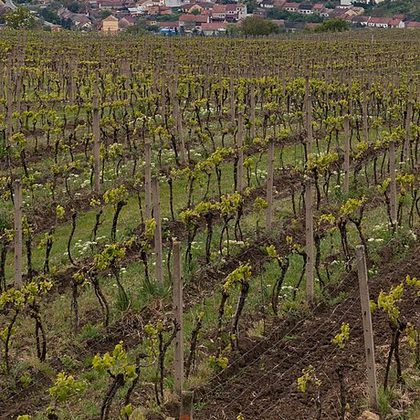
Dry, extensively worked farmland with a low shrub layer and plenty of bare warm ground between: old-fashioned unsprayed vineyards, olive groves, almond and fig orchards, hedges and field margins with rank herbs, market gardens and farmyard plots, and in the south-east prickly-pear hedges and palm gardens as well. In North Africa and the Middle East it also uses tamarisk scrub along dry river beds and acacia steppe. The nest is an open cup low in a vine, a fig, a cactus or a thorn bush. Almost always below a thousand metres.
Where the bird is most at home, classified with EUNIS — the European standard for habitats.



Range and movements
Breeds in Iberia, north-west Africa, southern Italy, the Balkans and Greece, Turkey and the Middle East, and eastwards to Pakistan and north-west India; every bird winters in the Sahel and the Sudan zone, south of the Sahara. Within Europe, Spain is by far the main stronghold, with Portugal next and small numbers in Greece and the Balkans. It arrives late, from the end of April and mainly in May, and is gone again in August and September. North of the breeding range it is a rare vagrant, with a scatter of records in Britain, the Netherlands and Scandinavia, nearly all in autumn.
- Breeding (summer)
- Passage
- Migration direction
- dark = core range, pale = thinly spread
Where and when to look
Andalusia or Extremadura in the second half of May, in the first two hours after sunrise. Find an old unsprayed vineyard or an almond grove with herbage between the rows, stand at a field edge and listen for the slow, repeated fluted motifs. The singer is usually on the highest point around: a post, a wire or the top of a fig tree. If you find one on the ground, wait until it runs and lifts the tail — the black-and-white tips in the fanned tail settle the identification in a second.
Conservation status
Not globally threatened, but in Spain it has suffered one of the sharpest collapses of recent decades: the national survey of 2020 arrived at about 17,300 birds, a fall of nearly 95 per cent against earlier estimates, with 71 per cent of what remains in Andalusia and 27 per cent in Extremadura. In Almería, Murcia and Alicante the counts run from a dozen to a hundred-odd singing males per province. Spain treats the species as Endangered, and SEO/BirdLife made it Bird of the Year in 2022. The causes all lie in the farmland itself: the switch from dry to irrigated cultivation, land consolidation that removes hedges and margins, more pesticide and more machinery, the scouring bare of the ground between the rows, and the replacement of old vineyards and almond groves by glasshouses, intensive horticulture and pistachio plantations.