All species › Waders, gulls and terns › Gulls and terns › Arctic tern
Arctic tern
Sterna paradisaea | Noordse stern | Charrán ártico
The Arctic Tern makes the longest annual journey of any bird on earth, from the Wadden islands to the Antarctic pack ice and back. In a mixed colony you know it by a shorter, rounder outline and a bill that is blood red from base to tip.

Voice
Higher, shorter and purer than Common Tern: a brisk, cheerful pee-pee-pee and a sharp, rising kreeer without the falling second syllable of Common Tern. Disturb a colony and you get a rattling kt-kt-kt as the birds dive at your head. It sounds from May to July over colonies on the Wadden islands, in the Delta and all along the Scandinavian and Icelandic coasts.
Recording: Doug Hynes — CC BY-SA 4.0 · Wikimedia Commons
Identification
The bill is uniformly blood red without a black tip, and the legs are short and bright red, so short that a perched bird almost seems to lie on its belly. At rest the long tail streamers project beyond the wingtips, which they rarely do in Common Tern. The underparts are distinctly grey, so a narrow white cheek stripe glows between the black cap and the grey breast. From above the wing is evenly grey with no dark wedge, and the black trailing edge to the hand is narrow and knife-sharp; from below all the primaries are translucent white with a thin black trailing line, so the wing looks almost transparent against the sky. Juveniles show a white panel in the secondaries, a weak dark carpal bar and a short dark bill; winter birds have a white forehead and a black bill.
Confusion species
Common Tern is the species to compare with every single time: an orange-red bill with a black tip, longer legs, streamers reaching at most to the wingtip, and above a dark wedge in the outer primaries that spreads as the summer wears on. From below Common Tern shows a broader, diffusely grey trailing edge where Arctic Tern has a hair-thin, crisp line. Roseate Tern is paler and whiter, with very long white streamers, a mostly black bill and faster, shallower wingbeats. At distance the combination of a tern on tiny legs with a translucent wing stays the most reliable.
Habitat
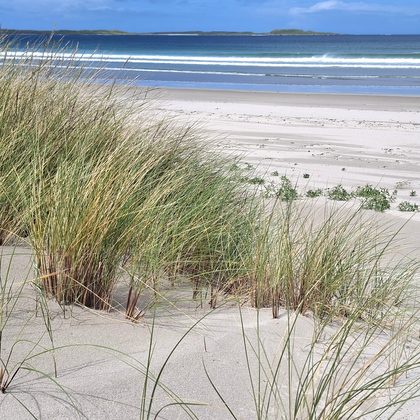
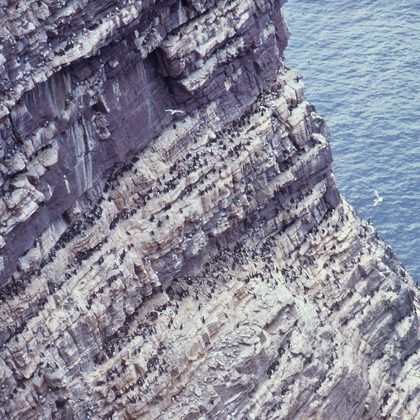
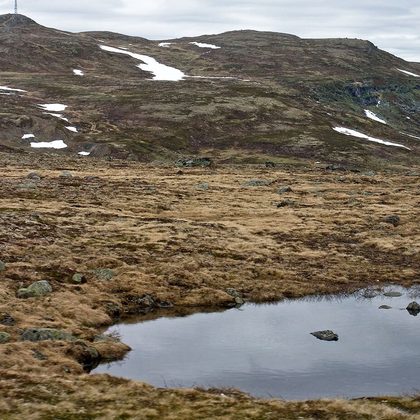
Shell beaches, saltmarsh, low dune slacks, rocky islets and tundra pools; on migration entirely marine, often far offshore. It fishes with short hovers and steep plunge-dives for sandeel, young herring and shrimp, usually in shallow water with a strong current such as tidal inlets and gullies. It breeds in loose colonies on bare ground, regularly among Common and Little Terns.
Where the bird is most at home, classified with EUNIS — the European standard for habitats.


Range and movements
Circumpolar in the Arctic, with the European core in Iceland, Norway, the Baltic and the British Isles; the Netherlands lies at the southern edge of the range. Dutch breeders are almost all on the Wadden islands and on Griend, with a handful of pairs in the Delta. In Spain it is purely a passage migrant at sea, chiefly off Galicia and in the Bay of Biscay in May and from August to October.
- Breeding (summer)
- Passage
- dark = core range, pale = thinly spread
Where and when to look
Go to a Wadden sea wall or tidal inlet in late April or early May, when Arctic and Common Terns arrive together and sit side by side on a groyne: that is when bill and leg length register in a single look. In June a walk past a colony on Texel, Terschelling or Griend gives the best flight views, with the sun behind you so the translucent hand lights up. Seawatching in May on an onshore wind produces migrating parties along the coast, where the shorter, faster beat and the lighter body put you on the species.
Conservation status
Not globally threatened thanks to the huge Arctic populations, but in the North Sea and the Baltic the picture is poor: numbers on the Wadden islands and in Scotland have fallen sharply in recent decades. Food shortage from warmer water and collapsing sandeel stocks is the main driver, alongside the flooding of low-lying colonies in summer storms and predation by foxes and large gulls. The species is therefore Red-listed in the Netherlands, and colonies on inaccessible islets clearly do better than those on the mainland.