All species › Passerines › Chats and flycatchers › Atlas pied flycatcher
Atlas pied flycatcher | Ficedula speculigera
Atlasvliegenvanger | Papamoscas del Atlas
The flycatcher of the Atlas cedar forests: the same shape and the same manner as European pied flycatcher, but the male is blacker, with more white in the wing and a broad white forehead. It breeds only in Morocco, Algeria and Tunisia, and has been treated as a separate species since the start of this century on the strength of song and genetic work. For anyone walking a Moroccan cedar wood in May it is one of the most conspicuous birds of the forest.

Voice
The song is the most reliable separation of all, and once heard it is not mistaken again. Where pied flycatcher swings between two pitches and finishes on a rising note, Atlas pied flycatcher delivers a shorter, harder and far more rhythmic phrase: three to five identical, sharply accented notes on more or less one pitch, like a small hammering — chee-chee-chee-choo — with less melody and more emphasis. It sings from a dead branch halfway up the crown, from late March into early June and hardest in the fortnight after arrival. The call is a sharp bit, with a dry tek in alarm.
No freely licensed recording is available for this species yet.
Identification
Small, compact and short-tailed, perching upright on a low branch, sallying out and usually returning to a different twig while flicking wings and tail. The breeding male is deep, matt black above — without any brown cast — and pure white below. The white wing patch is large and runs as a long tapering wedge far up the base of the primaries, much further than on pied flycatcher; the tertials carry broad white fringes. The forehead shows a broad white block, usually one panel rather than two separate spots. White in the tail is limited, often no more than a narrow edge to the outer feathers. The female is grey-brown where the male is black, with the same wing patch but smaller, and no white forehead. In autumn every bird looks like a female.
Confusion species
Everything turns on European pied flycatcher, and the difference rests on three things, in this order. First, the extent of white on the hand: on Atlas pied flycatcher the white runs as a tapering wedge well up the primaries, on pied flycatcher it stops shortly beyond their base. Second, the forehead: one broad white block against one or two small spots. Third, the tone of the upperparts: matt, even black against a black that nearly always shows brownish, especially in worn feathers. The female is a lost cause — in the field it cannot be separated from a female pied flycatcher, and anyone claiming one is really claiming a place and a date. That is also the practical handle: in the breeding season, April to July, every breeding pied-type flycatcher in the Atlas and the Rif is an Atlas pied flycatcher, whereas in August and September northern pied flycatchers pour through the same woods, so an autumn bird cannot be named on plumage. Collared and semicollared flycatchers do not occur in the Maghreb; spotted flycatcher, which does breed there, is larger, uniformly grey-brown, streaked on crown and breast, and has no white wing patch.
Habitat
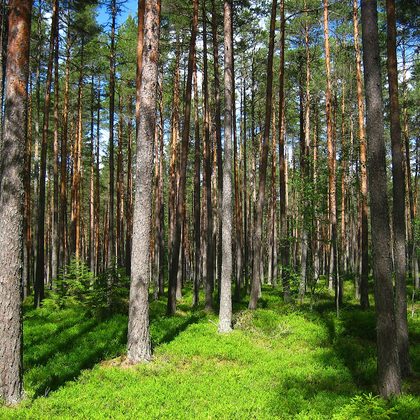
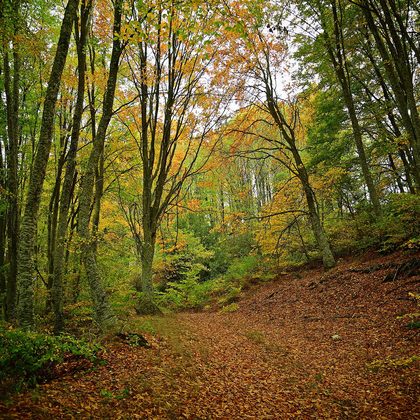
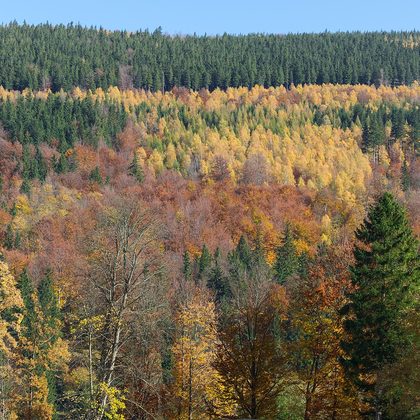
Mature mountain forest of the Atlas and the Rif, roughly between one thousand and two thousand four hundred metres, rich in dead timber and cavities: the cedar forests of the Middle Atlas, woods of Algerian and Portuguese oak, mixed cedar and oak, and locally cork oak and holm oak. The nest goes in a tree hole or an old woodpecker hole, and where nest boxes are put up they are taken as readily as in Europe. On migration it is far less particular, using gardens, oases and coastal scrub.
Where the bird is most at home, classified with EUNIS — the European standard for habitats.

Range and movements
A breeder of Morocco, northern Algeria and north-western Tunisia, centred on the Middle Atlas around Ifrane and Azrou and extending to the High Atlas, the Rif and Kabylia. All birds leave in August and September to winter in West Africa, returning from late March. Away from the breeding grounds the species is barely detectable, because it travels through the same country as pied flycatcher; there are records confirmed by song or in the hand from southern Europe, including Italy and Malta, but how many pass along Iberia is unknown.
- Breeding (summer)
- Passage
- dark = core range, pale = thinly spread
Where and when to look
The cedar forest at Azrou or Ifrane National Park, in the second half of April or early May, between sunrise and nine o'clock. Find the old cedars with dead limbs and listen first; the hard, rhythmic phrase gives the bird away before the eye finds it. Once you have the singer, go straight to the closed wing and look for the long white wedge on the primaries — that is the character that survives on a photograph. The same cedar woods hold Levaillant's woodpecker, so a morning there is worth setting aside in any case.
Conservation status
The category above is that of the European pied flycatcher. BirdLife, which assesses birds for the Red List, still keeps the Atlas pied flycatcher within that species and so does not assess it separately; the guide therefore shows the category of the wider species rather than “not evaluated”, because assessed it has been — only under a broader species concept. The range is small but the species is common within its forest belt, and densities in good cedar forest are high. The worry lies in the forest itself: Atlas cedar is in retreat under prolonged drought, heavy grazing by goats and sheep, illegal felling and the death of old trees — and it is precisely those old, half-dead trees that supply the cavities. On top of that the bird spends the whole winter in West Africa and depends on what happens there too. Morocco has brought the Middle Atlas cedar forests under protection, and putting up nest boxes in stands without old trees works here just as it does in Europe.