All species › Passerines › Chats and flycatchers › Semicollared flycatcher
Semicollared flycatcher | Ficedula semitorquata
Balkanvliegenvanger | Papamoscas semicollarino
The semicollared flycatcher is Europe's third black-and-white flycatcher and the only one you have to travel for: it breeds in the mountain woods of the Balkans, Turkey and the Caucasus, and nowhere else. Outside that block every claim deserves suspicion, photographs on the internet included, where pictures labelled with this name from central Europe almost always turn out to be Pied Flycatchers. To see one, go to the Struma valley or the Rhodopes in the first half of May.

Voice
The song sits between Pied and Collared: a short phrase of two to three seconds in thin, high, strained notes, slower and reedier than a Pied's and without its clear jump between two pitches. It sounds hesitant, as though the bird stops to think halfway. The call is a short scraping tsrr or zrr; at the nest a dry tek and a clear rising tsheb. In the field the song is useful but not conclusive, because all three species copy one another where they meet.
No freely licensed recording is available for this species yet.
Identification
The size and build of a Pied Flycatcher. The spring male is black above and white below, with four things to work through in order. First the neck: a white collar that runs up the side of the neck from the throat and stops halfway, leaving the band open. Second the wing: besides the usual white panel across the secondaries and primary bases there is a second, separate white bar across the median coverts, so the closed wing shows two distinct white marks rather than one panel. Third the rump: light grey, clearly paler than the back but not white. Fourth the tail: more white than a Pied shows, usually on the outer three pairs of feathers. The forehead carries a small white spot, not the broad band of a Collared. The female is grey-brown and looks much like a female Pied, but keeps the pale bar on the median coverts; in autumn plumage that remains the best mark.
Confusion species
Pied Flycatcher passes through the same country on migration and is the species you actually have to rule out — see its own page. Its male has a plain black hindneck with no white at all, a single white wing panel with no median-covert bar, a dark rump and on average less white in the tail; its black is more often brownish-black than glossy. Collared flycatcher, which on the Balkans breeds lower down and in more open woodland, has a collar running right round the neck, a broad unbroken white forehead, one large white wing panel that is broad on the primaries too, and a distinctly white rump; its own page carries the comparison as well. Among females and autumn birds almost all of this falls away and only the median-covert bar is left, and on a worn bird even that can be unclear — better then to let the bird go. Spotted flycatcher drops out at once on the complete absence of white in the wing.
Habitat
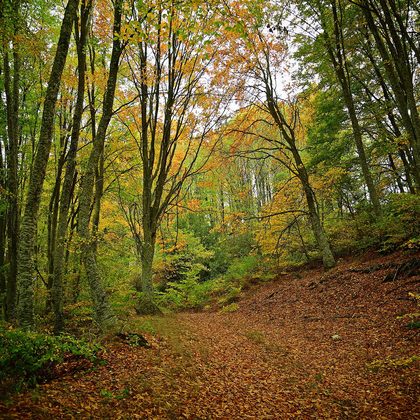
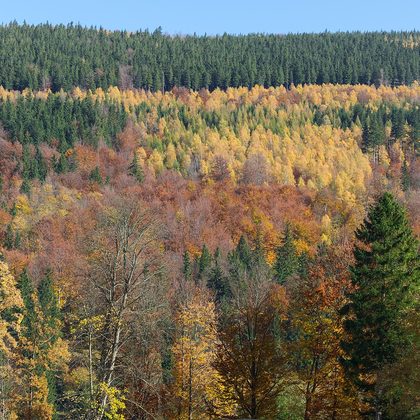
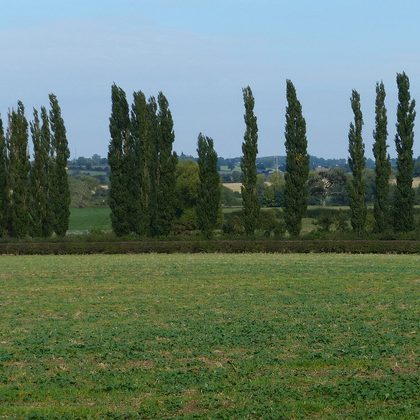
Mature broadleaved and mixed woodland in hill and mountain country, from about three hundred to two thousand metres, with a strong preference for oak and hornbeam and for old beech stands riddled with woodpecker holes. Also gallery woodland along mountain rivers, old walnut orchards and lines of trees at the edge of upland villages. It nests in woodpecker holes and natural cavities and takes nestboxes readily; in Bulgaria that is how the species has been given a lift at several sites.
Where the bird is most at home, classified with EUNIS — the European standard for habitats.
Range and movements
A breeder of south-eastern Europe and the Near East: Bulgaria, northern and central Greece, North Macedonia, Albania and southern Serbia, then Turkey, the Caucasus and northern Iran. Within the European Union the population is put at some three and a half to seven and a half thousand pairs, the great majority of them Bulgarian. All birds winter in eastern Africa. West and north of the breeding range it is an exceptional bird: it appears on neither the German nor the Dutch list.
- Breeding (summer)
- Passage
- Migration direction
- dark = core range, pale = thinly spread
Where and when to look
The first half of May in the Struma valley, the Kresna gorge or the southern Rhodopes in Bulgaria, in old oak and hornbeam woodland on the slopes. Find the bird first by its slow reedy phrase, then work through it in order: neck, median coverts, rump, tail. Take your time — a male that flicks its wing once shows the median-covert bar in a single frame, and that is worth more than half an hour spent squinting at the collar. Outside the breeding range the rule reverses: start from the assumption that the bird is a Pied Flycatcher.
Conservation status
Not globally threatened, but the European population is small, fragmented, poorly monitored and concentrated almost entirely in one country. The bottleneck is the same everywhere: the felling of old broadleaved woodland with hollow trees and the removal of dead wood, which takes the nest cavities with it. Where nestboxes have been put up in protected Bulgarian forests the response has been quick, and more than four fifths of the Bulgarian breeding birds now sit inside the Natura 2000 network.