All species › Passerines › Chats and flycatchers › Collared flycatcher
Collared flycatcher | Ficedula albicollis
Withalsvliegenvanger | Papamoscas collarino
In an old oak-and-hornbeam wood in Hungary, Slovakia or eastern Poland, the collared flycatcher is the flycatcher you meet in May: in the best stands there are four or five males in a single compartment. West of that it is a genuine rarity, and in Britain, Ireland and the Low Countries it turns up in exactly the fortnight when Pied Flycatchers are streaming through — which is the whole problem.

Voice
The song is a run of slow, strained whistles that sound as though they cost the bird an effort: tsee … tchoo … tsree, with clear gaps between them and a scraping, almost hissing edge. It is slower, higher and more plaintive than the hurried two-pitch phrase of a Pied Flycatcher, and far less tuneful. One warning: where the two breed together, Pied Flycatchers take over phrases from Collared, so in the hybrid zone the song proves nothing. The call is a thin drawn-out tsee and, in alarm, a dry tek, often in series.
No freely licensed recording is available for this species yet.
Identification
The size and build of a Pied Flycatcher, with the same upright stance and the same sallies from a low branch. The spring male is deep black above and pure white below and carries three marks that together settle it: a white collar running right round the hindneck, a broad unbroken white forehead patch, and a large continuous white wing panel that is as wide on the primaries as on the secondaries. Add a pale, greyish-white rump, best seen as the bird flies away, and a nearly all-black tail with less white in the outer feathers than a Pied shows. The female is grey-brown, cooler and greyer than a female Pied, with a broader and more continuous white base to the primaries and often a hint of a pale rump. In autumn every bird looks like a female.
Confusion species
Pied Flycatcher is where it goes wrong — see its own page, where the same difference is set out from the other side. Its male never has a closed collar but a black hindneck, a forehead patch of one or two small spots, a smaller wing panel that narrows on the primaries, a dark rump, and more white in the tail sides, not less. Between the females most of that falls away: look for the broader white primary base, the greyer upperparts and the paler rump, and if you did not hear the bird, leave it unrecorded. Semicollared flycatcher is the third of the trio and the hardest: its male has a collar that stops halfway round the neck, a small white forehead spot, a light grey rather than white rump, and — the best mark — an extra white bar across the median coverts, so the wing shows two separate white marks rather than one panel. Outside the Balkans, Turkey and the Caucasus that is an exceptional find. Female common redstart and spotted flycatcher drop out on the rusty tail and on the complete absence of white in the wing respectively.
Habitat
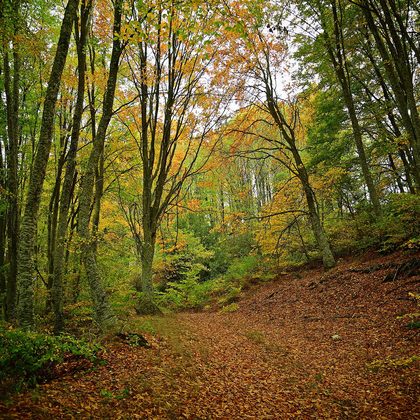
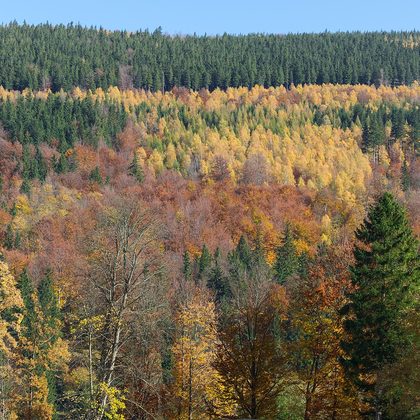
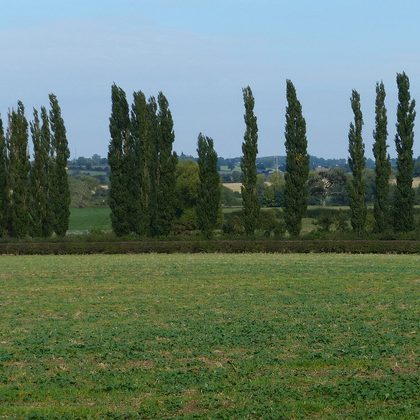
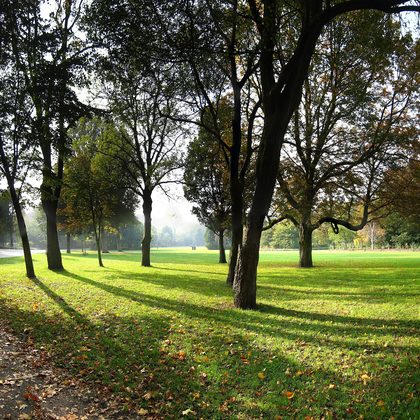
Mature closed broadleaved woodland with plenty of cavities and an open understorey, with a marked preference for oak-hornbeam and old beech; also old avenues, park woodland, orchards and estate woods. On Gotland and Öland it occupies the centuries-old wooded meadows, among gnarled ash and oak. Where nestboxes are put up it takes them as readily as a Pied Flycatcher, and where both species occur the boxes become the arena for a hard fight over the best holes.
Where the bird is most at home, classified with EUNIS — the European standard for habitats.
Range and movements
A breeder of central and eastern Europe, from eastern France and northern Italy east into Ukraine and western Russia and south into the Balkans, with two isolated strongholds on the Swedish islands of Gotland and Öland. Every bird leaves for sub-Saharan Africa, so the map shows the breeding range and nothing else. Vagrants reach Britain, Ireland, the Netherlands and Scandinavia in small numbers, overwhelmingly as singing males in late April and May and overwhelmingly on offshore islands and headlands; autumn records are far scarcer, largely because nobody trusts a brown flycatcher.
- Resident
- Breeding (summer)
- Passage
- Migration direction
- dark = core range, pale = thinly spread
Where and when to look
The first ten days of May in old oak-hornbeam woodland in Hungary, Slovakia or the Białowieża region, between sunrise and nine o'clock. Males sing from a branch beside the nest hole, usually five to ten metres up, and stay put long enough to be worked through properly. Anywhere further west the method is different: in the last days of April and the first of May, walk the coastal copses and island gardens and treat every Pied Flycatcher as a question — check the hindneck first, then the forehead, then the rump. A bird found by voice is worth more than a bird found by eye, except in the hybrid zone, where the reverse holds.
Conservation status
Least Concern, with a large population across central and eastern Europe. Where it declines locally the reason is always the same: the felling of old hollow trees and the tidying away of dead wood, which cuts the supply of nest holes. On Öland and Gotland Collared and Pied Flycatchers breed side by side and mixed pairs form regularly, in something like one pair in twenty-five. What follows is well documented: the young of such pairs are all but infertile, the females laying eggs that fail to hatch and the males producing misshapen sperm. The two species therefore stay apart, for all that they share the same boxes and the same caterpillars.