All species › Passerines › Tits › Azure tit
Azure tit | Cyanistes cyanus
Azuurmees | Herrerillo ciáneo
The Azure Tit is a Blue Tit rendered in white and sky blue, without a trace of yellow or green. It belongs to the willow carr, the reedbeds and the floodplains of eastern Europe and Siberia, and it is nowhere common there: a species you travel for deliberately, and then still need luck to see.

Voice
Related to Blue Tit, but louder and more silvery. The commonest call is a drawn-out rattling trill, tsirrrrr, closer to a Long-tailed Tit than to a Blue Tit, often combined with a sharp tsee-tsee. At the nest hole it gives an angry scolding churr. The song is a run of three or four clear high notes followed by a long rolling trill — tsee-tsee-tsee-tsirrrrrr — higher, longer sustained and more ringing than a Blue Tit's. Mainly from March to May, and easiest to hear over the reedbeds on a still morning.
No freely licensed recording is available for this species yet.
Identification
A shade larger than Blue Tit and, above all, much longer-tailed, which gives it a slimmer, more restless outline. The head is white with a single dark line: a narrow blue-black stripe from the bill through the eye, continuing round the nape as a dark collar. The crown is white, not blue. Upperparts are blue-grey, the wing bright azure with a broad white band across the greater coverts and broad white tips to the secondaries and tertials, together forming a large white wing panel that catches the eye at once on the closed wing. The tail is blue with white outer edges and white tips, and because it is graduated the white shows as a wedge at the end. Underparts are pure white, sometimes with a faint dark smudge in the centre of the breast. No yellow, no green — with this species that is the point that decides it.
Confusion species
Blue Tit, and nothing else. Every Blue Tit has yellow underparts, a greenish mantle and a blue crown; Azure Tit has white underparts, a blue-grey mantle and a white crown, plus a far longer tail and much more white in wing and tail. In the western part of the range, where the two species meet, hybrids occur: those birds show a yellowish wash across the breast, a green tinge on the mantle or some blue on the crown, and were long described as a separate species under the name pleskei. For fieldwork that means one thing only: an Azure Tit with even a trace of yellow or green is a hybrid and not a pure bird. Outside the normal range that check is compulsory, and the question of an escaped cage bird belongs with it.
Habitat
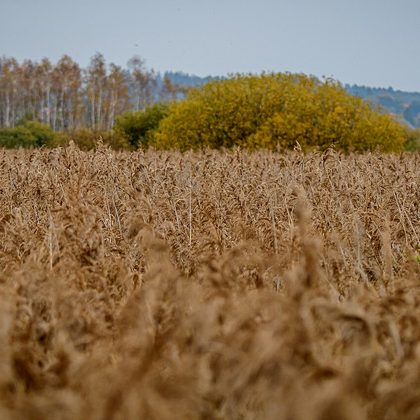
The core habitat is wet, dense, low growth along water: willow carr and osier-like willow thickets in river valleys, birch carr, and the transition from extensive reed to scrub. Also floodplain woodland of poplar, willow and birch, and bog with scattered trees. In winter it is often in the reed itself, climbing the stems like a Bearded Reedling in search of overwintering insects; in Russia it then also appears in village gardens and parks. It nests in cavities in soft rotten wood, in old woodpecker holes and occasionally in a hollow reed stem or a bank, and is strikingly secretive in the breeding season.
Where the bird is most at home, classified with EUNIS — the European standard for habitats.


Range and movements
From Belarus and the far east of the Baltic states and Ukraine east across European Russia and the whole of Siberia to Mongolia, Transbaikalia and north-east China, with a separate branch in the mountains of Central Asia. The European share is the western fringe of that great range and is thinly occupied; the nearest reliable breeding grounds for a western European birder are in Belarus and the Baltic border country. Largely resident but wandering in winter, and in some years birds turn up in Poland, Finland and the Baltic states. Further west every report is rare and is tested both against hybrid characters and against the possibility of an escaped bird.
- Winter
- Passage
- dark = core range, pale = thinly spread
Where and when to look
Belarus in May is the most practical address: the reed marshes and willow carr of the Pripyat valley and the Berezinsky reserve are among the most reliable sites in Europe. Go early, stand on a dyke or a track along the reed edge and listen for the rattling tsirrrrr; the bird usually announces itself first and then perches high in a willow. In winter, reed with willows in it is the best bet, because the bushes are bare and the white wing panel lights up from a distance. Always photograph or note the breast and the mantle — that is the only thing that rules out a hybrid.
Conservation status
Not globally threatened, since the Siberian part of the range is large and continuous. In the European part the picture is less calm: the species is scarce and local, and in Belarus it stands on the national red list. Numbers there are falling as river valleys are drained, reed is cut or burnt and willow carr is cleared. On top of that Blue Tit is spreading eastward in the zone where the two species meet, which reduces the share of pure Azure Tits in the western fringe populations. Keeping river valleys wet and unmanaged, with reed and willow, is the heart of the matter here.