All species › Tubenoses › Petrels and shearwaters › Balearic shearwater
Balearic shearwater
Puffinus mauretanicus | Vale pijlstormvogel | Pardela balear
The Balearic Shearwater breeds only on the Balearic Islands, which makes it about the only seabird that is essentially Spanish. After breeding almost the whole population leaves the Mediterranean, passes through the Strait of Gibraltar and moves up into the Bay of Biscay and the Irish Sea; a handful reach the Dutch coast every year.

Voice
Silent at sea. At the colony at night it gives a hoarse, snoring, wailing scream with a marked inhaling and exhaling rhythm, echoing out of crevices and sea caves along the cliffs. Audible only from March to June on the Balearics, chiefly on Formentera, Ibiza, Cabrera and the cliffs of Mallorca; away from the colony the species does not call.
No freely licensed recording is available for this species yet.
Identification
A medium-sized shearwater that looks pot-bellied and heavy beside a Manx: fuller belly, broader and more bowed wings, a bulging body behind the wing base and often slightly projecting feet. The flight is less elegant, with more and faster beats and shorter glides, and the bird generally stays lower to the water. Above it is dull greyish-brown, not black. Everything turns on the underparts: belly, breast and flanks are dirty white to dingy brown, with a variable brown wash across the breast sides and flanks. The underwing is greyish-white with a broad diffuse dark border, the axillaries are clearly dark and the undertail coverts are brown, not white. The boundary between dark cap and pale throat is vague and smudged rather than crisp. Dark individuals can look almost wholly brown.
Confusion species
Manx Shearwater is the confusion species and the difference lies underneath: Manx is clean white below with a sharp border running high below the eye, has white axillaries and white undertail coverts, is slimmer with straighter wings and glides longer and more smoothly. Balearic is grubby, with dark axillaries, brown undertail coverts and a blurred cap-throat border, and looks stockier. Yelkouan Shearwater, in the eastern Mediterranean, is the hardest: slimmer, cleaner white below and with white undertail coverts, but the two overlap and hybrids occur. Sooty Shearwater is larger and wholly dark below, with a silvery underwing panel. Cory's Shearwater is much bigger, with a yellow bill and a light, sailing flight.
Habitat
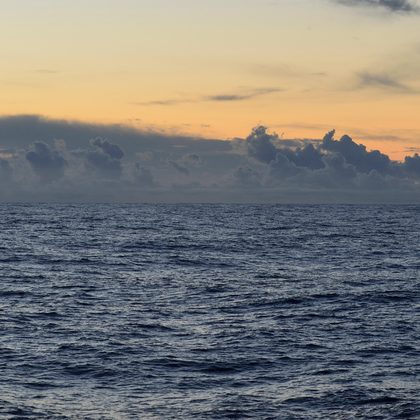
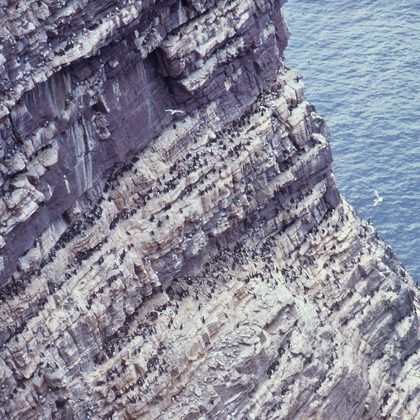
Breeds in crevices, caves and burrows on coastal cliffs and uninhabited islets of the Balearics, often just above the surf. Feeds over the shallow continental shelf, diving after sardines, anchovies and fishery discards, and rests in dense rafts on the water. Outside the breeding season on the Atlantic shelf, in the Bay of Biscay and as far as the Irish Sea and southern North Sea.
Where the bird is most at home, classified with EUNIS — the European standard for habitats.
Range and movements
Breeds only on the Balearic Islands, with a population in the order of a few thousand pairs. From May onwards most birds pass north through the Strait of Gibraltar, concentrating off Portugal, Galicia and in the Bay of Biscay from June to September, with a return passage in late autumn. In the Netherlands it is a rare but near-annual visitor, with a few to a few dozen records a year along the Zeeland and Holland coasts, usually in August and September on south-westerly to westerly winds. It is entirely absent from inland Spain.
- Winter
- Passage
- dark = core range, pale = thinly spread
Where and when to look
In Spain the Strait of Gibraltar is the classic site: from Tarifa or Punta Carnero, westerly winds in May and June carry hundreds to thousands out into the Atlantic, with the return in October and November. Off Galicia, Estaca de Bares in August and September is a near-certainty, and along the Catalan coast the birds pass close inshore in spring. In the Netherlands watch during a summer or early-autumn south-westerly gale from Westkapelle or the Brouwersdam; be strict and judge the bird on axillaries, undertail coverts and flight style, because most claims turn out on review to be Manx Shearwaters.
Conservation status
This species is Critically Endangered on the global Red List: the last category before extinct in the wild. Models based on adult survival predict a decline of more than eighty percent over three generations. The causes are bycatch in longline and gillnet fisheries, predation by introduced cats, rats and martens at the colonies, disturbance and development of coastal cliffs, and the collapse of the Mediterranean discard supply. It is the most threatened seabird in Europe.