All species › Passerines › Sylvia warblers › Balearic warbler
Balearic warbler | Curruca balearica
Balearengrasmus | Curruca balear
The Balearic warbler belongs to the low, wind-combed garrigue of Mallorca, Ibiza, Formentera and Cabrera, and to nowhere else on earth. It is the palest and smallest of the three dark scrub warblers: a grey bird with a long tail, an orange-red eye-ring and a white belly, rattling out a dry little phrase from the top of a rosemary bush.

Voice
The song is a short, low, dry phrase of one to two seconds, more muttered than whistled, with a rattling middle: chrre-cher-cherrit, usually from the top of a rosemary or mastic bush and often with a small upward hop at the end. It sounds flatter and less strident than the scratchy song of Sardinian warbler on the same slope. The call is the more useful sound: a dry, wooden cherr-r, like a fingernail run across a comb, shorter and lower than the rasping alarm of Dartford warbler, along with a sharp chek in series. In March and April it sings through most of the morning; later in the year the call is virtually all you hear.
No freely licensed recording is available for this species yet.
Identification
Small, slim and long-tailed, but distinctly paler than its relatives. The upperparts are grey with a brownish cast, the underparts white to off-white with a creamy pink wash across breast and flanks and a clean white belly; the throat is pale and finely speckled. That contrast between a grey head and pale underparts is the best single feature. Eye-ring orange-red, iris red-brown, legs orange, and the bill slightly finer and longer than in the other two. The tail is long and graduated, with pale edges to the outer feathers, and is cocked or swung slowly from side to side by an agitated bird. Females and young birds are duller and browner still, but keep the pale underside.
Confusion species
Marmora's warbler is the mirror species and the difference is underneath: evenly slate-grey right down to the belly in Marmora's, white with at most a pink wash in Balearic — see also its own species page, where the same difference is set out from the other side. Balearic is also smaller, shorter-winged and slightly finer-billed. Dartford warbler separates at once on its wine-red underparts. In practice the comparison hardly arises on the Balearics, because neither of the others occurs there; the everyday confusion is Sardinian warbler, present on the same islands but far bulkier, with a black cap, a sharply bounded white throat, a short tail and a loud, stuttering rattle. A small, pale, long-tailed warbler in low garrigue on Mallorca is this species.
Habitat
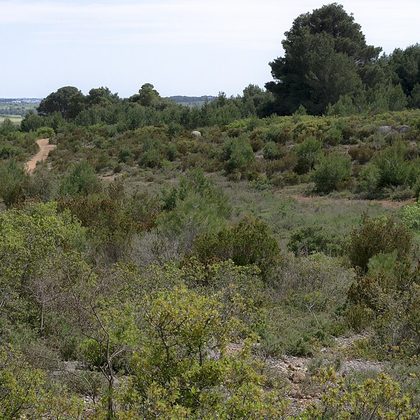
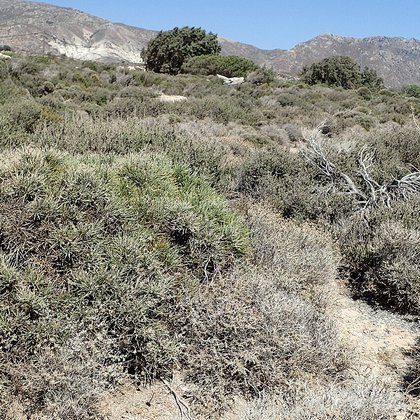
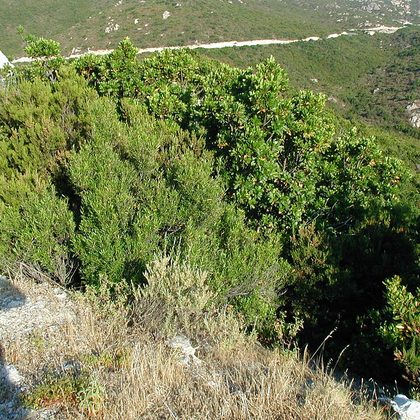
Low, open, aromatic garrigue: rosemary, mastic, creeping Erica multiflora, thyme and cistus, with the spiny cushions of the coastal socarrells, bare limestone in between and tussocks of diss grass. Also young juniper scrub on sandy coastal flats and the shrub layer under open Aleppo pine, and it returns very quickly to burnt or cleared ground as soon as low bushes are back. It avoids closed woodland and farmland. From sea level to about twelve hundred metres in the Serra de Tramuntana, with mountain birds dropping to the coastal belt in winter.
Where the bird is most at home, classified with EUNIS — the European standard for habitats.
Range and movements
The Balearics only: Mallorca, Ibiza, Formentera, Cabrera and a string of smaller islets. It vanished from Menorca in the 1980s and has not returned. The entire world population — roughly twenty thousand pairs — therefore sits within a single Spanish province, and wholly within this guide's map area. The species is resident and moves at most a few kilometres; away from the islands it is almost never recorded, not even on the nearby Spanish east coast. It was long treated as a race of Marmora's warbler and has been carried as a separate species since the start of this century, a treatment AviList 2025 follows.
- Resident
- Breeding (summer)
- Passage
- dark = core range, pale = thinly spread
Where and when to look
Late March to early May, early in the morning, in the low garrigue of the Formentor peninsula, the Boquer valley or the Albercutx watchtower on Mallorca, or on Cabrera and in the salt flats of Ibiza and Formentera. Find a slope with bushes no more than a metre high and scan the tops: the bird sings in short bursts and then sits still for a moment with its tail up. Walk the edge of a made path rather than pushing into the scrub, because inside dense mastic you will see nothing. Watch for the contrast between the grey head and the white belly; against the light that is often all you get.
Conservation status
Not threatened, but a species with everything in one place: lose the low garrigue of the Balearics and you lose the bird. Numbers have been reasonably stable in recent decades and it is locally common in suitable ground, at a few pairs per ten hectares. The pressures are coastal building and infrastructure, the closing over of old garrigue into tall scrub and pine wood once grazing and small-scale use stop, and large fires. Its disappearance from Menorca shows how quickly things can go wrong on an island.