All species › Passerines › Sylvia warblers › Dartford warbler
Dartford warbler | Curruca undata
Provençaalse grasmus | Curruca rabilarga
The Dartford warbler is the dark, long-tailed warbler of heath and Mediterranean scrub: a small, irritable bird with wine-red underparts and a fiery red eye-ring that pops onto the top of a gorse bush with its tail cocked and drops straight back in. It is the only warbler that sits out the winter in north-west Europe, which is exactly what makes it so vulnerable.

Voice
The song is a short, hurried, scratchy phrase of one and a half to two seconds, higher and thinner than a Whitethroat's and with a clear rattling edge: cher-witcher-chi-cherree, often two or three times over with short pauses. It is given from the top of a gorse or cistus bush and, on fine spring mornings, in a short dancing song flight in which the bird climbs a couple of metres above the scrub with its tail spread and drops back still singing. More distinctive still is the call: a rasping, drawn-out churrr, like tearing a strip of cloth, repeated endlessly by an agitated bird, together with a short hard tuk. Anyone who knows the rasping call finds the species far more often than anyone waiting for song, because outside spring it hardly sings at all.
Recording: Benoît Van Hecke — CC BY-SA 4.0 · xeno-canto
Identification
Small, dark and drawn-out, with a narrow tail usually held at an angle that gives the bird an angular, agitated look. Head and upperparts are dark slate-grey, the underparts wine-red to maroon-brown, with fine white speckling on the throat that is clearly visible on a singing male at close range. Eye-ring and iris are red to orange-red, the legs orange-brown, the bill dark with a pale base. The wing is short and rounded and looks browner than the back; the tail is blackish with narrow white tips to the outer feathers. The female is browner above and much duller pinkish-brown below, and juveniles are drab and almost lack the red altogether. In flight it is the shape that tells: a dark little bird with far too much tail, flitting low and weakly from bush to bush.
Confusion species
Within the tricky trio of dark scrub warblers, Dartford is the only one with genuinely wine-red underparts; Marmora's warbler is evenly slate-grey above and below with no warm tone at all, and Balearic warbler is the palest of the three, with a white belly and at most a pink wash on the breast. Both of those species pages set out the same difference from the other side. In practice geography decides: Dartford is the bird of southern England, France, Iberia, Italy and north-west Africa, Marmora's that of Corsica, Sardinia and the Tuscan islets, Balearic that of Mallorca, Ibiza, Formentera and Cabrera. Only in the North African winter quarters can they sit side by side, and there colour and call have to do the work. Sardinian warbler, which shares the same scrub throughout, is bulkier, has a black cap cut off sharply against a clean white throat, and a far noisier rattle. Subalpine Warbler is smaller and shorter-tailed with an orange throat and a white submoustachial stripe.
Habitat
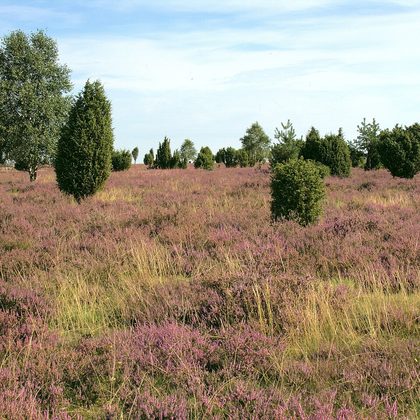
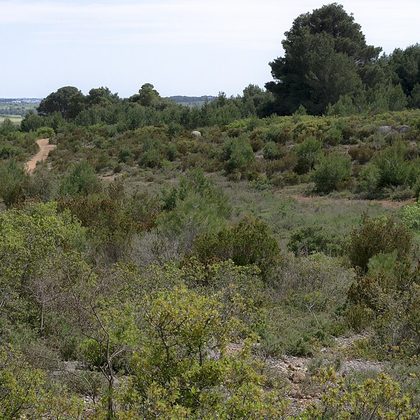
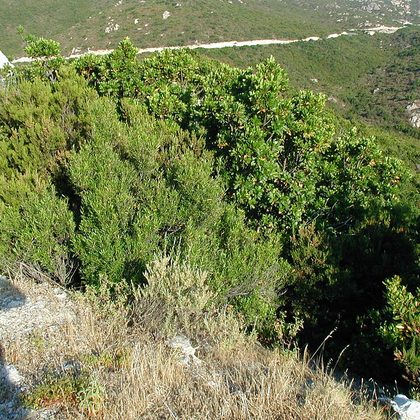
Low, dense, prickly scrub on poor, sunny ground. In southern England and western France that means true heathland: ling and gorse, ideally with some old, tall gorse clumps to shelter in. Further south, Mediterranean scrub takes over: cistus fields, broom-covered slopes, garrigue of rosemary and thyme, low maquis, and in north-west Africa scrub on mountain slopes. It avoids woodland and tall trees, wants bushes between half a metre and a metre and a half high, and disappears as soon as the shrub layer grows too tall and closed, or is burnt away. The nest is placed low in heather, gorse or cistus.
Where the bird is most at home, classified with EUNIS — the European standard for habitats.

Range and movements
South-western Europe and north-west Africa: from the heaths of Dorset, Hampshire and Surrey through western and southern France across the whole Iberian Peninsula to Liguria and Tuscany, and on the far shore in Morocco, Algeria and Tunisia. It is a resident that moves only short distances, and its entire range lies within this guide's map area. In Britain, at the northern edge, winter decides everything: after the ice winter of 1962 and 1963 about ten pairs were left, the national survey of 2006 found more than three thousand territories, and the 2025 survey came out roughly a quarter higher again. By far the greatest numbers, though, breed in Spain and Portugal, where the species has been declining clearly since the 1990s. In the Netherlands only a handful of records have been accepted.
- Resident
- Breeding (summer)
- Winter
- Passage
- dark = core range, pale = thinly spread
Where and when to look
March and April, in the first hour after sunrise, on a heath with gorse in flower or in a cistus field on a south-facing slope. Stand on a rise and scan the bush tops; the bird sings briefly and shows itself only for seconds at a time. Do not walk into the scrub but follow a path along its edge and wait for the rasping alarm — that gives it away on quiet winter days too, when it is silent but still reacts to walkers. In strong wind it stays stubbornly inside the bush and your chances are poor, so pick a calm, sunny morning instead.
Conservation status
Near Threatened, which is striking for a bird with so large a range. The reason lies in Spain and Portugal, where most of the world population breeds and where numbers have been falling for decades: scrub is lost to pine and eucalyptus planting, burnt off, or cleared for fields and pasture, and large summer fires strip whole hillsides in one go. At the northern edge, hard winters cause sudden crashes from which recovery takes years. Where old heath and varied cistus scrub are left standing and are not flailed or burnt all at once, the species does perfectly well.