All species › Passerines › Sylvia warblers › Rüppell's warbler
Rüppell's warbler | Curruca ruppeli
Rüppells grasmus | Curruca de Rüppell
Rüppell's warbler is the black-throated warbler of the Aegean: a grey warbler whose male has a jet-black head and throat cut through by a broad, snow-white moustachial stripe. On a rocky slope above the sea, with a male singing from a kermes oak, it is one of the finest birds in Greece.

Voice
The song is a rapid, hard, slightly stuttering warble of two to four seconds, fuller and louder than that of the region's other warblers, with short rattling and grating notes between clear cheerful whistles: cherre-chek-chek-witcheree-cherr. It is given from a projecting twig on a bush top and very often in a short song flight: the male climbs a few metres above the scrub on slow, exaggerated wingbeats, hangs there a moment and drops back still singing. The call is a hard, wooden chek, usually in series, and a dry rattle tserr-r-r when agitated. Song runs from arrival in late March into early June, fiercest in April, mainly in the first hours after sunrise.
No freely licensed recording is available for this species yet.
Identification
The male is unmistakable: crown, chin and throat deep black, with a broad white moustachial stripe running between them from the bill base into the side of the neck, and below that sharply bounded pale grey underparts turning white on the belly. The back is clean grey, the wing dark with conspicuously pale fringes to the tertials and greater coverts, and the tail black with white outer feathers. Eye-ring red, iris red-brown, legs grey-brown. The female is far plainer: grey head, pale throat, often a faint dark shading on the chin and a hint of the pale moustachial stripe, with off-white, sandy-tinged underparts. On her and on young birds those pale tertial fringes are the thing to hold on to, forming a pale panel on the closed wing. The bird is slimmer than a Sardinian warbler and has a longer, more pointed wing — it is, after all, a genuine long-distance migrant.
Confusion species
Sardinian warbler shares the entire range and is the main confusion species. Its male also has a black cap, but the black stops at the eye and leaves a clean white throat; there is no white moustachial stripe, the wing is plain without pale tertial fringes, and the bird is more compact with a shorter wingtip. Females and first-years are harder: look then at the pale fringes to tertials and coverts, at the cleaner grey of the upperparts and at Rüppell's longer primary projection. Further east, Menetries's Warbler joins in, paler, with a pink flush below and a tail in constant up-and-down motion, and on Cyprus there is Cyprus warbler, whose male does show a white moustachial stripe but is black-spotted over the whole underside. Barred warbler, passing through the same region, is far bulkier and has two white wing bars.
Habitat
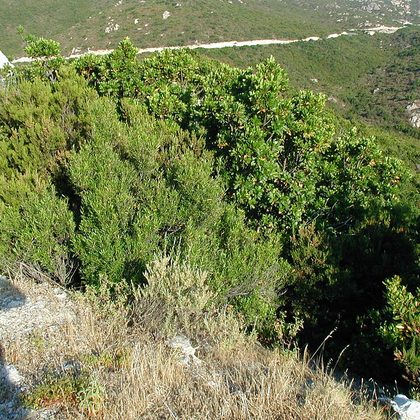
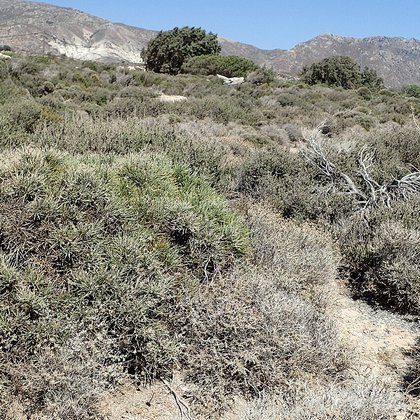
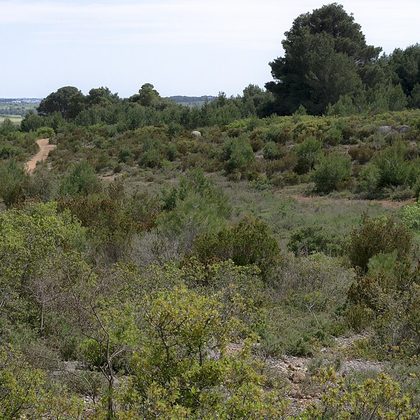
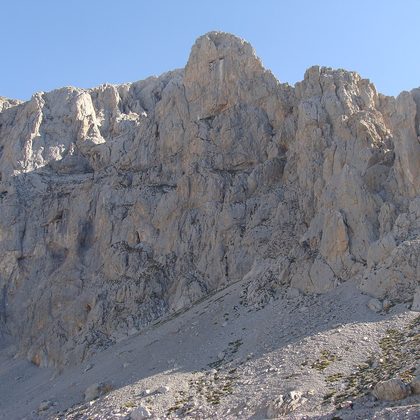
Warm, dry, stony ground with low scrub: phrygana of spiny cushion plants, macchia of kermes oak, mastic and juniper, and garrigue on limestone slopes, always with bare rock and loose stone in between. It is often on rocky hillsides and on old terraces going over to scrub, and also uses open, thin bushy woodland of kermes oak and cypress. Unlike Sardinian warbler it does not need tall dense cover; it is most numerous exactly where the vegetation is thin and the rock shows through. Usually below a thousand metres, but on Crete up to about sixteen hundred.
Where the bird is most at home, classified with EUNIS — the European standard for habitats.
Range and movements
A small breeding range around the Aegean: southern Greece and the Peloponnese, the Greek islands from Lesvos and Chios to Crete and Rhodes, and western and southern Turkey. It is a full migrant and winters far outside Europe, in north-east Africa along the southern edge of the Sahara from Chad and Sudan to Eritrea. Arrival is in late March and early April, departure in August and September. Westwards it is a genuine vagrant: a handful of records in Italy, France, Britain and Scandinavia, mostly singing spring males that have overshot. It has not been recorded in the Netherlands, nor in Spain.
- Breeding (summer)
- Passage
- dark = core range, pale = thinly spread
Where and when to look
The second half of April on Lesvos is the classic choice: the hills around Ipsilou, the slopes above the Kalloni gulf and the road to Sigri, where several singing males hold ground within earshot of each other in the open scrub. The dry slopes of Mount Hymettus near Athens and the south coast of Crete are good too. Go early, find a slope with knee-high bushes among bare rock, and watch for the song flight: a black-and-white head climbing above the scrub is recognisable at a hundred metres. On every grey warbler without a black cap, check the tertial fringes before writing it off as a Sardinian warbler.
Conservation status
Not globally threatened, but the range is small and the trend is downward. The main pressures are on the breeding grounds: overgrazing by goats that strips out the shrub layer, large fires, and at the other extreme the closing over of abandoned terraces into tall scrub and woodland. Holiday building and road construction along the Greek and Turkish coasts count too, precisely in the low coastal belt where the species is commonest. Because it winters along the southern edge of the Sahara, conditions there and along the long migration route also play their part.
Scientific name
Curruca ruppeli (Temminck, 1823) (GBIF: Sylvia ruppeli)
Temminck described the species in 1823 as Sylvia ruppeli; because it was later moved to another genus, the author and year stand in brackets. The genus Curruca was introduced in 1802 by Bechstein. Curruca is Latin, the name of an unidentified small bird mentioned by the Roman poet Juvenal. ruppeli honours the German naturalist and traveller Eduard Rüppell (1794–1884), who collected in north-east Africa and Arabia. The specimen the first description was based on came from Iraklion, Crete.