All species › Passerines › Sylvia warblers › Cyprus warbler
Cyprus warbler | Curruca melanothorax
Cyprusgrasmus | Curruca chipriota
The Cyprus warbler breeds nowhere but Cyprus, which makes it the one bird for which you must go to that single island. The male is a small black-hooded warbler with spotted underparts: from chin to belly it is marked with black spots on white. Since the Sardinian warbler colonised the island in the 1990s, it has shared its scrub with a new neighbour.

Voice
The song is a short, dry, wooden strophe of two to four seconds: a halting, irregular grating and chirping with hardly a clear whistle in it, slower and far more monotonous than the hurried rattling chatter of Sardinian warbler, as if someone were scraping a stick across a comb and dropping in the odd short squeak. It is delivered from a projecting twig on top of a low bush, and in March and April often in a short fluttering song flight as well. The call is a hard, dry tchek, and an agitated bird gives a rattling tcherrr that stays short and wooden. Next to a Sardinian warbler the voice is the most useful difference: Sardinian sounds fast and angry, Cyprus warbler slow and stiff.
No freely licensed recording is available for this species yet.
Identification
Small and compact, with a long tail that is often held up. The male has a black head running below the eye, a narrow white moustachial stripe along the side of the throat and — the decisive character — underparts spotted and scaled black on a white ground, from the throat well down onto the belly and flanks. An orange-red to red-brown ring surrounds the eye. The mantle is dark grey, the wing shows narrow white fringes to the tertials and greater coverts, and the tail is dark with white outer feathers; the legs are red-brown. The female is greyer and much duller, with a grey-brown head and spotting confined to the throat and upper breast. Juveniles are dullest and can be almost unspotted, but keep the white tertial fringes.
Confusion species
Sardinian warbler is the only real confusion species and now also the neighbour in the same scrub — see its own species page, where the same difference is set out from the other side. In Sardinian warbler the underparts are clean white to pale grey without a single spot, the eye-ring is a brighter red, the wing is plain grey without white tertial fringes, and the song is a fast scratchy chatter shot through with rattles. In Cyprus warbler black spots lie over throat, breast and flanks, the eye-ring is orange-red, narrow white fringes edge the tertials and coverts, and the song is dry, wooden and far more monotonous. Females are harder than males: a female Cyprus warbler is greyer than a female Sardinian and always retains spotting on the throat, where a female Sardinian is plain buffy white. Rüppell's warbler, which passes through on migration, has in the male a solidly black throat with a broad white moustachial stripe — black rather than spotted. Ménétries's Warbler, also a migrant, is paler, has a duller black head and constantly waves its tail up and down.
Habitat
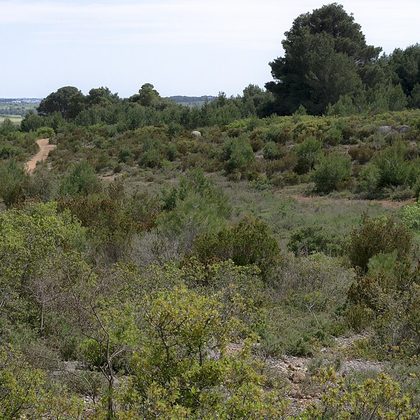
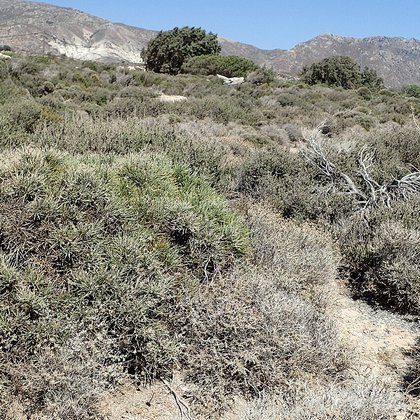
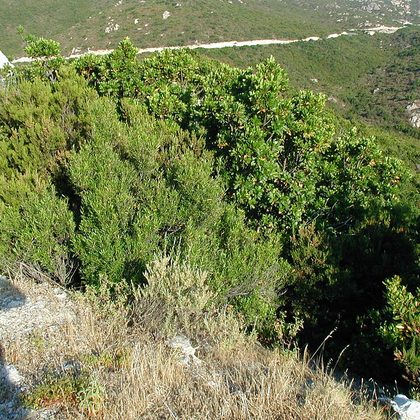
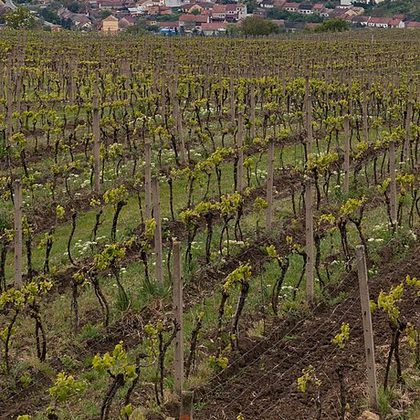
Open, low, stony scrub on the limestone slopes of Cyprus: garrigue and phrygana with cistus, thyme and dwarf shrubs, low maquis of mastic and kermes oak, abandoned terraces, vineyards and almond groves with scrubby margins. It occurs from sea level into the foothills of the Troodos, and has traditionally held the thinner, more open and higher scrub, while the Sardinian warbler since its arrival has taken mainly the denser, lower and damper growth. In winter the birds that leave the island use wadis with acacia and tamarisk.
Where the bird is most at home, classified with EUNIS — the European standard for habitats.
Range and movements
Breeds only on Cyprus. Some birds stay on the island through the winter; the rest move south-east and winter in the wadis of Israel, Jordan and Sinai — all still inside this map area, so that the entire range of the species fits within it. Beyond that it is a rarity, with a handful of records in Lebanon, Egypt and Greece. It has never been recorded in north-west Europe.
- Resident
- Breeding (summer)
- Winter
- Passage
- dark = core range, pale = thinly spread
Where and when to look
March and April, on the Akamas peninsula, at Cape Greco or in the southern foothills of the Troodos, in the first hours after sunrise. Walk a hillside path through low cistus and thyme and wait for the dry, wooden strophe; the male then sings well in the open on a twig. Check the underparts first: black spots on white is Cyprus warbler, clean white is Sardinian. Then check the wing for the narrow white tertial fringes, because a hard-singing female can deceive at first glance.
Conservation status
Still assessed as not threatened globally, but with a small range and worries that do not sit easily with that. Since the Sardinian warbler established itself on Cyprus in the 1990s and spread across the island, Cyprus warbler numbers in western Cyprus have fallen markedly over a run of years, above all in the lower, denser scrub the newcomer takes. On top of that comes the large-scale illegal trapping of songbirds with limesticks and mist nets, which costs Cyprus millions of birds a year, and the loss of small-scale almond groves and terraces. For a species that breeds on a single island, each of those pressures weighs heavily.