All species › Passerines › Sylvia warblers › Marmora's warbler
Marmora's warbler | Curruca sarda
Sardijnse grasmus | Curruca sarda
Marmora's warbler is the darkest of the tricky trio: an evenly slate-grey little bird with a red eye-ring and a long graduated tail, living in the low maquis on the bare, mistral-scoured slopes of Corsica and Sardinia. Where it occurs it is not scarce, but it occurs in very few places.

Voice
The song is a hurried, scratchy phrase of one to two seconds, fuller and lower than Dartford warbler's and shot through with short rattles: cherre-chek-cherritt, usually from a projecting twig above the maquis and sometimes in a small song flight with the tail fanned wide. It sings mainly from March to June, most fiercely in the early morning. The call is at least as useful: a hard, dry chek, often in accelerating series, and a rattling cherr-r-r when agitated. On a windy slope that rattle carries further than the song, and it is usually the first sign of the bird.
Recording: Tanguy Loïs — CC BY-SA 4.0 · xeno-canto
Identification
Small and long-tailed, and evenly dark slate-grey from crown to belly — that uniform grey, throat and belly included, is the feature. There is no trace of red, pink or brown in the plumage; at most the back looks a shade warmer than the head. The eye-ring is orange-red and stands out against the dark face, the iris red-brown, the legs orange and the bill dark with an orange base. The tail is long, graduated and blackish, with narrow pale edges to the outer feathers, and is often cocked or slowly swivelled. The female is slightly duller and browner grey but stays uniform; juveniles are drab brown with a dull eye. The crown feathers are raised when the bird is excited, giving a shaggy, angular head.
Confusion species
Balearic warbler is the mirror image and the difference is on the belly: in Marmora's the slate-grey runs evenly down onto the lower underparts, while in Balearic that area is white with at most a pink wash, so the grey head stands out clearly against it — see also its own species page. Marmora's is also slightly larger and longer-winged. Dartford warbler is the third of the trio and the easiest: wine-red underparts and white speckling on the throat. Range does most of the work — Corsica, Sardinia and the Tuscan islets for this species — except in the North African winter quarters, where it can sit alongside Dartford warblers and the colour of the underparts has to decide. Sardinian warbler, common on the same islands, is bulkier and has a black cap above a sharply bounded white throat.
Habitat
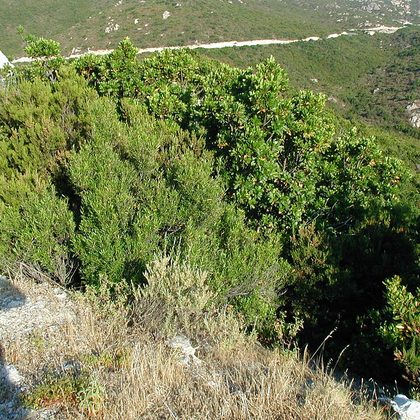
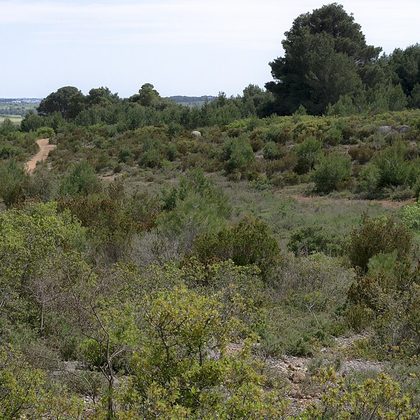
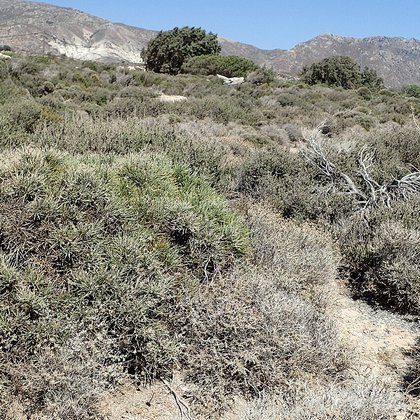
Low, open maquis and garrigue on stony slopes: cistus, mastic, thyme, gorse and dwarf fan palm among bare boulders, and on the coast the salt-clipped heath of the clifftops. It avoids woodland and tall scrub and wants bushes no more than a metre or so high; recent burns are reoccupied within a few years, as soon as the cistus returns. From sea level well up into the mountains: on Corsica and Sardinia above eighteen hundred metres, in the dwarf scrub of the bare summits.
Where the bird is most at home, classified with EUNIS — the European standard for habitats.
Range and movements
Corsica, Sardinia and the small Tuscan islands — Capraia, Elba, Giglio, Montecristo — with outposts on Pantelleria and the Tunisian islet of Zembra. That is all: one of the smallest ranges of any European songbird. Some birds stay on the islands all year, others cross the sea to winter in north-east Algeria, Tunisia and north-west Libya, so that the whole range, wintering grounds included, lies within this guide's map area. Away from those islands it is a real rarity: only a handful of Dutch records have been accepted, and Spain has just one reliable record to date, a singing male in the Garraf massif near Barcelona in May 1997.
- Resident
- Breeding (summer)
- Passage
- dark = core range, pale = thinly spread
Where and when to look
April and May, shortly after sunrise, on a stony slope with low cistus maquis: Capo Caccia and Asinara on Sardinia, Cap Corse or the macchia around Bonifacio on Corsica. Find ground where the scrub comes no higher than your waist and stay on the path; scan the tops for a small dark bird with its tail held up. If you hear the dry chek, stand still and wait: it will come and look at you. In the mountains it pays to walk the upper edge of the macchia in May, because there it sits in open dwarf scrub where it is easy to see.
Conservation status
Not threatened, and locally common on the islands themselves, but with a range so small that any large-scale change tells immediately. The main concerns are big summer fires that clear thousands of hectares of low maquis at a stroke, coastal building and tourism, and the closing over of old maquis into tall scrub and woodland once grazing and small-scale use cease. On the smaller islets the population runs to a few dozen pairs, and there survival can hinge on a single fire or a single bad year for rats and cats.