All species › Passerines › Sylvia warblers › Spectacled warbler
Spectacled warbler | Curruca conspicillata
Brilgrasmus | Curruca tomillera
Spectacled warbler is the Whitethroat's little brother, and it lives where Whitethroat will not go: in the lowest, driest, most open bushes there are — thyme cushions, salt steppe and abandoned fallow. Its name sits around the eye: a broad, clean white eye-ring in a dark little face. It is constantly taken for a Whitethroat or for a female subalpine warbler, and yet, once seen properly, it is unmistakable.

Voice
The song is a fast, high and surprisingly musical little phrase of two to four seconds, thinner and sweeter than the scratchy chatter of a Whitethroat, often opening with a few clear whistles and ending in an accelerating trill. It comes from the top of a low bush or in a fluttering song flight: the bird climbs a few metres on rapid wingbeats and settles back on the bush still singing. The call is the handiest character: a dry, purring rattle, drrrrt or cherrr, given at the least disturbance and carrying far over open ground, plus a short, hard chek. Song runs from February into June, early in the year in the south, and on warm days all morning.
No freely licensed recording is available for this species yet.
Identification
A miniature Whitethroat: smaller, rounder and far shorter in the wingtip, with a long tail often held cocked. The male has a grey head with blackish-grey lores and ear-coverts, and set into them a broad, strikingly white eye-ring — the effect is a small dark mask with spectacles on it. The throat is clean white and stands out sharply against it. The mantle is warm rufous-brown and the wing carries a broad, bright rusty panel, even more contrasting than a Whitethroat's. The underparts are a pale pinkish buff. The bill is fine, with a pale lower mandible, and the legs are yellowish to orange straw. The female has a browner head but keeps the white eye-ring and the rusty wing panel. The very short primary projection — barely more than the length of the tertials — shows in every plumage.
Confusion species
Whitethroat is the standing confusion, and four things settle it: Spectacled warbler is clearly smaller and shorter in the wingtip, has dark lores and ear-coverts with a broad white eye-ring set in them, a brighter and warmer rusty wing panel, and a finer bill. Whitethroat has a plain grey or brown head with no mask, at most a narrow white ring, and a longer primary projection. The calls separate them at once: Spectacled gives a dry, purring rattle, Whitethroat a hard check and a rasping chairrr. The second trap is a female or first-year subalpine warbler — Western, Eastern or Moltoni's, it makes no difference here: those have a reddish orbital ring rather than a white eye-ring, a plain grey-brown wing with no rusty panel, no dark mask, and a longer, slimmer tail. Dartford and Balearic warblers are darker, greyer and longer-tailed, and lack both the white throat and the rusty wing panel. In north-west Africa Tristram's Warbler (Curruca deserticola) joins in; it also has a rufous wing, but orange-buff underparts and a much more obvious pale supercilium.
Habitat
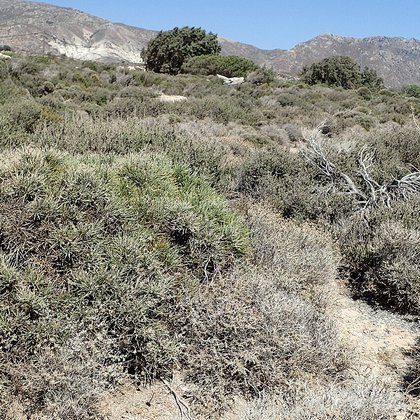
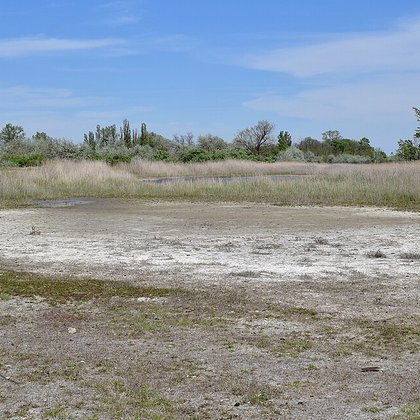
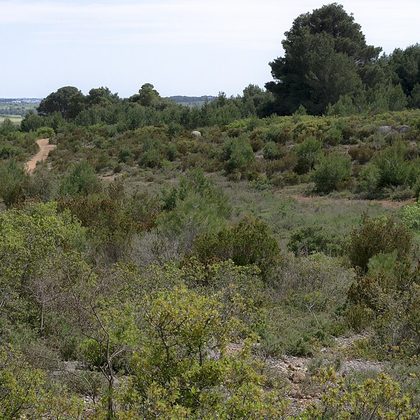
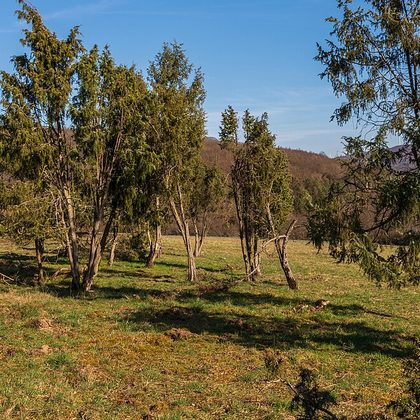
Low, open, dry scrub where the bushes do not touch: thyme cushions and other low aromatic mats, salt-tolerant bushes of salt pans and inland saline flats, esparto and steppe grassland, old fallow and field margins, and garrigue on the driest slopes. Also lava fields and dry coastal plains in the Canary Islands. It feeds low and much on the ground between the cushions, and disappears as soon as the scrub grows above half a metre or becomes too dense — exactly where the subalpine warblers begin.
Where the bird is most at home, classified with EUNIS — the European standard for habitats.
Range and movements
All round the Mediterranean: Iberia, southern France, the Balearics, Corsica, Sardinia, Italy, Sicily, Malta, Greece and Crete, Cyprus, southern Turkey and the Levant, and along the whole of North Africa from Morocco to Egypt. Beyond that it breeds in the Canary Islands, on Madeira and on the Cape Verde islands. Southern and island birds are resident; those of inland Spain and France move in winter to lower, warmer ground and into North Africa, as far as the southern fringe of the Sahara. In Spain it is commonest in the south and centre — the saline flats of Murcia, Almería and Albacete and the steppes of the Ebro valley — and scarce in the north. In north-west Europe it is an exceptional vagrant.
- Resident
- Breeding (summer)
- Winter
- Passage
- Migration direction
- dark = core range, pale = thinly spread
Where and when to look
March and April, in salt steppe or a thyme field in Murcia, Almería or the Monegros, in the first hour after sunrise and with little wind. Stand still on the track and wait: the bird sits low and is invisible until it sings or gives its purring rattle. In the song flight it is in clear air for a few seconds, and that is the moment to look. Then check the white eye-ring in the dark face and the very short wingtip; anyone who meets a Whitethroat in the same ground learns the difference in a single morning.
Conservation status
Not threatened (Least Concern), with a large range around the Mediterranean and on the Atlantic islands. Numbers swing sharply from year to year, because dry winters and late frost hit a bird that nests this low and this exposed. The structural pressure comes from the conversion of steppe, fallow and saline flats into irrigated farmland and glasshouses, from coastal building, and from the end of extensive grazing, which lets low mat scrub grow into tall bushes the species no longer uses. In several Spanish regions it is therefore on the regional list of threatened birds, even though it is in no danger globally.