All species › Tubenoses › Petrels and shearwaters › Barolo shearwater
Barolo shearwater | Puffinus baroli
Kleine pijlstormvogel | Pardela chica macaronésica
The Barolo shearwater is the smallest shearwater of the North Atlantic: a little black-and-white bird that whirrs low and fast over the water on a wingbeat that suggests an auk more than a shearwater. It belongs to Macaronesia — the Azores, Madeira, the Selvagens and the Canaries — and it breeds in winter, when almost every other seabird of those islands has gone.
No freely licensed photograph of a living wild bird of this species exists.
Voice
Silent at sea. At the colony at night it is noisy and much higher-pitched than its larger relatives: a fast, wheezy, slightly squealing ka-kee-ka-kerr repeated in short bursts, given both in flight above the cliff and from inside the crevice. Because it breeds in midwinter, that chorus can be heard in the Canaries and off Madeira from January into April, on nights when hardly any other seabird is calling.
No freely licensed recording is available for this species yet.
Identification
Small, compact and short-winged, black above and clean white below, with the border between the two cutting across the ear-coverts rather than below the eye: the face is white to above the eye, so that the eye sits as a dark dot in a white field. That white face is the clincher at close range. The bill is short, thin and blue-grey with a dark tip, the legs blue. From below the bird is white right through to the undertail coverts, with only a narrow dark trailing edge to the wing. The wingtip looks noticeably rounded. The flight is a long series of fast, whirring beats low over the water with brief glides between them; the bird barely changes height and banks far less steeply than the larger shearwaters. Feeding birds sometimes stretch the head up, and they slip under the surface from a sitting position.
Confusion species
Manx shearwater is the standard confusion: distinctly larger and longer-winged, with a more pointed hand, and the dark cap runs down below the eye so that the face reads dark rather than white. Its flight is a few beats followed by a long slanting glide with heavy banking, flashing black then white; the Barolo whirrs on with much shorter glides. Yelkouan shearwater is bigger and dirtier brown above with dusky undertail coverts, and belongs in the Mediterranean. Bulwer's petrel is the same size but wholly dark, with a long wedge-shaped tail. Band-rumped and Monteiro's storm-petrels are far smaller, dark, and carry a white rump band. At long range, when only size and the whirring beat register, the first impression is often of a little auk — which is exactly why you wait for the white face.
Habitat
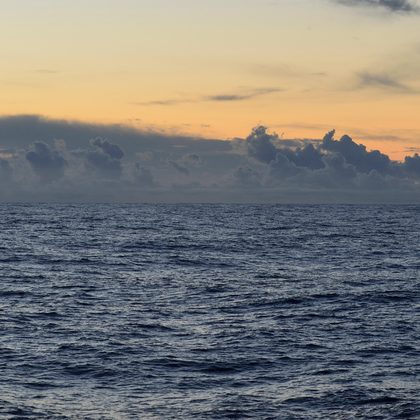
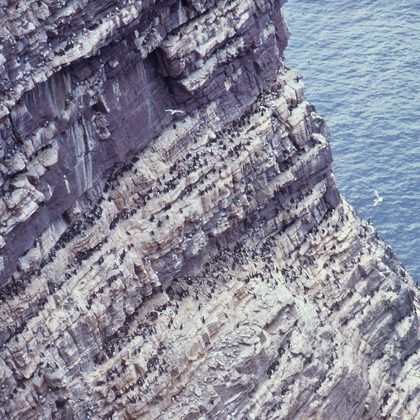
Outside the breeding season over deep water around the islands and the ocean beyond, taking small fish and squid by working a short way under the surface from a sitting position. It breeds in narrow crevices and cavities in steep sea cliffs and on bare rocky islets, often in places halfway up a wall that nobody can reach, and visits the colony only at night. Colonies persist only where there are no rats and cats.
Where the bird is most at home, classified with EUNIS — the European standard for habitats.
Range and movements
Macaronesian. It breeds in the Azores, on Madeira, Porto Santo, the Desertas and the Selvagens, and in the Canaries, with by far the largest colony — some 1,400 pairs — on the Selvagens. Outside the breeding season the birds spread over the North Atlantic; they are recorded regularly off Portugal and Galicia, mainly from July to December, and once or twice a year from headlands in Ireland and south-west England. Records from the North Sea are exceptional, and identifying a distant Barolo on a seawatch is notoriously difficult.
- Breeding (summer)
Where and when to look
Travel is the only serious option. A pelagic off Tenerife, La Gomera or Lanzarote in February, March or April coincides exactly with the busiest period at the colonies and produces birds whirring past low and close; the same works off Madeira and Porto Santo in the same months. Staying in Europe, the best chance is a seawatch from Estaca de Bares or Cabo Vilán in Galicia, or Cabo de São Vicente, from August to October in a strong north-westerly. Read the wingbeat and the flight height first and the face second: a distant Manx can look like this for a few seconds, but it will not keep it up.
Conservation status
Not globally threatened (IUCN: Least Concern), but the Macaronesian population is not large and is falling on several islands; a clear decline has been documented on Tenerife. The causes are the same everywhere: rats and cats taking eggs, chicks and incubating adults out of the crevices, and light pollution, which pulls fledglings towards street lights and harbours on their first night flight, where they come down and cannot take off again. Spain lists the species in its national catalogue of threatened species for that reason. Clearing rats from islets and switching off or shielding coastal lighting during the fledging period are the two measures that deliver most.