All species › Tubenoses › Petrels and shearwaters › Zino's petrel
Zino's petrel | Pterodroma madeira
Madeirastormvogel | Petrel de Madeira
Zino's petrel is a seabird that breeds at 1,600 metres, on bare mountain ledges in the middle of Madeira — six of them, and nowhere else in the world. With sixty-five to eighty pairs it is one of the rarest seabirds in Europe. It had all but been forgotten when Paul Alexander Zino, following a shepherd's directions, found it again in 1969, and outside the breeding season it is next to untraceable.

Voice
Wholly silent at sea. Over the mountain ledges the birds call in flight after midnight with a long drawn moaning wail that rises and then breaks off, and from the burrow comes a hoarse, repeated two-syllable note. The voice is higher and thinner than that of the Desertas and Cape Verde birds, and it was exactly that difference in pitch that helped the species be found again in the 1960s. Calling is heaviest on dark, mist-free nights from May into September.
No freely licensed recording is available for this species yet.
Identification
A small, finely built gadfly petrel with long narrow wings that are broad at the base and held slightly bowed. The upperparts are grey with a blackish M running from wingtip to wingtip; rump and tail are a paler, colder grey than the mantle, and that pale rear end is the most useful thing the bird has to offer at range. The crown is grey, the face white with a dark smudge around the eye, the underparts white with a grey patch on each side of the breast that does not close into a band. The underwing is dark throughout, though a minority of birds show a paler panel in it. The bill is black, short and — this is the point — shallow and fine: averaging a little over ten millimetres deep at the base, against thirteen in Desertas petrel. In wind the flight is fast and high-arcing, the bird climbing several metres and shearing over on stiff wings; in calm it glides low with short, snappy bursts of beats.
Confusion species
Here is the honest heart of the matter: at sea this bird cannot be separated with confidence from Desertas petrel, and neither of them can be separated from Fea's petrel of the Cape Verdes. All three share the same grey back, the same M, the same paler tail, the same white face and the same dark underwing. The only real difference is structural: Zino's is smaller and slighter and has a noticeably shallower, finer bill, averaging around ten and a half millimetres deep against nearly thirteen in Desertas, and its wing is about a centimetre and a half shorter on average. Nobody judges a few millimetres of bill depth through a moving telescope on a pitching boat. In practice only a sharp photograph of the bill in profile will settle it, and even then a good share of photographed birds stay nameless; the honest field label is Fea's/Zino's petrel. Two ways round it do work. The first is the calendar: Zino's lays from mid-May to mid-June and Desertas not until July and August, so the birds calling over the massif on a June night are these. The second is the place: stand on Pico do Areeiro at night and there is nothing else. Outside the group, confusion is easier to settle. Great shearwater is larger and browner with a white collar and a white underwing; Cory's and scopoli's shearwaters are much bigger and slower with heavy yellow bills; Bulwer's petrel is small, uniformly dark and has a long wedge-shaped tail.
Habitat
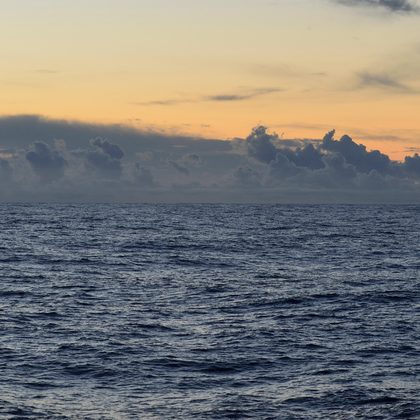
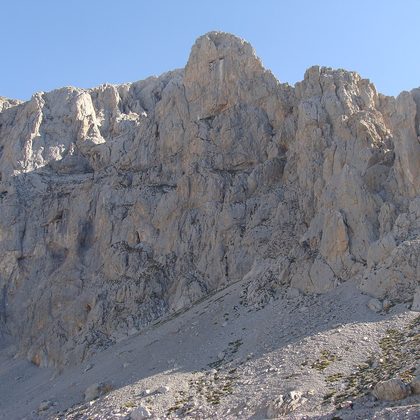
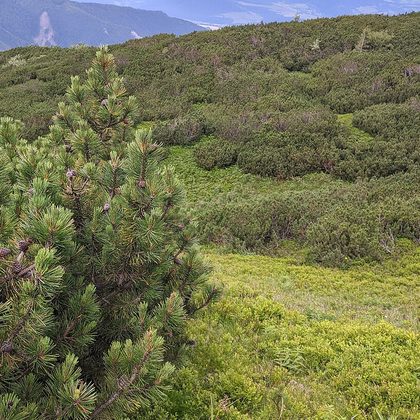
Two entirely different worlds. Breeding takes place in earth burrows on narrow ledges, vegetated with mountain heath and ferns, on near-vertical rock faces in the central massif of Madeira between Pico do Areeiro and Pico Ruivo, at 1,600 metres and above — the only European seabird nesting that high and that far from the sea. The rest of the year it lives over the open Atlantic, above deep water and along fronts and seamounts, snatching squid and small fish from the surface at night without settling.
Where the bird is most at home, classified with EUNIS — the European standard for habitats.
Range and movements
Endemic to Madeira, with a breeding range you can take in from a single viewpoint: six ledges in the high centre of the island. The whole world population is 130 to 160 mature birds. At sea the birds have been tracked far out into the Atlantic, up towards the Azores and off Iberia, but since they cannot be told from Desertas petrel out there, the map beyond Madeira is largely guesswork. North of Biscay records are rare and almost always logged as Fea's/Zino's.
- Breeding (summer)
Where and when to look
Go to Madeira and go up the mountain at night. The natural park and local guides run evening excursions near Pico do Areeiro from June to early September: you wait in the dark after sunset until the first birds come in over the ravine and start wailing overhead. You barely see them and you hear them all the better, and it is the only way to log the species with certainty. Go with a guide and stay on the path — this is six ledges above a drop, and disturbance here is not a theoretical worry. By day, a pelagic out of Machico or Funchal between July and September is the chance of a sighting, with the emphasis on sharp photographs of the bill; expect most birds to go into the notebook as Fea's/Zino's.
Conservation status
Endangered (IUCN), which makes it one of the most threatened seabirds in Europe. In the 1980s only a few dozen pairs were left; rats taking eggs and chicks, and feral cats taking incubating adults off the ledges, were the cause then and remain it now. Since the natural park began controlling rats on the ledges and trapping cats, pair numbers have crept up — enough for the species to be moved down a step in 2004, from critically endangered to endangered. How narrow the margin is became clear in August 2010, when a mountain fire swept the colony and killed three adults and twenty-five of the thirty-eight chicks. Lighting along the mountain roads and in the villages also brings fledglings down where they cannot take off again, and one egg per pair per year makes recovery from any setback slow.