All species › Waterfowl › Ducks, geese and swans › Barrow's goldeneye
Barrow's goldeneye
Bucephala islandica | IJslandse brilduiker | Porrón islándico
The only duck whose European range is Iceland and, in practice, one lake system within it. Around Mývatn and the Laxá in June it swims among the Tufted Ducks and Wigeon as though it were the commonest thing on the water. For anyone who knows Common Goldeneye it is an exercise in small differences that add up to a distinctly different bird.

Voice
Usually quiet. Displaying drakes give a soft frog-like ka-KAA as they throw the head back over the mantle, with an audible rush of wings; females give a low growling gek-gek. Display peaks on Mývatn in May and June, with a great deal of chasing and splashing.
No freely licensed recording is available for this species yet.
Identification
The drake is black and white with a purple-glossed head, a steep forehead and a bulging crown that overhangs the nape; the yellow eye stands out. The white face patch is a crescent, a moon-shape with its points turned up. Along the black upperparts runs a row of separate white blocks on the scapulars, with a black spur cutting down across the white flank in front of the wing. The female is grey with a chocolate-brown head, a white collar and, in Iceland, an almost entirely orange-yellow bill. In flight both sexes show a white wing panel broken into blocks by black lines.
Confusion species
Common Goldeneye is the only real confusion species, and the way to do it is to stack the features. Head shape: Barrow's is tall and flat-backed with the highest point in front of the eye and a bulge overhanging the nape, Common is triangular with the peak above or behind the eye. Face patch: crescent-shaped and pointed upwards on Barrow's, round to oval on Common. Bill: shorter and deeper on the Barrow's drake, which makes the head look blunter still; on the female in Iceland it is wholly orange-yellow, where Common usually shows a dark bill with a yellow band near the tip. Wing pattern: on Barrow's the white panel is chopped into separate blocks by black bars, on Common it forms one continuous white field. Scapulars: a row of individual white spots against a large white oval. Away from Iceland, treat female-type birds with real caution, because Common Goldeneye bill colour varies and a yellow-billed female proves nothing on its own.
Habitat
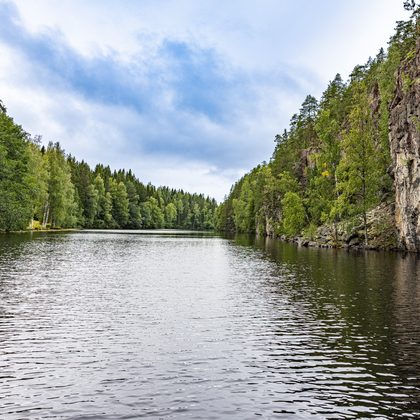
Shallow, food-rich lakes and fast, ice-free rivers over lava, where the birds dive for midge larvae, crustaceans and snails. In winter they shift to the open stretches of the Laxá and to sheltered coastal bays and river mouths. Nests go into cavities in lava fissures, among boulders and in buildings, because Icelandic birch is too small to offer tree holes, but the bird itself is always found on water.
Where the bird is most at home, classified with EUNIS — the European standard for habitats.

Range and movements
Breeds in western North America, in eastern Canada and in Iceland. The Icelandic birds are the only European population, number only a few thousand, and are almost entirely confined to the north-east around Mývatn and along the Laxá. Elsewhere in Europe the species is a major rarity and the few reports carry a heavy burden of proof against escaped birds; there are no accepted British or Irish records of wild origin, and none for the Netherlands or Spain.
- Breeding (summer)
- dark = core range, pale = thinly spread
Where and when to look
Go to Mývatn in May or June and walk the north shore near Reykjahlíð and the upper Laxá. Early in the morning the drakes display on the sheltered stretches and the head shape reads best; scope through them and compare each bird against the Common Goldeneyes on the same water. When they flush, watch for the black bars chopping the white wing panel into blocks.
Conservation status
Not threatened globally, but the Icelandic population is small, isolated and on the national red list. Every pressure sits at Mývatn: swings in the midge swarms the birds live on, past diatomite extraction and water-level management, predation of nests and ducklings by introduced American Mink, and rising visitor pressure along the shores. For this duck, protecting the lake and its outflow is the whole story.