All species › Pelicans, herons and ibises › Herons and bitterns › Black-crowned night-heron
Black-crowned night-heron
Nycticorax nycticorax | Kwak | Martinete común
The Night Heron is a stocky, short-necked heron that spends the day tucked into willows or swamp woodland and only becomes active at dusk. Its Dutch name is a straight imitation of the call you hear passing overhead at night.

Voice
A short, hoarse, barking kwark or kwok, usually given singly in flight and most often at night or just after sunset — you frequently hear the bird pass without seeing it. At the colony an assortment of harsh throaty notes and a rattling begging call from the young. Your best chance is a warm evening in May or June over swamp woodland or fish ponds.
Recording: Joost van Bruggen — CC BY-SA 4.0 · Wikimedia Commons
Identification
Compact and heavily built, with a short thick neck, a large flat head and a stout, slightly decurved bill. The adult is unmistakable: glossy black crown and mantle, pale grey wings, white to pale grey underparts, two or three long white nape plumes and a big deep-red eye. Legs yellow-green, turning pink to coral in display. The juvenile looks entirely different: dark brown with conspicuous white to buff droplet spots on the coverts and back, streaked underparts and a dull yellow eye. In flight it shows rounded broad wings, steady fairly quick beats, a hunched profile and toes projecting just past the tail.
Confusion species
In flight, Little Bittern is the classic confusion, especially with juvenile Night Herons. The wing settles it: Little Bittern always shows a large pale covert panel contrasting sharply with black flight feathers, while a young Night Heron looks uniformly dark brown with only fine pale spotting. The Night Heron is also nearly twice the size, broader winged and much slower in its beat. Juvenile Night Heron against Bittern: the Bittern is far bulkier, buff with heavy black barring on wing and tail, and looks owl-like in flight. Adult Night Herons are confusable with nothing.
Habitat
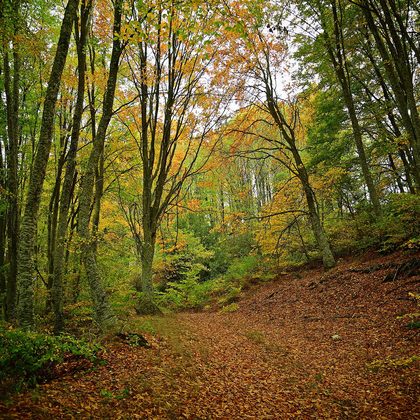
Swamp woodland and willow scrub along rivers, old clay pits, fish ponds and oxbows; the birds nest in trees and bushes over or beside water and roost there by day. Hunts at dusk and by night from the bank, from a branch or standing in shallow water, taking fish, frogs and aquatic insects.
Where the bird is most at home, classified with EUNIS — the European standard for habitats.



Range and movements
In Spain it is widespread and locally numerous, with colonies along the Guadalquivir, in Doñana, the Ebro Delta, the Albufera and along many rivers with gallery forest. In the Netherlands it is a very scarce breeder with a few small colonies, including in the Gelderse Poort and along the great rivers; a long-established semi-feral population around zoos means not every Dutch Night Heron is automatically a wild bird. The species winters in tropical Africa and returns in April.
- Resident
- Breeding (summer)
- Winter
- Passage
- Migration direction
- dark = core range, pale = thinly spread
Where and when to look
On a still evening in May or June, sit by a fish pond, oxbow or riverine wood and stay until half an hour after sunset; that is when the birds leave their day roost and betray themselves with the barking flight call. By day it pays to scan dense willows over the water with a scope: a roosting Night Heron sits low and motionless with the neck drawn in.
Conservation status
Not globally threatened (IUCN: Least Concern), but clearly reduced in Europe over the long term through the loss of riverine forest, river canalisation and the draining of fish ponds and marshes. Restoring natural river dynamics and swamp woodland is the key; the species fares considerably better in southern Europe than in the north-west.