All species › Pelicans, herons and ibises › Herons and bitterns › Little egret
Little egret
Egretta garzetta | Kleine zilverreiger | Garceta común
The Little Egret is the most elegant of the three white herons: slim, black-billed and with yellow feet worn like little boots. It hunts by dashing about rather than waiting, and that behaviour often gives it away before the plumage does.

Voice
Usually silent away from the colony. When flushed it gives a hoarse, croaking aaahk, and at colonies a persistent, quarrelsome gaa-gaa-gaa with grunting notes. Loudest over mixed heronries in April and May, and at roosts as dusk falls.
Recording: Joost van Bruggen — CC BY-SA 4.0 · Wikimedia Commons
Identification
Slim and long legged, with a thin, wholly black, pointed bill — all year round, which is the key separation from a winter Great Egret. Legs black, toes bright yellow; at close range in display you can see the lores flush red and the feet turn orange-red. Breeding birds carry two long narrow nape plumes and loose breast and back plumes. The neck is shorter and evenly curved, without the sharp low kink of a Great Egret. In flight it is quicker and looser than the larger species, with the feet trailing as two yellow points beyond the tail.
Confusion species
Great Egret is clearly larger, has a yellow bill in winter, always black toes and a long, sharply kinked neck; its wingbeats are slower and heavier. Cattle Egret is smaller and stocky, with a short yellow bill and a jowl, and feeds in grass among livestock rather than in water. The white morph of Western Reef Heron, rare but recorded in southern Europe, has a heavier, paler horn-coloured bill and thicker yellow legs and looks clumsier; that species is the reason to check bill colour and shape carefully on any odd-looking individual.
Habitat
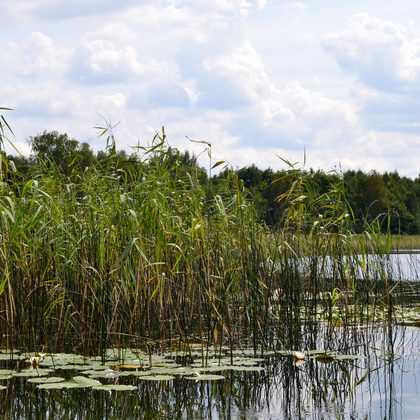
Shallow salt, brackish and fresh water: estuary mudflats and creeks, saltpans, lagoons, saltmarsh, but also rice fields, ditch banks and fish ponds. Hunts actively — running, flicking its wings, vibrating a foot in the mud to flush shrimps and small fish.
Where the bird is most at home, classified with EUNIS — the European standard for habitats.



Range and movements
In Spain it is common and numerous, with large numbers in Doñana, the Guadalquivir marismas, the saltpans of Cádiz and San Pedro del Pinatar, the Ebro Delta and the Albufera. In the Netherlands it has bred only since the 1990s and remains scarce, with small colonies in the Delta; outside the breeding season it appears in varying numbers along the coast and inland, and in mild winters it stays in the Delta. Here too the contrast with Spain is large: what is an ordinary coastal bird there is still a pleasing record in the Netherlands.
- Resident
- Breeding (summer)
- Winter
- Passage
- dark = core range, pale = thinly spread
Where and when to look
In the Netherlands walk a creek or inlaag in the Delta on a falling tide in August or September; the birds then hunt shrimps in the gullies and stay busy in full view. In Spain the saltpans work best late in the morning, when low water concentrates dozens together and makes it easy to compare bill and leg colour against Cattle and Great Egrets.
Conservation status
Not globally threatened (IUCN: Least Concern) and much increased in Europe since the end of the plume trade and the restoration of coastal wetland. It continues to expand northwards; hard winters can set the northern outposts back temporarily. Loss of tidal habitat and the salinisation or freshening of lagoons are the main local threats.