All species › Gamebirds › Pheasants and partridges › Black francolin
Black francolin | Francolinus francolinus
Zwarte frankolijn | Francolín ventrinegro
For most British birders this is a Cyprus bird, and often the first one heard on a spring morning. It is a partridge-sized gamebird whose male is close to black, with a bold white cheek patch, a chestnut collar and a spatter of white spots down the underparts. You stand at the edge of a field before the heat comes up, listening to a grating shriek from somewhere in the grass, and see nothing whatever.

Voice
The thing that gives it away. The male climbs onto a stone heap, an earth bank or the top of a low bush and throws out a shrill, grating kik … kik-KEEK-kek-kerrak, four or five syllables ending in a rusty flourish, like metal dragged over metal. Repeated every ten to twenty seconds, audible for a mile, and usually answered within a minute by a neighbour. Given from March to June in the first hour after sunrise and the last hour of light; at other times you rarely hear it.
Recording: Somesh Tripathi — CC0 · Wikimedia Commons
Identification
The male is unmistakable: head, breast and belly deep black, a large white patch on the cheek, a broad chestnut collar, and round white spots over the underparts that turn into black-and-white bars along the flanks. Mantle golden brown with pale feather edges, tail black with narrow white bars, legs red-brown. The female looks like a different bird — warm brown, streaked and scaled throughout, with a chestnut patch on the nape and no cheek patch or collar. Both flush with fast whirring beats low over the crop and drop in again thirty metres on.
Confusion species
There is no second francolin in the region, and a black male is confusable with nothing. The female is another matter: brown and streaked, she suggests an outsize quail, but she is nearly twice the size and carries that chestnut nape patch, while a young hen pheasant is larger still and has a much longer, tapering tail. Chukar, which shares ground with the francolin in Turkey and Israel, is grey with a white bib inside an unbroken black line and has a red bill and red legs; the female francolin has a dark bill and is streaked all over, never plain grey. At range the carriage helps: the francolin holds its body level and its neck upright, the rock partridges look rounder and shorter.
Habitat
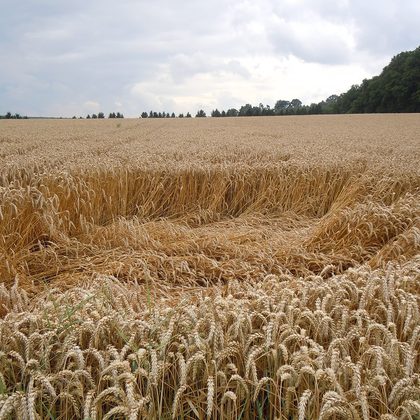
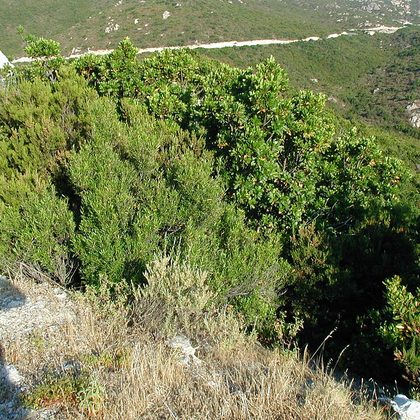
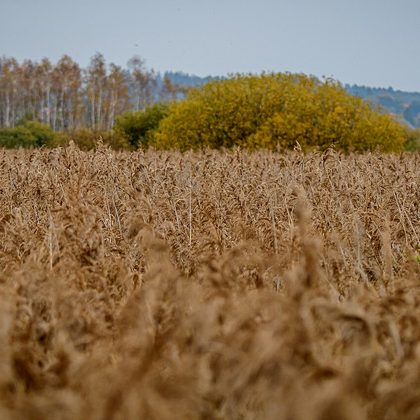
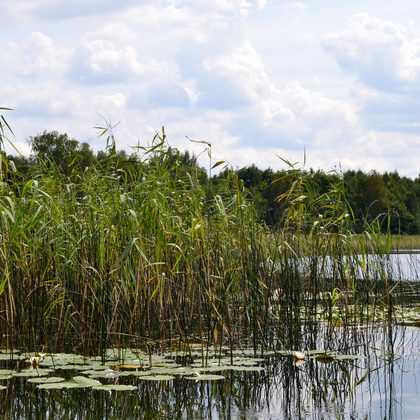
Damp low-lying farmland with cover close at hand: irrigated crops and market gardens, stubbles and fallow, rank field margins with bramble and tamarisk, ditch reed and the scrub along streams and rivers. On Cyprus it also takes drier bushy slopes as long as cultivation lies alongside. Water is almost always part of the picture; dry steppe and bare hillsides it leaves to the rock partridges.
Where the bird is most at home, classified with EUNIS — the European standard for habitats.
Range and movements
Three areas within the guide's window. Cyprus, where it is spread over the whole island and commonest in the Paphos district and on the Karpas peninsula. Southern and south-eastern Turkey, taking in the Çukurova, the Göksu delta and the plains beyond. And the Levant: the Israeli coastal plain, the Jezreel and Beit She'an valleys, the Hula and the rim of the Jordan valley. The range once reached much further west — into the first half of the nineteenth century there were birds in south-east Spain, on Sicily and on islands in the Aegean. Hunting removed them, and later attempts to put the species back have come to nothing.
- Resident
- Breeding (summer)
- Passage
- dark = core range, pale = thinly spread
Where and when to look
Cyprus in April, from an hour before sunrise to two hours after. Drive the farm tracks around Anarita, Mandria and Agia Varvara at walking pace and switch the engine off the moment you hear one. Then look not in the grass but on the high points: a stone heap, a bank, a fence post, the top of a bush. That is where the calling male stands, and from there he is identifiable at three hundred metres. Once he drops into cover the chance has gone — sitting still pays better than walking in.
Conservation status
Not globally threatened; the bulk of the species sits in Iran, Pakistan and India. The western edge, however, has worn thin. Spain, Sicily and Greece lost it two centuries ago. In Israel a comparison of the 1980-1990 and 2010-2020 atlases shows a clear contraction: fewer occupied squares and lower numbers in nearly all of them, driven by the loss of rank field margins and by nests destroyed in cultivation. Cyprus is the exception, the one place where the population holds its ground and is edging up again.