All species › Gamebirds › Pheasants and partridges › Caucasian snowcock
Caucasian snowcock
Tetraogallus caucasicus | Kaukasisch berghoen | Perdigallo caucásico
A heavy, dove-grey partridge of the highest Caucasus, rarely found below two thousand metres. You hear it long before you see it: a clear, mournful whistle that carries the best part of a kilometre off a scree slope.

Voice
A long, pure whistle, plaintive and oddly like a Eurasian Curlew: tyew-oo-ee, often doubled, starting low, rising, then falling away clearly at the close. On a still morning it carries nearly a kilometre across the slopes. Alarm is a loud cackling ka-ka-ka-ka, and feeding parties keep up a bubbling chatter. Hens rarely whistle. Most sound comes in the first two hours after sunrise.
No freely licensed recording is available for this species yet.
Identification
A bulky, short-necked bird the size of a small goose. Head and neck are grey with a sharply cut white throat and a white patch on the side of the neck, backed by a rusty band down the neck sides. Upperparts are grey-brown with pale arrow-shaped fringes, the flanks carry chestnut streaks, the belly is dark grey and the undertail coverts white. In flight a white panel shows in the wing. There is a yellow orbital ring, the bill is dark and the legs dull yellow. The sexes look alike; the hen is slightly smaller and duller.
Confusion species
Caspian Snowcock (Tetraogallus caspius) is the only confusion species. The ranges almost touch but do not overlap: this bird holds the Greater Caucasus, Caspian Snowcock the Lesser Caucasus of Armenia and eastern Turkey and the Alborz, with the Kura depression between them. Caspian is bigger at 56–63 cm with a wingspan over a metre, colder and paler grey, lacks the rusty band on the neck sides and the chestnut flank streaks, has a grey rather than rufous nape, and shows more white in the wing. The voice differs too: the Caucasian whistle drops distinctly in pitch at the end, the Caspian one does not.
Habitat
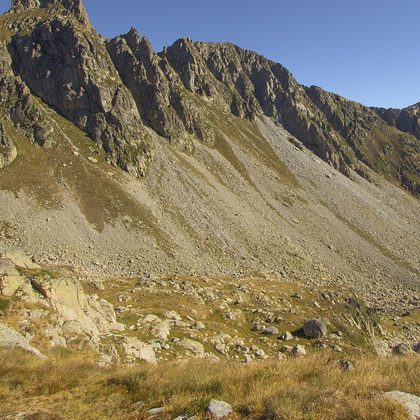
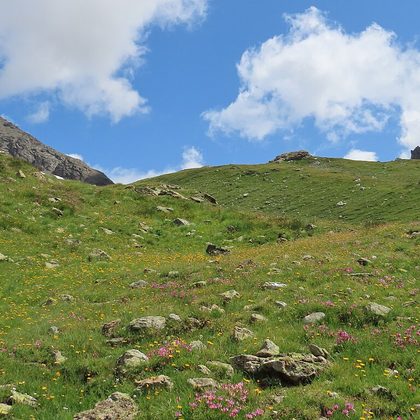
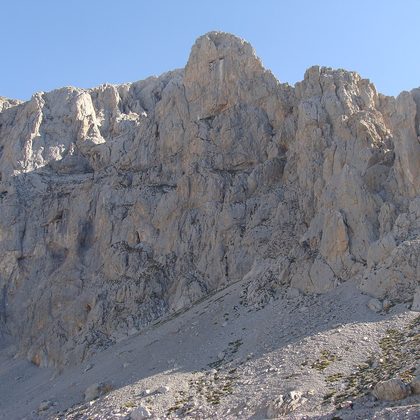
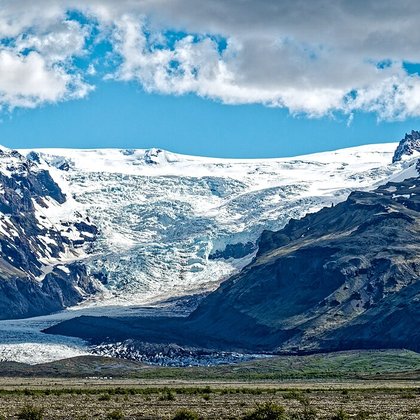
Bare, steep ground above the treeline between roughly 2,000 and 4,000 m, with rock ribs, scree and boulder fields broken by small grassy patches and clumps of dwarf scrub, preferably close to snowfields and glacier edges. In summer the birds favour north-facing slopes for the cool, in winter south-facing ones where snow blows clear. In March they sit around 2,300–2,400 m; by summer they work right up to the permanent snow.
Where the bird is most at home, classified with EUNIS — the European standard for habitats.
Range and movements
Endemic to the Greater Caucasus, from the Black Sea to the Caspian, across Russia, Georgia and Azerbaijan. Because it flies poorly, its distribution is a string of isolated massifs with no contact with relatives outside the range.
- Breeding (summer)
- Passage
- dark = core range, pale = thinly spread
Where and when to look
Kazbegi in Georgia and the Teberda–Dombay area in Karachay-Cherkessia are the usual choices. Climb above 2,500 m in May or June, be in place before sunrise and use the whistle to locate birds, then scan the scree patiently, because the grey plumage disappears completely against stone. Often the first view is of a party crossing a valley on stiff, gliding wings.
Conservation status
Least Concern, with a large but thinly spread population in mountains that are hard to reach. The real pressures are local: hunting and poaching, disturbance and overgrazing by sheep flocks on the summer pastures, and in the longer term the retreat of the snowfields, which shrinks the cool, damp margins where the birds feed through the summer.