All species › Gamebirds › Pheasants and partridges › Hazel grouse
Hazel grouse
Tetrastes bonasia | Hazelhoen | Grévol común
Europe's smallest forest grouse and one of the hardest birds on the continent to actually see. Most encounters amount to a clattering shape going away through the spruces and the realisation that the thin noise you heard a moment earlier was the bird itself.

Voice
A very high, thin whistle that seems to carry badly and that older ears often miss entirely: tseee-tseeee-ti-ti-ti-ti, reedy and running down at the end, usually repeated several times. The hen answers with a liquid tettettettet. Flushed birds whirr away on hard, dry wingbeats, and that sound gives the bird away far more often than the eye does. Cocks whistle in March and April and again in September and October, mostly in the first two hours after sunrise.
Recording: Alexander Kurthy — CC BY-SA 3.0 · Wikimedia Commons
Identification
A small, compact grouse with a little head, a raisable crest and finely feathered legs. Upperparts grey with rufous shoulders, underparts white with dense dark drop-shaped marks that read as scaling. The cock has a black throat sharply outlined in white and a small red comb; the hen has a brownish throat without that pattern. The tail is the clincher: grey with a broad black subterminal band and a narrow white tip, always visible as the bird goes away. A white shoulder stripe along the bend of the wing is the other useful mark.
Confusion species
First-autumn Black Grouse are the usual mistake: brown and barred too, but clearly larger and longer, with no crest, no black throat patch and no black tail band with a white tip. Their tail is square to slightly forked where Hazel Grouse is rounded, and they sit on open moor and bog edge rather than inside closed woodland. The second pitfall is Grey Partridge, shorter and rounder, with an orange-brown face, a horseshoe on the belly and rufous tail sides, and living out on farmland where Hazel Grouse never goes. In the mountains Rock Partridge comes into it, with a white face inside a black border and sharp black flank bars, always on open rocky slopes.
Habitat
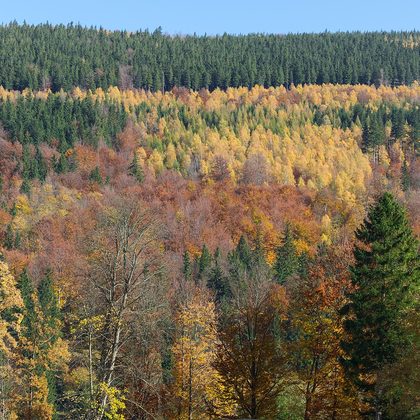
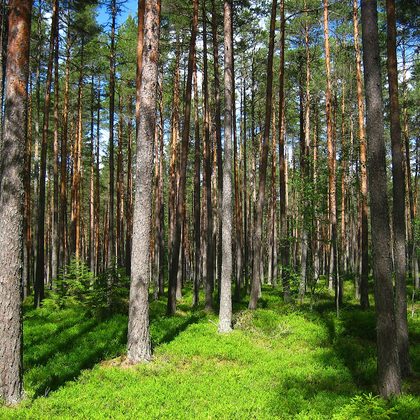
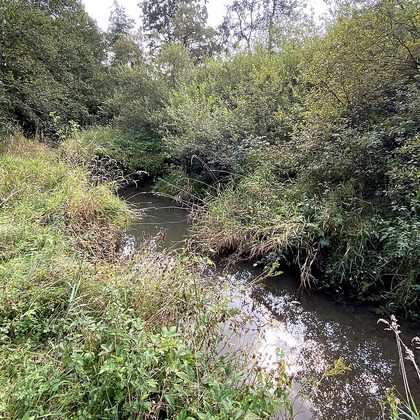
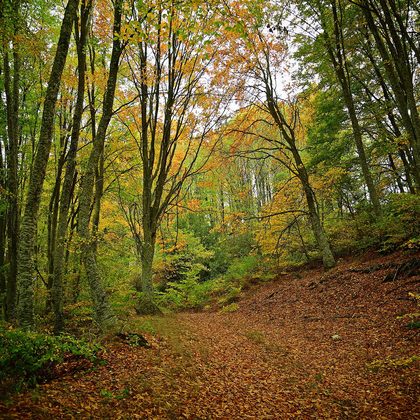
Dense, damp coniferous and mixed woodland with a well-developed shrub and herb layer, preferably with spruce branched right down to the ground. Stream valleys with alder, birch and willow matter a great deal, because the catkins of those trees are the winter food. Add glades, young plantation and windthrow carrying bilberry and raspberry for the broods. Where the wood has been tidied and the understorey is gone, the species goes with it.
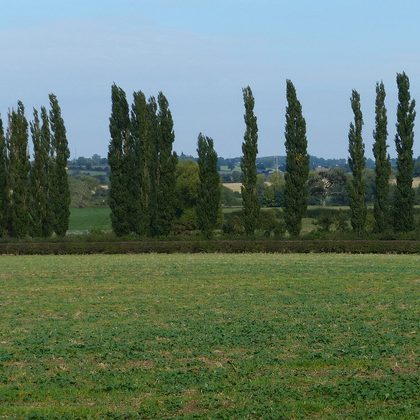
Where the bird is most at home, classified with EUNIS — the European standard for habitats.
Range and movements
Fennoscandia and the Baltic states through Poland, Czechia, the Carpathians and the Balkans and far into Siberia and Japan, with separate populations in the Alps and the Swiss Jura. The western picture is bleak: gone from the Ardennes, down to a handful of birds of the western form rhenana in the Vosges, and lost from the Pyrenees. There has never been a British record worth the name and none should be expected.
- Resident
- Breeding (summer)
- Winter
- Passage
- dark = core range, pale = thinly spread
Where and when to look
Walk a forest track in the Beskids, the Bieszczady or the Bavarian Forest at first light in April, slowly, stopping for a few minutes at a time. Stay on paths beside alder-lined streams with young spruce alongside, and listen for wingbeats above all: nine sightings in ten begin with a bird bursting off the path edge. Whistle lures are banned in many areas and disturb the birds in the breeding season; going without one lowers your chances and improves the observation.
Conservation status
Not globally threatened, thanks to the Russian population, but central and western Europe have been losing it for decades. The cause is silvicultural: even-aged, tidied stands with no shrub layer, the clearing of windthrow and deadwood, and the loss of small-scale transitions between broadleaves and conifers. Fragmentation, cold wet weeks while the chicks are small and heavy predation pressure all add to it. Recovery is possible but slow, because the bird crosses open country badly and recolonises poorly.