All species › Passerines › Chats and flycatchers › Black wheatear
Black wheatear | Oenanthe leucura
Zwarte tapuit | Collalba negra
Black wheatear is the bird of the rock face: gorges, dry ramblas, limestone cliffs and sea cliffs around the western Mediterranean, where the sooty-black male sits singing in the sun on a ledge with his white rump showing. It is the largest wheatear in the region and the only one that stays on its own crag all year.

Voice
The song is loud and fluty, almost thrush-like: a short phrase of clear wistful whistles with scratchy notes between them, given from a ledge or in a song flight that rises and falls in front of the cliff. It is heard from January onwards, long before almost every other bird of the rocks. The call is a clear whistled pee-pee, and a dry chak-chak in alarm; both carry in the echo of a gorge.
No freely licensed recording is available for this species yet.
Identification
A large, heavy wheatear of 16 to 18 cm with a long tail. The male is wholly sooty black and glossy in sunlight; the female is dark brown and a little duller, but marked in exactly the same way. Rump and tail base are white, and on that white sits a black inverted T made of a broad terminal band and a central stripe, so that in flight the white of the tail is cut off sharply by the black tip. Bill and legs are black and strong, the undertail-coverts white. Juveniles are brown and faintly scaled, with the same tail pattern.
Confusion species
In Iberia no confusion is possible, since no other wheatear there is entirely black. The problem lies in the Maghreb, where white-crowned wheatear also occurs. The adult White-crowned has a pure white crown, but juveniles and first-years are as black as black wheatear, and then the tail settles it: White-crowned has a nearly all-white tail with black limited to the tips of the central feathers and no continuous terminal band, whereas black wheatear always shows the broad band and the inverted T. White-crowned is also slimmer, longer-billed and glossier. Black redstart is far smaller and has a rusty tail that shivers at every landing. Blackbird is larger, has no white rump, and the male has a yellow bill.
Habitat
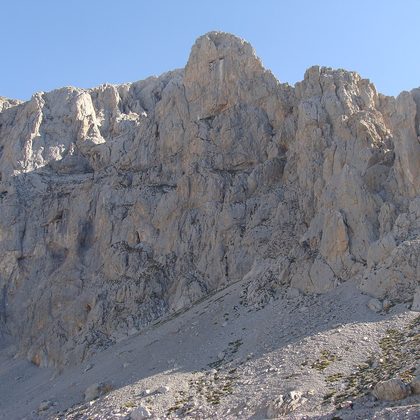
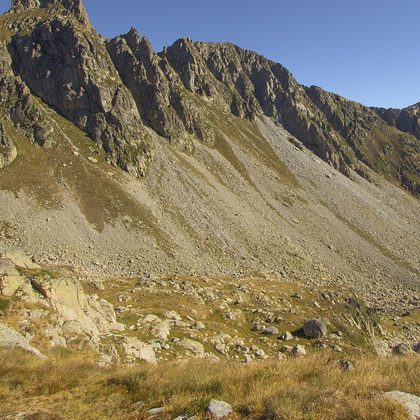
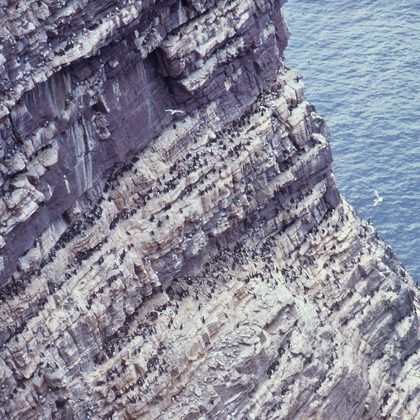
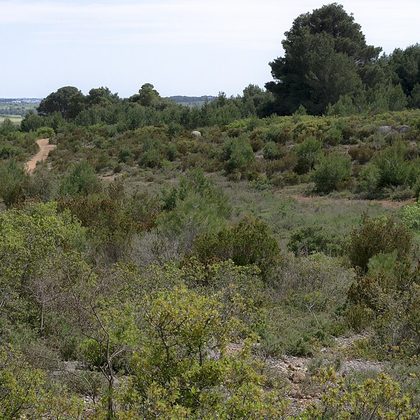
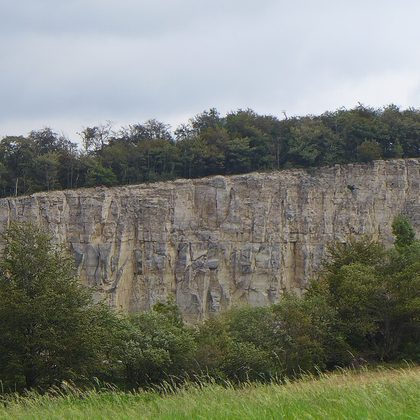
Limestone cliffs and rock plateaux, gorges and barrancos, incised dry watercourses, badlands, quarries and sea cliffs, almost always with low Mediterranean scrub — thyme, rosemary, garrigue — at the foot or on the ledges, because that is where the food is. Up to 2,000 m in the sierras and down to sea level at Cabo de Gata and the Garraf. Also in ruins, abandoned farmsteads and cuttings along mountain roads.
Where the bird is most at home, classified with EUNIS — the European standard for habitats.
Range and movements
Confined to the western Mediterranean: the Iberian Peninsula and north-west Africa, from Morocco through Algeria and Tunisia to north-western Libya. In Spain the stronghold is the Mediterranean coastal belt and the ranges behind it — Almería, Murcia, Alicante, Valencia, Catalonia — with an arm along the Sistema Ibérico and scattered pairs in Andalusia, the centre and the south-west; it is absent from the whole Cantabrian coast. In Portugal it holds the Douro valley and the interior of the Alentejo. It has stopped breeding in southern France, where the last territories were in Roussillon. Around the year 2000 the European population was put at a few thousand to somewhat over ten thousand pairs, almost all of them Spanish.
- Resident
- Breeding (summer)
- Winter
- Passage
- dark = core range, pale = thinly spread
Where and when to look
A morning in February or March in a limestone gorge in south-east Spain — El Torcal, Cabo de Gata, the Sierra de Grazalema, the Garraf — and listen before you look: the fluty song bounces off the wall. Then look for the pile of stones. The male carries pebbles, some of them 23 g, close to two thirds of his own weight, and heaps them on the ledge by the nest crevice; a site used for years may hold hundreds or thousands. Females lay more eggs for males that carry more stones, so the heap is an advertisement and not an ornament.
Conservation status
Not globally threatened, and locally stable or slightly increasing in Spain, but gone from France and in retreat along the northern and inland edge of its range. What harms it is the loss of cliff with scrub at the foot: working quarries, coastal development, climbing routes and via ferratas on breeding faces, and the loss of the mosaic of low scrub and bare ground where it feeds, whether through abandonment or through ploughing. Where the crag is left quiet and there is rosemary at its base, the bird holds on well.