All species › Passerines › Chats and flycatchers › Red-tailed wheatear
Red-tailed wheatear | Oenanthe chrysopygia
Oostelijke roodstaarttapuit | Collalba afgana
Red-tailed wheatear is the drabbest bird with the finest tail: grey-brown and featureless from the front, orange-red with a black T from behind. It breeds in the mountains of the Caucasus, Iran and Afghanistan and winters in Arabia and India; a handful reach Israel each winter, and that is the only time it can be seen within the area of this guide. Anyone who finds one there is handed the identification problem of the whole group at once.

Voice
In the winter quarters it is nearly silent. The call is a short hard chack and a thin rising whistle; two birds disputing a good bush produce a fast rattle. The song, heard only on the breeding grounds and chiefly in May and June, is a simple repeated whistle followed by a run of rasping, clicking and squeaky notes, usually from a rock point and sometimes in a short song flight. It is markedly quieter and less varied than the song of northern wheatear.
No freely licensed recording is available for this species yet.
Identification
A small wheatear with a plain, expressionless face and a surprisingly coloured rear end. The upperparts are uniform grey-brown without markings, crown and mantle the same shade, with a faint narrow pale supercilium that is clearest in front of the eye; the ear-coverts often carry a warm rusty wash. The underparts are evenly grey-white with a buff or apricot cast across the breast, and the undertail-coverts are soft orange — but with no hard boundary, so that from the front the bird shows nothing contrasting at all. Rump and tail base are bright orange-rufous, the rest of the tail black: a broad terminal band and black central feathers, together the inverted T on a rufous ground. Legs and bill are black. The sexes are much alike; the male shows at most a dark lore between bill and eye, and never any black on the throat.
Confusion species
Kurdish wheatear is the problem, and it is a real one: the two were separated only recently, they share the rufous rump, the rufous tail base with its black T and the orange undertail-coverts, and the tail offers nothing to tell them apart. Look at the throat and the belly. Red-tailed wheatear is evenly grey-buff below, grading gently into the orange of the vent and with not a trace of black on the throat. A breeding male Kurdish wheatear does have a black chin and throat, and below it a white belly standing out hard against orange flanks. Out of breeding dress and on females that distinction largely goes: Kurdish wheatear then shows only a dark brown cheek patch, which on a worn bird can be hard to see at all. Location therefore carries real weight — the Caucasus and Iran against Turkey and northern Iraq — but in Israel both are on the list and a share of the birds stays unnamed. Beyond that the confusion is limited: northern wheatear has a clean white rump, so does Isabelline wheatear, desert wheatear has an all-black tail, and common redstart is slimmer and longer-tailed, keeps to bushes and has the whole tail rufous with only a dark centre.
Habitat
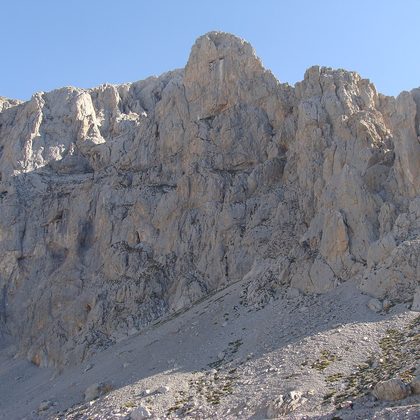
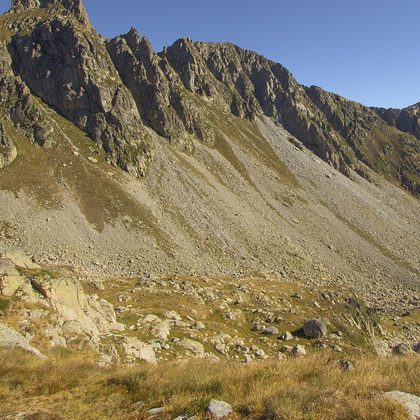
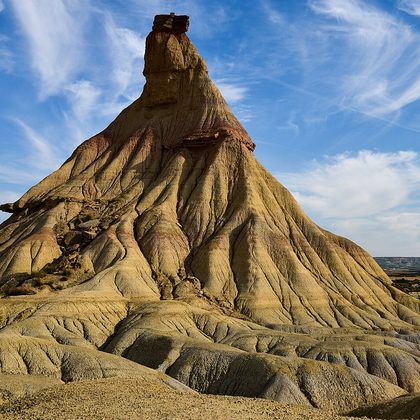
In the breeding season bare, steep mountain slopes between roughly 1,200 and 4,000 m: rock ribs, screes, ravines and high stony pasture kept short by goats and sheep. Outside the breeding season it descends a long way and takes to lower, warmer, flatter country: stony hills, semi-desert, wadi floors, fallow fields and salt flats with scattered bushes. The picture is the same everywhere: a great deal of bare ground, a few stones to hunt from, and no more than that.
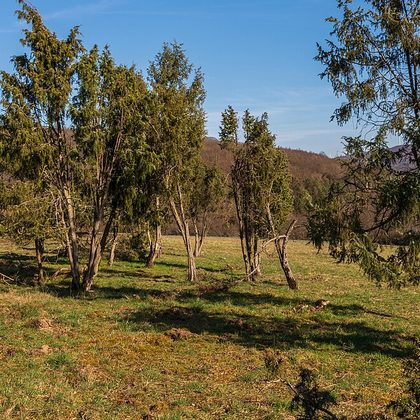
Where the bird is most at home, classified with EUNIS — the European standard for habitats.
Range and movements
A breeding bird from north-east Turkey, Armenia and Azerbaijan through Iran to Afghanistan, southern Tajikistan and western Pakistan. It winters on the Arabian Peninsula, in Eritrea, in southern Iraq and Iran and in Pakistan and north-west India. The breeding range lies almost entirely east of the map area of this guide: in Europe and the Mediterranean it is known only as a winter visitor and vagrant to Israel, where small numbers are recorded in most years in the Arava, the Negev and around the Dead Sea. Further west it has never been reliably reported.
Where and when to look
November to March in the Arava or around the Dead Sea, and then with plenty of patience. Find the tail first: flush the bird and watch for the orange-red of rump and tail base. Then work from front to back — plain face without a mask, evenly grey-buff underparts, no trace of black on the throat — and check it against a photograph on your phone, because this is the species above all others you will want to look at again later. Photograph everything you can: throat, flanks and spread tail. Come home without pictures and you will usually be left with a question mark.
Conservation status
Not threatened: the range across the mountains of Iran, Afghanistan and Central Asia is large and the population is regarded as stable. As with its counterpart the figures are weak, because the two species were long lumped together and the breeding range is hardly ever counted systematically. Locally heavy grazing may even help it, since bare ground is what it needs; what does it harm is large-scale mining and road building through the high valleys. Within the area of this guide it is far too rare for any trend to be spoken of.