All species › Passerines › Chats and flycatchers › Kurdish wheatear
Kurdish wheatear | Oenanthe xanthoprymna
Koerdische tapuit | Collalba colirroja
On Kurdish wheatear the tail is not white but rust-red. That single fact sets it apart at once from everything else moving about in the Levant — and at the same time makes it almost impossible to separate from red-tailed wheatear, with which it was counted as one species until the 1980s. It breeds in the bare mountains of south-east Turkey and northern Iraq and then heads south; in Israel it is a scarce migrant and winter visitor.

Voice
The song is short and hurried: a scratchy, slightly squeaky phrase of two or three seconds with a few clear whistles worked in and sometimes a little mimicry, delivered from a boulder or in a low fluttering song flight over the slope. It sings mainly in April, May and June and falls silent afterwards. The call is a hard chack-chack like knocked stones, usually introduced by a thin whistled hweet; in the winter quarters that is often the only sound it makes.
No freely licensed recording is available for this species yet.
Identification
A small, short-tailed wheatear in muted colours with one arresting feature: rump and tail base are rust-red rather than white. The upperparts are plain grey-brown, the crown a little greyer, with a narrow white supercilium. The breeding male has a black chin and throat, and that black runs on across lores and ear-coverts into a mask cut off sharply by a white breast. Flanks and undertail-coverts are orange-rufous and the belly is white, and it is precisely that boundary between white and orange that is hard on this bird. The tail is rust-red at the base with a broad black terminal band and black central feathers, so that the familiar inverted T lies here on a rufous rather than a white ground. On females and on birds out of breeding dress the mask is reduced to a dark brown cheek patch with a white throat below it, and the underparts are buffier. The wing is dark brown and carries no white.
Confusion species
Everything turns on red-tailed wheatear. The two share exactly what catches the eye first: the rufous rump, the rufous tail base with its black T, orange undertail-coverts and plain grey-brown upperparts. The tail pattern offers nothing to separate them — shade and extent of rufous overlap completely, and anyone working from that is fooling himself. What does count is throat and belly. A breeding male Kurdish wheatear has black on chin and throat and below it a white belly standing out hard against orange flanks; red-tailed wheatear never has black on the throat, at most a dark lore, and its underparts are evenly grey-buff with no sharp boundary. On females and autumn birds that difference largely disappears. Location is then the best help: in Turkey and northern Iraq Kurdish wheatear is the bird to expect, in the Caucasus and further east the other, and in Israel both occur. The honest answer is that a good share of wintering birds stays nameless and goes into the notebook as 'Kurdish or red-tailed wheatear'. Beyond that: northern wheatear has a clean white rump, desert wheatear an all-black tail, and red-rumped wheatear of the North African deserts does have a rufous rump but an entirely black tail and, in the male, a grey-white head.
Habitat
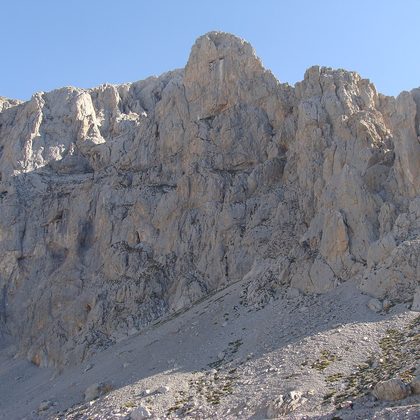
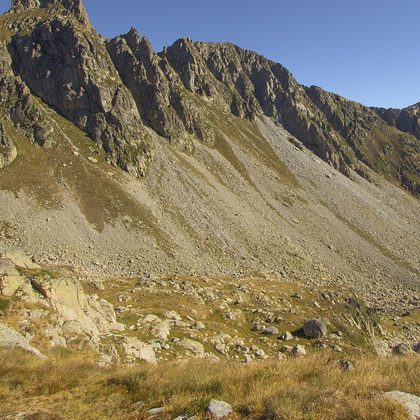
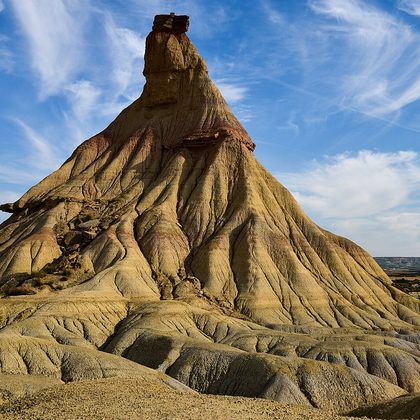
Bare stony mountain slopes with little or no scrub: screes, rock ribs, ravines and steep loess banks, mostly between 1,500 and 3,000 m, and in Turkey with a liking for slopes kept short by sheep and goats. The nest is in a hole in an earth bank or under a flat stone, often at the end of a short tunnel. Outside the breeding season it drops to lower, warmer ground: stony semi-desert plains, wadi floors, field margins and salt flats, where it feeds from the ground in short sprints from one stone to the next.
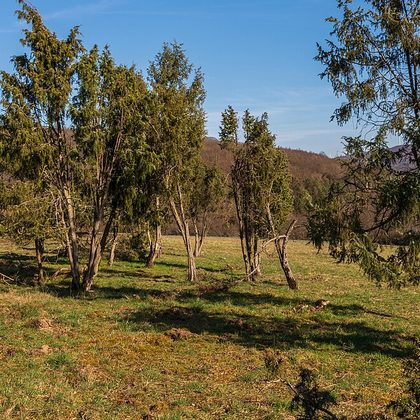
Where the bird is most at home, classified with EUNIS — the European standard for habitats.
Range and movements
A breeding bird of south-east Turkey, northern Iraq and western and southern Iran, with its western limit roughly at the upper Euphrates. Every bird leaves: they winter in north-east Sudan and Eritrea, on the Arabian Peninsula and in southern Iran, and pass through the Levant on the way. In Israel it is a scarce migrant in October and November and again in February and March, with a small number wintering each year in the Arava, the Negev and around the Dead Sea. It has not been recorded in Europe west of Turkey; on the map it therefore touches the area of this guide only along its south-eastern edge.
- Breeding (summer)
- Winter
- Passage
- Migration direction
- dark = core range, pale = thinly spread
Where and when to look
In winter along the Arava or in the Judean Desert: drive a gravel track slowly and watch for small upright birds hopping from stone to stone. Flush one and look at the tail — the rufous base with the black T rules out half the wheatears at a stroke. Then take your time over the throat, because that is where the decision between the two red-tailed wheatears is made, and write down honestly what you did not see. In May the surest place is a high mountain road in south-east Turkey, where males in full breeding dress sing from the screes and the black throat shows at a distance.
Conservation status
Not threatened: a broad range in the mountains of Turkey, Iraq and Iran, and a population with no known decline. The uncertainty lies mainly in the data: the breeding range is hard to reach and in part unsafe, so numbers and trends can barely be counted, and because the species was until recently lumped with red-tailed wheatear the older figures are difficult to use. What may matter in the longer run is the loss of extensive sheep and goat grazing, since without grazing the bare slopes close over, and the short open ground it lives on then goes with them.