All species › Passerines › Chats and flycatchers › Mourning wheatear
Mourning wheatear | Oenanthe lugens
Oostelijke rouwtapuit | Collalba núbica
Mourning wheatear is the black-and-white bird of the desert edge: a wholly white crown and nape above a black face, a black mantle and a snow-white belly. Unlike almost every other wheatear it does not migrate. The same pair holds the same wadi in the Negev, the Judean Desert or the Jordanian highlands year after year, and in December the bird is standing on exactly the stone it used in May.

Voice
The song suits the name: a short, mournful phrase of clear, slightly plaintive whistles, slower and purer than the scratchy delivery of most wheatears, with a few dry rattling notes worked through it. It is sung from a rock point, a wall or a telephone wire, most often in the first hours of daylight and from January into May — early in the year, because in the desert the breeding season starts early. The call is a hard chack like knocked pebbles and a thin rising hweet; alarm turns it into a rapid series of ticks.
No freely licensed recording is available for this species yet.
Identification
A small, sharply pied wheatear that stands very upright and bobs a great deal. Crown and nape are pure white, the white running well down the back of the neck; lores, ear-coverts, chin, throat and upper breast are jet black and pass without a break into a black mantle, black scapulars and black wings. The underparts are clean white, and there the best character sits: the undertail-coverts are warm orange-buff to rusty buff, one softly coloured patch beneath an otherwise severely black-and-white bird. The tail is white at the base with a broad black terminal band and a long black centre — the familiar inverted T, but carrying more black than on northern wheatear. From below the wing is not uniformly dark: a pale band shows across the flight feathers. The female differs hardly at all from the male, being only duller and brown-black where he is jet black. Juveniles are scaled with pale fringes but already carry the orange-buff vent.
Confusion species
Pied wheatear is the hard one, since it too has a white crown and a black throat. On pied the crown shades to grey-white towards the rear, the black of the throat is drawn out in a point onto the breast sides, and the underparts are clean white all the way to the vent, without that orange-buff patch; there is also less black in the tail, the terminal band being narrower. The calendar helps: in the Levant pied wheatear is a migrant of March and April and of September, while mourning wheatear sits on the same slope all year. Cyprus wheatear has a cream-white crown and buff to apricot underparts and breeds on Cyprus alone. Finsch's wheatear, which winters in the same deserts, is bigger and heavier and has the whole mantle and back white as well as the crown, so that the black is confined to face, throat and wings. White-crowned wheatear is large and entirely black apart from a white crown and a white tail base, and lacks the white belly altogether. In the basalt desert of eastern Jordan and southern Syria there is a nearly all-black form with a dark crown that some handbooks treat as a species in its own right. Finally, the black-throated forms of western and eastern black-eared wheatear also show a black throat, but their crown and mantle are sandy and their tail is largely white.
Habitat
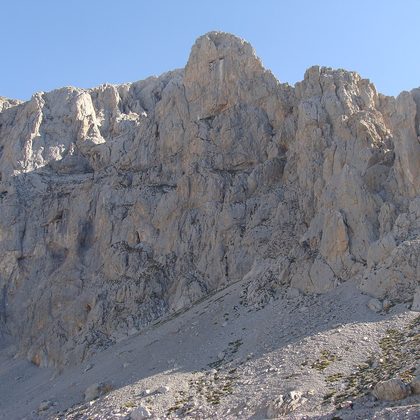
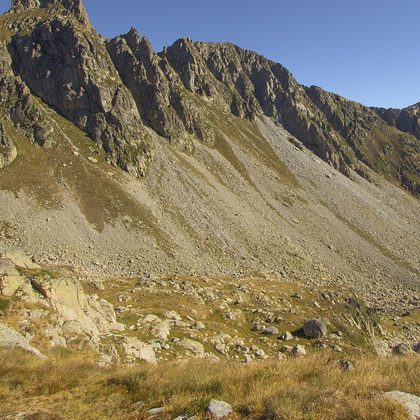
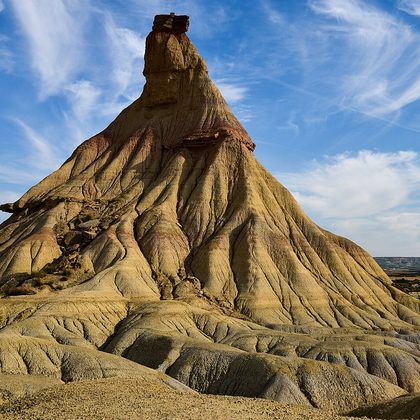
Rocky desert and semi-desert with relief: the walls and rims of wadis, steep boulder-strewn slopes, screes, ravines, cliffs and erosion gullies, from below sea level at the Dead Sea to well over a thousand metres in the Jordanian highlands. Bare stony ground with a handful of lookout perches is enough; the bird needs no bushes. The nest goes deep into a rock crevice or under an overhanging block, often behind a small pavement of pebbles the pair lays at the entrance itself. Old ruins, village walls and abandoned quarries are occupied too.
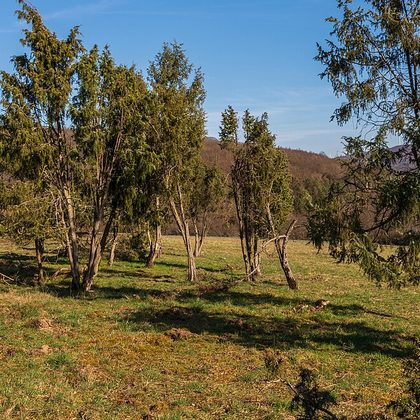
Where the bird is most at home, classified with EUNIS — the European standard for habitats.
Range and movements
From the Egyptian Eastern Desert and Sinai through Israel, Jordan and Syria to Iraq and Iran; the related birds from Morocco to Libya have lately been treated as a separate species. Within the area of this guide it is a resident of the Negev, the Judean Desert, the Dead Sea rift and the highlands of Jordan and southern Syria, everywhere at low density but extremely sedentary: territories are defended all year and pairs stay together. It does not reach Europe, and even within the Mediterranean it has never been recorded west of the Levant. On the map that shows as a narrow band along the eastern edge of the region.
- Resident
- Winter
- Passage
- dark = core range, pale = thinly spread
Where and when to look
The first two hours after sunrise at Sde Boker, Ein Avdat or the rim of the Ramon crater in the Negev. Stand on the edge of a wadi and let the light do the work: a bird flashing black and white against sand-coloured rock is visible at three hundred metres, and the moment it flies the white tail base leaps out. Then wait for it to turn — the orange-buff vent settles the identification. In Jordan the same works at Petra and along the King's Highway, where the birds are used to people and sit tight down to ten metres.
Conservation status
Not threatened: a large range and a population that is stable overall, though it lives everywhere at low density. Pressure is local. Quarries, road building, military training grounds and the construction of hotels and viewpoints in the desert destroy exactly what it needs, which is rock faces with crevices. Off-road driving disturbs breeding pairs, and where wadis are used as tips the numbers of crows and cats go up. Against that, much of the Negev and of southern Jordan is protected desert, and the species does well for itself in old ruins and abandoned villages.