All species › Passerines › Chats and flycatchers › Finsch's wheatear
Finsch's wheatear | Oenanthe finschii
Finsch' tapuit | Collalba de Finsch
Finsch's wheatear is the stocky, bull-necked black-and-white wheatear of the bare stony slopes of Anatolia. To see it within this guide in winter you go to Cyprus or the Levant, where it drops down to the steppes and desert margins and holds a patch of stony ground alone — one bird to a hillside, the same bird all winter.
Voice
The song is short, loud and clear: a phrase of two to four seconds that opens with a few hard scratchy notes and turns into a run of pure, faintly mournful whistles falling away at the end, delivered from a stone or a boulder and sometimes from a brief rising song flight that ends with the tail spread. It sings from March into June, midday included. The calls are a hard chak, often in series, and a thin whistled hweet. In the winter quarters it is largely silent apart from the hard chak with which it defends its territory against others of its kind.
No freely licensed recording is available for this species yet.
Identification
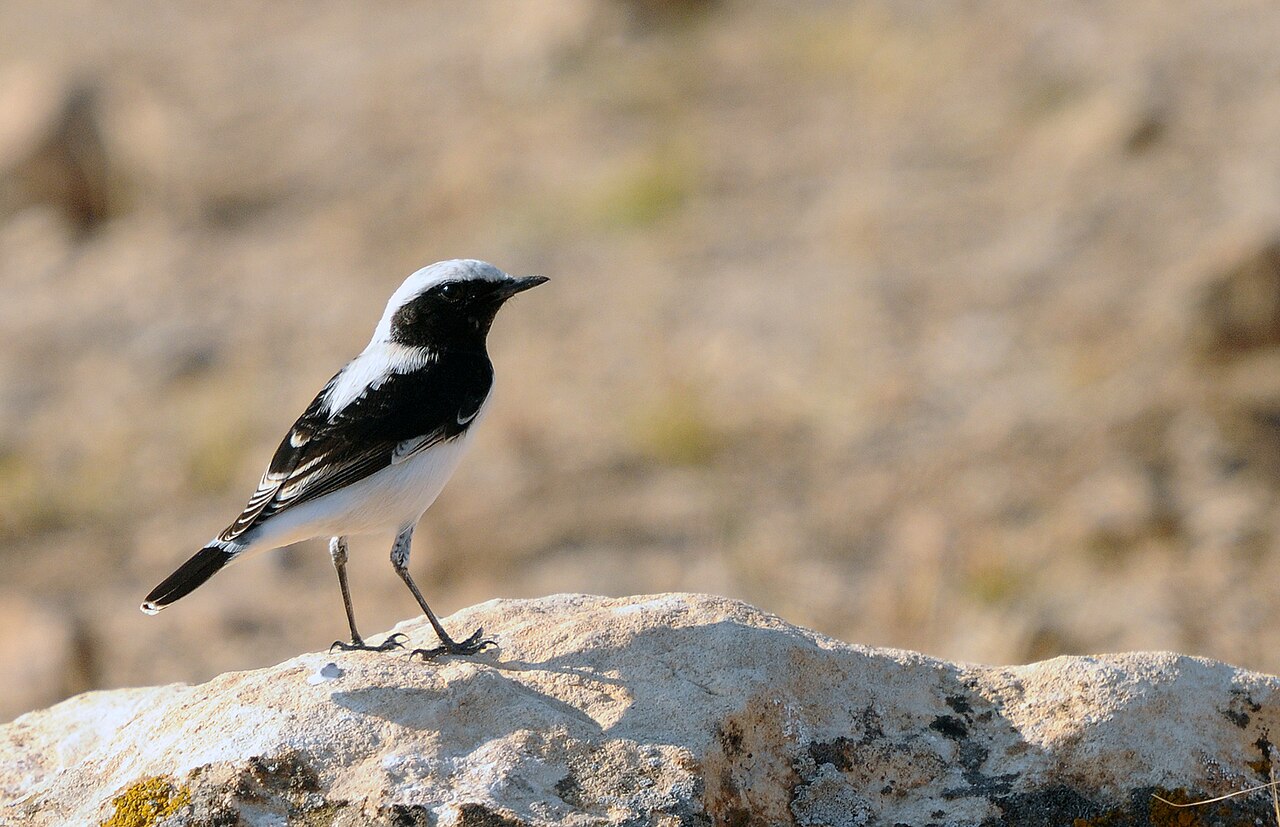
A medium-sized but heavily built wheatear with a thick neck, a large head and a short wing; beside the slim northern wheatear it looks top-heavy and compact. The male is crisply black and white: a pure white crown running back over the nape, and below it a single unbroken black area taking in face, throat, upper breast, side of neck, mantle, scapulars and wings. Underparts and rump are clean white. The tail carries a great deal of black: on a white base sits a broad black terminal band covering roughly a third to a half of its length, and the black also creeps up the outer feathers, so that the white looks confined to the base. The female is grey-brown to sandy above with a paler crown and cream to light buff underparts, often with a dingy grey to blackish throat patch, and shows exactly the same broad terminal band. In autumn pale fringes partly cover the male's black and he looks brownish and scaled.
Confusion species
Pied wheatear is the real problem: also white on crown and nape, also a black throat running unbroken into a black mantle, also white underparts. Three things decide it. First the tail: on Finsch's the black terminal band is broad and the black climbs the outer feathers, so the white is restricted to the base; on pied the band is narrow and the white reaches far back, the black concentrated in a central wedge. Second the structure: Finsch's is shorter-winged and shorter-tailed and more solidly built, thick-necked and with a short primary projection, where pied is slim and long-winged. Third the calendar, which in the field is the most useful of all: in the Levant and on Cyprus a black-and-white wheatear between November and March is always Finsch's, because pied wheatear only passes through there in spring and autumn and does not winter. Mourning wheatear has orange-buff undertail coverts and a narrower terminal band and clings to rock faces rather than sitting out on open stony slopes. Hooded wheatear has no terminal band at all, is longer in tail and bill, and flies in a looser, more sweeping way. Cyprus wheatear, present on Cyprus only in summer, has a cream crown and distinctly buff to apricot underparts. Eastern black-eared wheatear in its black-throated morph also shows a black throat, but its mantle stays pale and its tail is largely white. On females it comes down again to the broad terminal band, the compact build, and where and when the bird is seen.
Habitat
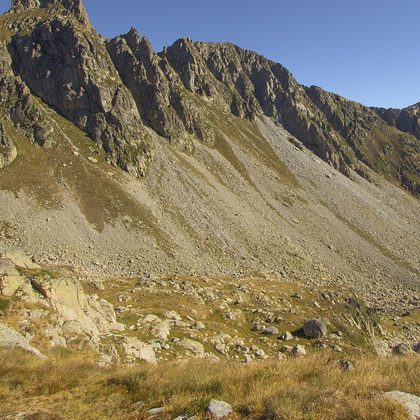
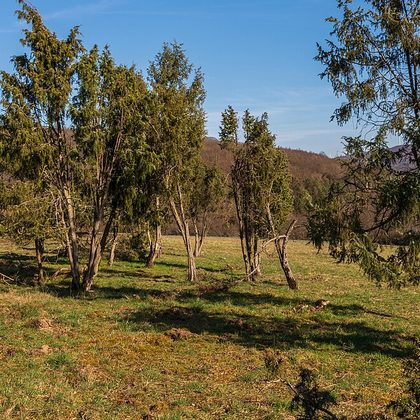
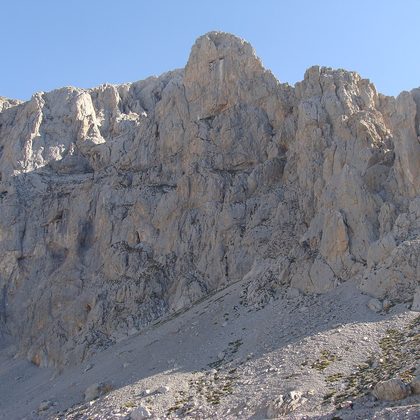
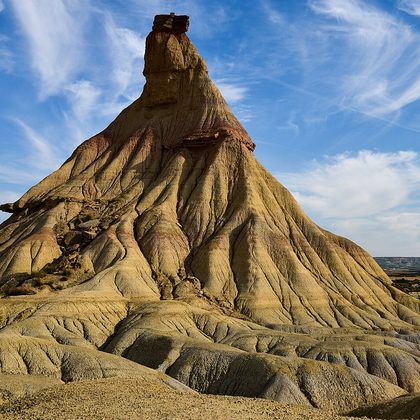
Bare, dry, stony mountain slopes: screes and boulder fields, eroded slopes with scattered rocks, rocky mountain steppe with low thorny shrubs, and the upper edge of abandoned terraces. Vegetation must be present but only as scattered clumps; closed grassland is useless to it. In Turkey and Iran it breeds between roughly five hundred and three thousand metres. The nest goes under a flat stone, in a crevice or in a dry-stone wall; like many wheatears it often lays a small apron of pebbles at the entrance. In winter it drops to lower, flatter ground: stony plains, wadi edges, fallow fields, almond groves and the surroundings of villages.
Where the bird is most at home, classified with EUNIS — the European standard for habitats.
Range and movements
Breeds in central and eastern Turkey, from the Konya plain east to Lake Van, and on from Syria and the Caucasus through Iran to Turkmenistan and Afghanistan. In winter the centre of gravity shifts south-west: it is then a regular but never numerous winter visitor to Israel, the Palestinian territories, Jordan, Lebanon and Syria, and to Cyprus, where the records fall strictly between October and March with none at all from May to September. In Turkey itself part of the population winters in the lower southern valleys. It reaches Greece and the Aegean islands rarely, and western Europe only exceptionally.
- Resident
- Breeding (summer)
- Winter
- Passage
- dark = core range, pale = thinly spread
Where and when to look
Two moments. January and February on Cyprus, on the stony fallows of the Mesaoria or around the salt lake at Larnaca, and in the same weeks in the Judean desert and the northern Negev: look for a single black-and-white bird sitting alone on a stony slope and driving off any other wheatear — that solitary winter territoriality is itself a clue. Flush it and watch nothing but how much black is in the tail. Then May on the Anatolian plateau, at Nemrut, around Van or in Cappadocia, when it sings from the boulders on the bare slopes above the villages and will often sit still on the same stone for minutes on end.
Conservation status
Not threatened globally: a large range from Turkey to Afghanistan, a large population and no sign of rapid decline. It gains from extensive grazing rather than suffering under it, since sheep and goats keep the slopes bare and open. Where it does lose ground is where stony hillsides are ploughed or planted with trees, where old terraces and dry-stone walls are cleared away and its nest sites go with them, and where mountain steppe is converted to irrigated arable. In the Levantine winter quarters it has never been numerous, and the numbers there say more about the weather in Anatolia than about the state of the species.