All species › Passerines › Chats and flycatchers › Blackstart
Blackstart | Oenanthe melanura
Zwartstaart | Colinegro real
The blackstart is the tamest bird in the desert. It sits on the handrail of the path at Ein Gedi, on the steps of Masada and on the table of a desert guesthouse, and lets people approach to within a metre. Close to, it is an unremarkable grey bird — until it fans its tail, which is jet black, and settles the matter in a single movement.

Voice
The song is short and surprisingly melodic for so grey a bird: a series of four to eight clear, plaintive whistles that falls away at the end, with a few drier scratchy notes among them, repeated at intervals of half a minute. It sings from a boulder, an acacia branch or a roof edge, chiefly in the first hour after sunrise and again at dusk, and in spring at midday too. The calls are a thin plaintive tseep and, in alarm, a hard rattling trrrt. Heard in every month of the year.
No freely licensed recording is available for this species yet.
Identification
A small, evenly ash-grey chat without markings: crown, mantle, breast and belly run into one another without contrast, at most a shade paler on throat and belly, and the wing is barely darker than the back. Bill and legs are black and fine. The only feature the bird owns is its tail, and that is therefore decisive: wholly black, with no white base, no white outer edges and no terminal band — and there is no white rump either, the grey back simply running on into the black. The tail is seldom still: the bird spreads it into a fan, lowers it and closes it again, dozens of times a minute, and that slow opening and closing is often the first thing noticed at a distance. Sexes are alike, and juveniles differ only in faint pale spotting on the back.
Confusion species
No other bird in the region is uniformly grey and has a wholly black tail with no white rump; that is the whole identification. Where it does go wrong is among the other black-tailed species. Desert wheatear also has a black tail, but above it a creamy white rump that cuts sharply against the black, and it is sandy rather than grey; the male adds a black throat. Red-rumped wheatear likewise has a black tail, but is larger and heavier with a rusty rump, the male masked in black and the female rufous-headed. The female black redstart, which winters through the Levant, is grey-brown and at range genuinely recalls a blackstart, but her tail is rusty red rather than black — in case of doubt that is all you need to see. Spotted flycatcher is browner, streaked on crown and breast, sits upright and waits instead of hopping about, and never fans its tail.
Habitat
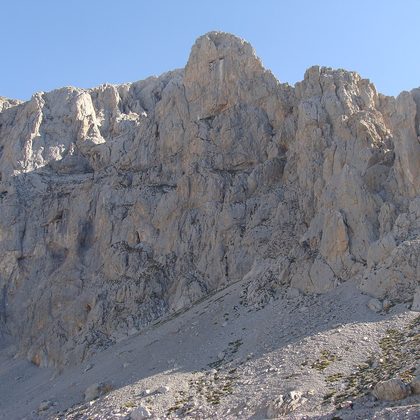
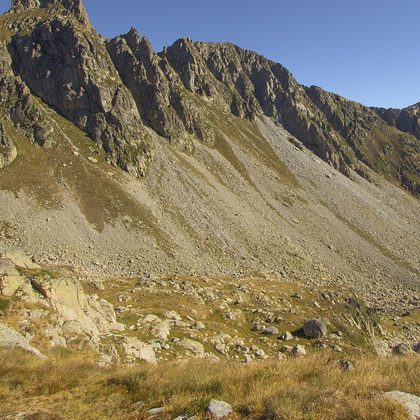
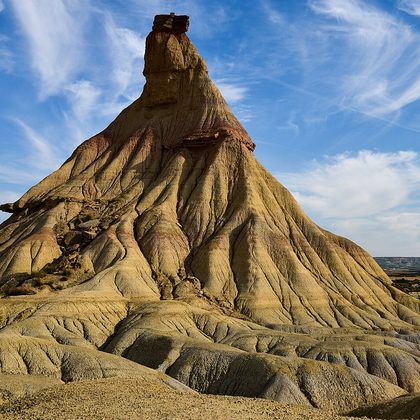
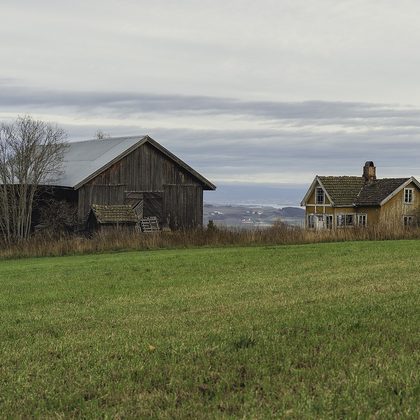
Rocky desert wadis with some green in them: gorges and canyons with vertical walls, screes, dry beds with acacia, caper and oleander, and the surroundings of springs and oases. Where there is water in the desert, this bird is there too. It avoids the bare open plain and always needs two things: rock to nest in — the nest goes in a crevice, under a stone or in a hole in an earth bank — and bushes or trees to work through just above the ground. From more than four hundred metres below sea level at the Dead Sea up into the mountains of Sinai, and it settles remarkably readily around buildings: field schools, car parks, date gardens and desert camps are all part of its habitat.
Where the bird is most at home, classified with EUNIS — the European standard for habitats.
Range and movements
Within the area of this guide it is the common chat of the Jordan rift and the deserts beside it: the Judean desert, the Dead Sea shore, the Negev and the Arava in Israel and the Palestinian territories, the wadis of Dana, Petra and Wadi Rum in Jordan, and Sinai and the Red Sea mountains in Egypt, reaching north into southern Syria. Beyond the map the range continues across Arabia to Yemen and Oman and over the Red Sea into Sudan, Eritrea and Ethiopia. It is resident in the strictest sense: the same birds hold the same stretch of wadi year after year, and there is no migration or winter movement to speak of. Israeli observers report it in all twelve months in much the same numbers.
- Resident
- Migration direction
- dark = core range, pale = thinly spread
Where and when to look
Any month of the year, and easiest where the people are. Walk up the Nahal David path at Ein Gedi, stand by the cable car at the foot of Masada, or drink coffee at a guesthouse in the Arava: within a quarter of an hour a small grey bird will be two metres away, fanning its tail open and shut. When it does, look at the rump as well as the tail, because it is precisely the absence of a white rump that separates it from every wheatear. For the song be early: the first hour after sunrise in a wadi with acacias, while it is still cool.
Conservation status
Not threatened, with a large range and a population regarded as stable; locally it is downright numerous. Two things are worth watching. The first is water: the springs and oases of the Jordan rift are under pressure from abstraction for farming and drinking water, and where a spring dries the vegetation the bird lives among goes with it. The second is the acacias of the Arava, dying back in many places as the water table falls and occasional flood water is captured upstream; with those trees go part of its insect supply and its shade. As long as the wadis keep their rock, their bushes and their water, the species itself gives no cause for concern.