All species › Passerines › Chats and flycatchers › Red-rumped wheatear
Red-rumped wheatear | Oenanthe moesta
Roodstuittapuit | Collalba culirroja
Red-rumped wheatear is the wheatear of the flat, bare desert plain, where nothing rises above the surface — no rock, no tall bush. It is heavy and big-headed, it digs its own nest tunnel into a sandy mound under a low shrub, and it is the one wheatear in which the female wears the striking head pattern: hers is rusty red, while in every other species it is the male that carries the markings.

Voice
The song is a short, untidy phrase of hard rattling and buzzing notes with a few clear whistles among them and scraps of mimicry picked up from its neighbours on the plain, delivered from a low bush, a stone or a wire, and sometimes in a low fluttering song flight. It sounds heavier and drier than the song of northern wheatear. The calls are a hard chak and a rolling, purring churr that is kept up when the bird is uneasy. Heard from February into May, loudest in the first two hours after sunrise.
No freely licensed recording is available for this species yet.
Identification
A solid, heavily built wheatear with a big head, a short wing and a wholly black tail. The male has a pale grey crown and nape, a narrow white supercilium below it, and below that a black mask that takes in lores, ear coverts, chin, throat and upper breast as one black area and runs down the side of the neck onto the dark grey mantle. The underparts are white, the wing blackish brown with broad pale fringes and a white panel. Rump and uppertail coverts are warm rusty brown, and the tail is black from base to tip, with no white and no terminal band. The female carries no black at all: head, throat and side of neck are warm rufous to cinnamon, the mantle is grey-brown, the underparts creamy white, and rump and tail are patterned exactly as on the male. Juveniles resemble the female but paler and faintly scaled.
Confusion species
Take the tail first. A wheatear with a tail black from base to tip, without a trace of white at the base, can in North Africa and the Levant only be red-rumped or desert wheatear. The rump separates those two: warm rusty brown on red-rumped, creamy white to pale sandy on desert wheatear, and the difference registers at once in flight. Desert wheatear is also smaller and slimmer, sandy rather than grey above, and its black throat runs on to the shoulder without any grey crown above it. The female desert wheatear is plain sandy, without a hint of the rufous that covers the head and throat of a female red-rumped. The rufous-rumped wheatears of Turkey and Iran — Kurdish wheatear and red-tailed wheatear — do have a pale tail base with a black band above it, that is, the familiar inverted T, and their ranges do not meet this one. Northern, Isabelline and both black-eared wheatears all show a broad white panel on rump and tail base and are out on that alone.
Habitat
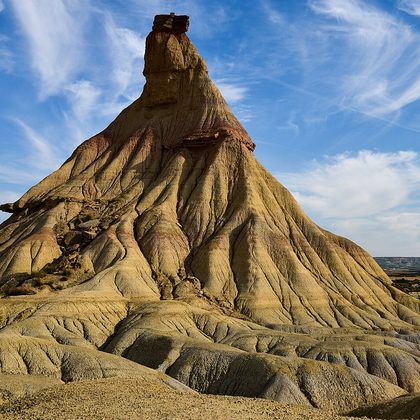
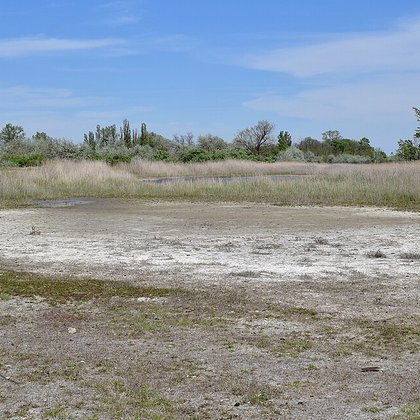
Flat, bare, soft-floored desert — emphatically not the rocks: sandy and silty semi-desert plains with scattered low saltbush, the margins of chotts and sebkhas, old river beds, hamada under a thin skin of gravel, and abandoned fallow at the desert edge. It needs diggable ground, because it excavates its own nest tunnel — often half a metre into a sand cone beneath a shrub — or takes over the burrow of a gerbil or jird. Almost always below a thousand metres.
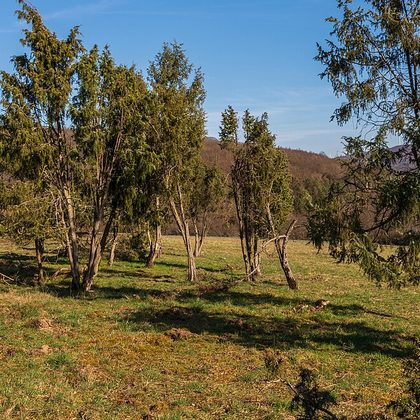
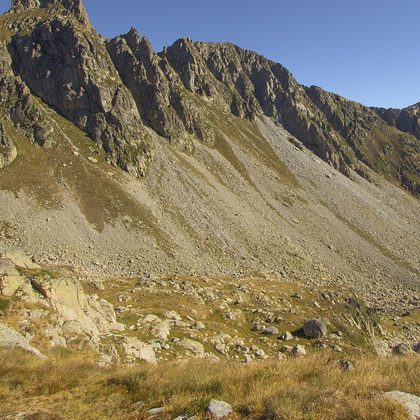
Where the bird is most at home, classified with EUNIS — the European standard for habitats.
Range and movements
The centre of gravity is the Maghreb: from the southern flank of the High Atlas and the Anti-Atlas in Morocco through the Saharan fringe of Algeria into southern Tunisia, and on east through Libya into Egypt. In the eastern part of the guide's area it is much scarcer: Israel and Jordan hold a small population in the north-western Negev and the Arava, and records there cluster strongly in the winter half of the year. Beyond the map the range continues across Syria and Iraq into northern Arabia and western Iran. It is resident, wandering within the plains outside the breeding season but not truly migratory.
- Resident
- Winter
- Passage
- dark = core range, pale = thinly spread
Where and when to look
March and April on the Tagdilt track near Boumalne Dadès in Morocco, or on the plains around Douz and Ksar Ghilène in Tunisia. Drive at walking pace across a gravel plain with scattered low shrubs and look for a heavy, big-headed bird that lifts off the ground and settles on a bush top. Flush it and use that one moment to check two things at once: is the tail wholly black, and is the rump rusty or creamy white? That closes the identification. If you find a pair, stay with them — the female, with her rusty-red head, is the finest thing the plain has to offer.
Conservation status
Not threatened globally: a large range from Morocco to Iran and a population regarded as stable, and locally common in the core of that range. The pressure is at the edges and is everywhere the same: semi-desert turned over to irrigated agriculture, overgrazing by outsized herds that removes the low shrubs it digs beneath, and roads and solar plants laid out on exactly the flat, bare ground it needs. In Israel and Jordan, at the eastern edge, the numbers run to tens or low hundreds of birds, and that small outpost is more fragile than the global assessment suggests.