All species › Passerines › Chats and flycatchers › Isabelline wheatear
Isabelline wheatear | Oenanthe isabellina
Izabeltapuit | Collalba isabel
Isabelline wheatear and the female northern wheatear are the hardest pair in the whole group: both pale, both sandy brown, both standing upright on a clod in bare country. Yet the Isabelline is a different bird — larger, longer-legged, plainer-faced and with far more black in a shorter tail. It is the wheatear of the steppe, from Turkey to Mongolia, and it nests in the burrows of susliks and gerbils.

Voice
The song is loud, hurried and lark-like, far more powerful than that of northern wheatear: it opens with a few croaking, clucking notes and runs on into a long series of clear whistles with a great deal of mimicry of other steppe birds, often in a high fluttering song flight that ends in a dive with the tail spread. The whistled, almost human notes that come through it are characteristic. The call is a loud whistled weet and a hard chak, with a curiously squeaky cheep near the nest. Heard from April into July.
No freely licensed recording is available for this species yet.
Identification
A large, heavy and strikingly long-legged wheatear with a big head and a short tail; the impression is of a pale, slightly top-heavy bird standing very upright and constantly bobbing and flicking its tail. The whole bird is uniformly sandy — upperparts, breast and flanks run into one another without contrast — and the wing is as pale as the mantle, because the wing feathers carry broad sandy fringes. One feather breaks the rule: the alula is dark and stands out as a small black mark against the pale wing. The face is plain, with dark lores, an eye-ring and a white supercilium that is most obvious in front of the eye. The bill is long, heavy and black, the legs long and black. The tail is short, with a white base and a broad black terminal band covering more than half of it, so that the white rump panel looks small. Underwing-coverts and axillaries are clean white. The sexes are alike.
Confusion species
It all turns on female and autumn northern wheatear — see its own species page, where the same difference is set out from the other side. Northern wheatear is smaller and shorter-legged, with a longer tail and a less upright stance. Its wing is clearly darker than the mantle — blackish-brown feathers with pale fringes — so the closed wing contrasts, and within it the alula does not stand out. Its supercilium is buff and broadest behind the eye, where the Isabelline's is white and strongest in front of it. The breast is warmer orange-buff on northern wheatear, uniformly sandy on Isabelline. The tail decides: on northern wheatear the black terminal band takes up about a quarter to a third of the tail and the white looks generous, on Isabelline more than half and the white looks mean. With the bird in the hand or on a good photograph, look at the axillaries: white on Isabelline, mottled grey on northern wheatear. Desert wheatear has an all-black tail. Western and eastern black-eared wheatear are smaller and slimmer, with far less black in the tail and, in the male, a black throat or a black ear patch.
Habitat
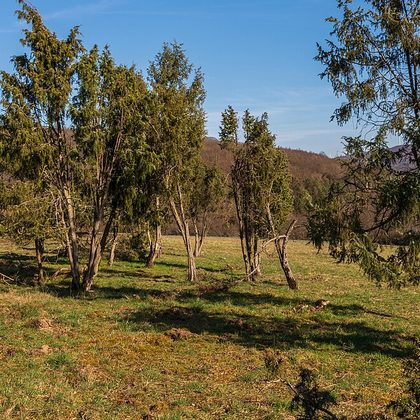
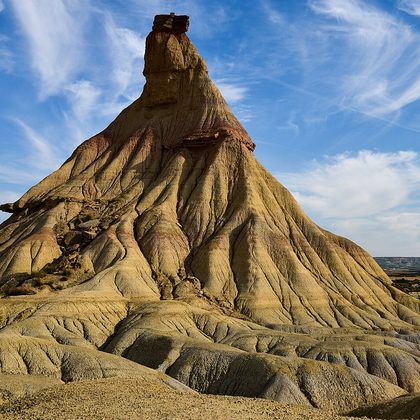
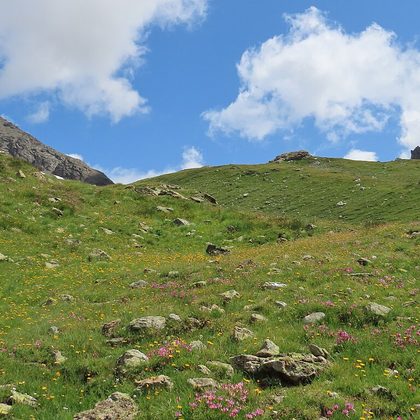
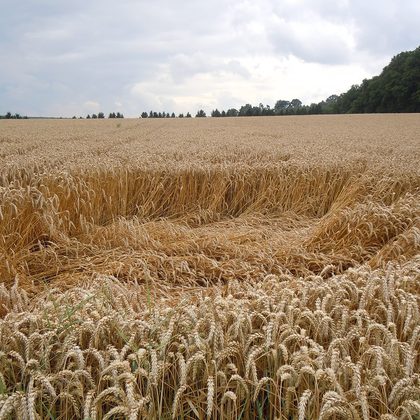
Dry, open, short-cropped plains: steppe and steppe grassland, semi-desert with scattered tussocks, stony plateaux and mountain steppe to above 3,000 m in Iran and Central Asia, heavily grazed pasture and fallow field margins. The nest choice is decisive: it almost always breeds in the burrow of a digging mammal — suslik, gerbil, hamster or jerboa — and not, as the other wheatears do, under a stone. Where the rodent colonies go, it goes with them.
Where the bird is most at home, classified with EUNIS — the European standard for habitats.
Range and movements
A breeding bird of the steppe belt, from south-east Europe and Turkey through the Caucasus, Iran and Central Asia to Mongolia and northern China. The western edge lies in Romania, Bulgaria, northern Greece and Ukraine, where it breeds locally and in fluctuating numbers; in Turkey and the Caucasus it is common. Every bird leaves the breeding range: they winter in the Sahel from Senegal to Ethiopia, on the Arabian Peninsula and in north-west India. To north-west Europe it comes as a rare vagrant, almost always in October and November, and then usually on bare fields and saltmarsh near the coast.
- Resident
- Breeding (summer)
- Winter
- Passage
- Migration direction
- dark = core range, pale = thinly spread
Where and when to look
May on the Anatolian plateau, around Sivas or Niğde for instance: drive a gravel road across the steppe and look for the bird standing bolt upright on a molehill or a rodent mound. It will often fly up first, sing its lark-like phrase and drop back with the tail spread — exactly the moment to see the broad black terminal band. With an autumn vagrant do the same: never mind the plumage, watch the proportions and the tail, and if need be wait until the bird lifts a wing and shows the white axillaries.
Conservation status
Not threatened: an enormous range, a large population and a stable trend overall. Regionally there is pressure. The ploughing of steppe and the persecution and decline of burrowing rodents take away its nest sites, while very extensive grazing helps it: grass that has grown tall is of no use to it. Along the western edge of the range, in south-east Europe, numbers are consequently small and erratic, while the core in Asia remains as strong as ever.