All species › Passerines › Chats and flycatchers › White-crowned wheatear
White-crowned wheatear | Oenanthe leucopyga
Witkruintapuit | Collalba yebélica
White-crowned wheatear is the black-and-white bird of the Sahara: on a boulder in a wadi, on the wall of a ksar or on the edge of a hotel terrace, and so little shy that it will almost walk over your feet. It sings all year, at first light, at dusk and on clear nights by moonlight as well.

Voice
A loud, varied and surprisingly musical song, far richer than that of most wheatears: clear whistles, rolling trills and snatches of mimicry of other desert birds, strung together into long phrases. It sings the whole year round, most freely at first light and again at sunset, and on clear nights in the dark as well. The call is a clear chee-weet and a hard, short chak.
No freely licensed recording is available for this species yet.
Identification
A large, slim wheatear of 17 to 18 cm, wholly glossy black. The adult wears a pure white crown that sits on the black head like a cap; first-year birds still have a black crown and gain the white only in their second calendar year. Rump and tail are white, with black restricted to the tips of the central tail feathers and a small black tip on the outer ones — there is no continuous terminal band, so the tail looks almost entirely white with a black line down the middle. The bill is long and black, the legs black, and the stance upright and long-legged.
Confusion species
Black wheatear is the real problem, and only in Morocco, Algeria and Tunisia, where the two live side by side. Black wheatear is never white-crowned, is duller and browner black, shorter-billed and heavier in build, and always shows a broad black terminal band right across the tail — the inverted T. If the black closes off the tail from edge to edge it is black wheatear; if the black stays a stripe down the middle it is White-crowned. The first-year White-crowned with its still-black crown is the bird that produces most of the mistakes, and there only the tail helps. Pied wheatear also has a white crown, but is much smaller, has white underparts and a clear black terminal band on the tail. Cyprus wheatear is small and buff below.
Habitat
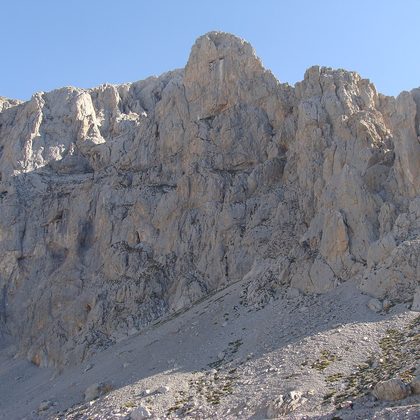
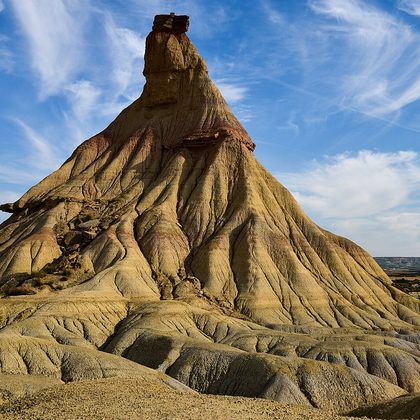
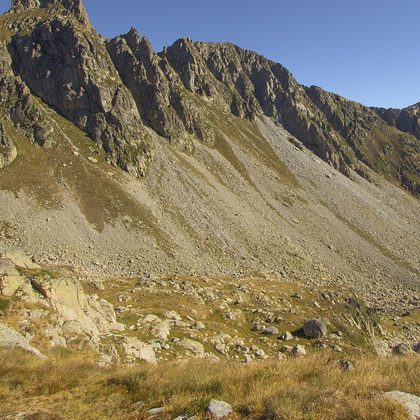
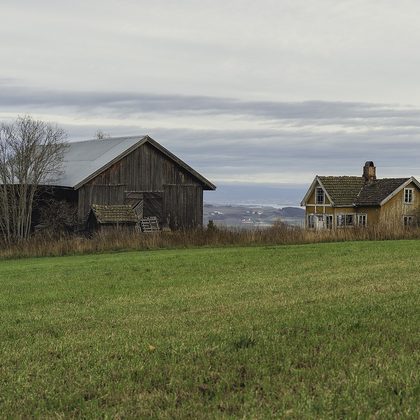
Rocky desert: hamada, boulder-strewn wadis, gorges and escarpments, scree at the foot of a jebel — anywhere with a crevice to nest in. Alongside that, and very characteristically, the built desert itself: ksour and kasbahs, ruins, the walls around palm gardens, filling stations and hotel terraces, where it finds insects, scraps and water. Bare drifting sand without rock or wall it avoids.
Where the bird is most at home, classified with EUNIS — the European standard for habitats.
Range and movements
Resident across the Sahara and Arabia: from Mauritania, Mali, Niger and Chad eastwards through southern Morocco, Algeria, Tunisia, Libya, Egypt and Sudan to Sinai, Israel, Jordan, the Arabian Peninsula and Iraq. Within the area of this guide it is therefore an ordinary breeding bird, from the Draa valley and Merzouga to the Negev and the Arava; the southern part of its range falls outside the map. It does not migrate, but wanders in dry years. In Europe it is an extremely rare vagrant, and for most records the question of escaped cage birds remains open.
- Resident
- Winter
- Passage
- dark = core range, pale = thinly spread
Where and when to look
In Israel the Makhtesh Ramon is the surest place: park at the crater rim and the birds come to you. In Morocco the Todra and Dades gorges work, or the village of Merzouga, where the bird sits on the garden walls. With any black wheatear-shaped bird, look first at the crown and then, above all, at the tail. Watch too for the display flight: the male climbs steeply, hangs for a moment and drops back with the white tail spread wide.
Conservation status
Not threatened. The species is widespread, numerous in suitable terrain and has gained from people: roads, wells, rubbish and buildings in the desert have provided new food and new nest sites, and along tarmac roads and around settlements it has locally increased. Disturbance of breeding cliffs by desert tourism and trapping for the cage-bird trade matter locally, but not on a scale that affects the population.