All species › Passerines › Chats and flycatchers › Siberian rubythroat
Siberian rubythroat | Calliope calliope
Roodkeelnachtegaal | Ruiseñor calíope
The Siberian rubythroat is a Siberian chat that pairs the size and stance of a Nightingale with a throat like a live coal. It breeds from the Urals to Kamchatka and Japan and winters in South-East Asia; within the map area it is a major rarity, with a scatter of records on the North Sea islands and along the Atlantic coast.

Voice
The song is a long, bubbling, highly varied stream of clear loud notes, rattles and whistles, with plenty of imitation mixed in; in volume it comes close to Nightingale, but it lacks the silences and so sounds more continuous. It is delivered from a bush top or a dead branch, often long after sunset. In western Europe you will almost always hear only the call, and that is the better character: a loud, disyllabic, rising hoo-eet that suggests a person whistling, and a deeper, grating tschack in alarm.
No freely licensed recording is available for this species yet.
Identification
Slightly smaller and more compact than a Nightingale, with long legs, a frequently cocked tail and an upright, wheatear-like carriage on the ground. Upperparts uniform olive-brown, wings and tail unmarked. The male has a brilliant red throat sharply framed by a black lore, a broad white supercilium and a white submoustachial stripe; breast and flanks are grey-brown, the belly off-white. The female lacks the red — or shows at most a pink wash — but keeps the distinctive head pattern of pale supercilium and pale moustachial, with a faint dusky breast band. First-autumn birds, which are precisely the ones that turn up in western Europe, are usually brown and marked as the female.
Confusion species
On head pattern there is little else to consider: no other chat in the area combines a white supercilium, a white submoustachial and a dark lore on a plain olive-brown bird. Nightingale and thrush nightingale are larger, longer-tailed and lack any head stripes. Female Bluethroat shows a rufous tail base with a dark terminal band, which Rubythroat never does — its tail is plain brown. A male Rubythroat and a red-spotted male Bluethroat are occasionally muddled on a poor photograph, but on Bluethroat the red sits in the middle of a blue shield, while on Rubythroat it covers the whole throat. With every record, weigh provenance too: the species is a widely kept cage bird in Asia, and a bird with damaged tail feathers, wear at the base of the bill or a ring of unfamiliar make deserves suspicion.
Habitat
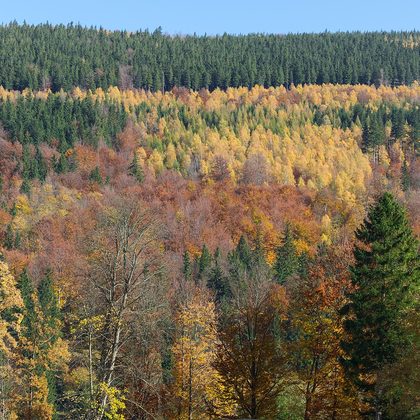
Breeds in the taiga: damp thickets in open coniferous and mixed forest, willow and birch growth along streams, rank clear-fell and bog margins, and higher up the subalpine scrub above the treeline. Everywhere the point is a dense low shrub layer over damp ground in which it forages on foot. In winter quarters it takes rank herbage, reed fringes, gardens and secondary scrub.
Where the bird is most at home, classified with EUNIS — the European standard for habitats.



Range and movements
Breeds from the western slope of the Urals — just outside the map area — eastwards across Siberia to Kamchatka, Sakhalin and Hokkaido, and south into the mountains of central China. Winters in South-East Asia, from India and Bangladesh to southern China, Thailand and the Philippines. Westward it is an outright vagrant: a few dozen records for the whole of Europe, heavily weighted to Shetland, Fair Isle, Heligoland and the Dutch and Belgian coast, and almost all in October. Britain's records are concentrated on the Northern Isles.
Where and when to look
Do not expect to find one in the map area; anyone who wants the species travels to Siberia or to an Asian wintering ground, where it is a common bird of rank cover and reed edges. If one does appear on a North Sea coast, treat it like any eastern skulker: look low in the densest sea buckthorn or elder, keep your distance and wait for it to come out to the edge to feed of its own accord. A bird driven into cover is gone for the rest of the day. Always support a claim with photographs of head and tail.
Conservation status
Not globally threatened (IUCN: Least Concern), with a vast range and a population regarded as stable. Trapping for the cage-bird trade does press on numbers locally, above all in China; that same trade is why a western record is assessed with some caution. Within the map area the species carries no conservation task of its own: it is and remains a guest.