All species › Birds of prey › Hawks, eagles and kites › Bonelli's eagle
Bonelli's eagle | Aquila fasciata
Havikarend | Águila perdicera
Bonelli's Eagle is the fastest hunter among Europe's eagles: a medium-sized, long-tailed raptor that races along cliff faces and takes partridges, pigeons and rabbits in full flight. Spain holds roughly two thirds of the European breeding pairs; beyond Iberia the species is scarce and local everywhere.

Voice
At the eyrie a yelping, high kyu-kyu-kyu in short runs, and when excited a hoarse, nasal kair that carries far along the cliff. Pairs call mainly during display from mid-January to March and whenever another raptor appears over the territory; outside the breeding season the species is virtually silent. Begging young give a persistent, plaintive pseeew in June and July.
Recording: Bubulcus — CC BY 3.0 · Wikimedia Commons
Identification
Clearly bigger than a Buzzard and bulkier than a Goshawk: a wingspan of 143 to 180 centimetres exceeds the Buzzard's (110–133) by half, and a female of nearly three kilos weighs twice what a female Goshawk does. It soars on flat, fairly long and straight wings, not in the shallow V of Buzzard and Golden Eagle, and glides with the fingers swept slightly back. Adults are white below with fine dark streaking, the dark underwing coverts forming a black band across the wing; above dark brown with a striking white to off-white patch on the mantle, visible at long range in good light. The tail is long — about as long as the wing is broad — pale grey with fine bars and one broad black terminal band. Juveniles look quite different: warm rufous to buff below and almost unstreaked, with a pale base to the primaries, a dark trailing edge to the wing, and as yet no broad tail band and no white mantle patch.
Confusion species
Size is the first filter: in wingspan Bonelli's Eagle is half again a Buzzard and appreciably larger than a Goshawk. Golden Eagle is larger still, soars in a distinct shallow V and as an adult is dark brown with a golden nape, never white below; young Golden Eagles show sharply defined white patches at the base of the primaries and a white tail base with a broad black terminal band, whereas in Bonelli's the tail base stays grey and only the terminal band is black. Buzzard is far smaller and more compact with a short broad tail, dark carpal patches and a pale U-shaped band across the breast. Goshawk is a woodland bird with a head that projects clearly ahead of the wings, a broad tail base and rounded tail corners, flying in series of three to five powerful beats and a long glide. The juvenile is the hardest: its rufous underparts suggest a pale-morph Booted Eagle, but that bird is far smaller, has white landing lights at the wing bend and a square-cut tail; and a Black Kite, which is slimmer and looser in flight, more uniformly dark, and has an obviously forked tail.
Habitat
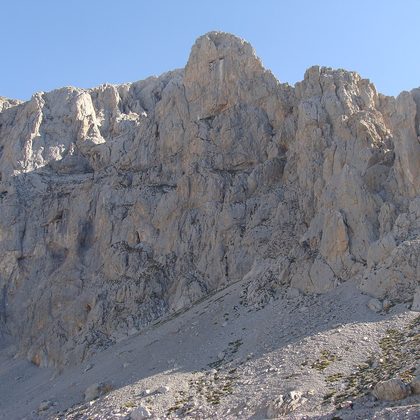
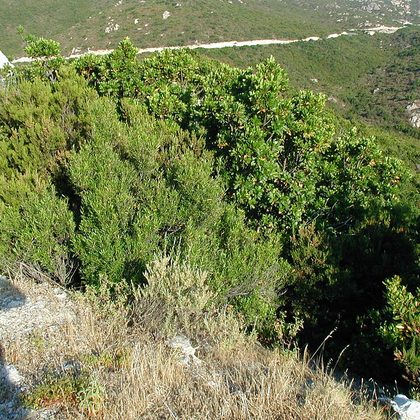
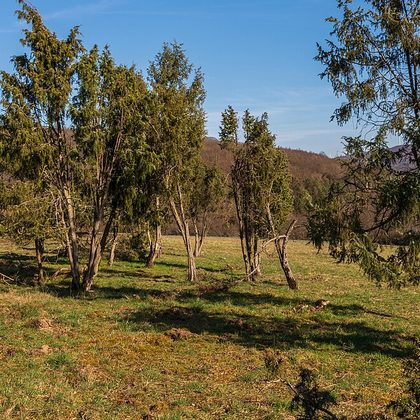
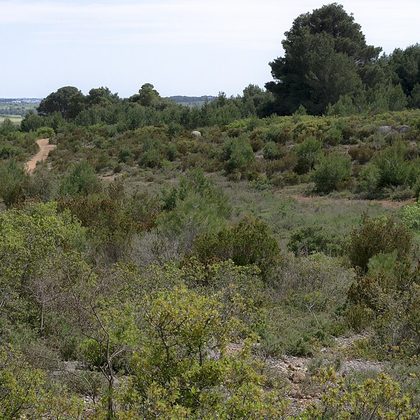
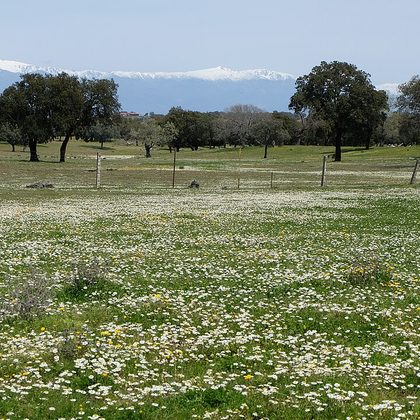
Warm, rocky hill and mountain country up to about 1500 metres: limestone walls and crags for the eyrie, surrounded by maquis, garrigue, holm oak woodland, dehesa and dry grassland for hunting. The diet is chiefly rabbits, partridges, pigeons and corvids, with the occasional hedgehog or lizard, usually taken in a low, fast attack just above the scrub. Immature birds spend their first years in open, prey-rich lowlands — arable land, steppe and broad river valleys — often tens of kilometres from any rock face.
Where the bird is most at home, classified with EUNIS — the European standard for habitats.
Range and movements
A breeding bird of the Mediterranean: Iberia by far the most pairs, then southern France, parts of Italy, Sicily, Sardinia, the Balkans, Greece, Turkey and the Middle East, plus north-west Africa. Beyond that it breeds on to India, southern China and the Lesser Sunda Islands, so its range extends well outside the map area. Resident, with only immature birds wandering; in the Netherlands it is an exceptional bird whose wild status is rarely certain, since the species is also kept by falconers.
- Resident
- Breeding (summer)
- Winter
- Passage
- Migration direction
- dark = core range, pale = thinly spread
Where and when to look
Mid-January to March, in the first hour after sunrise, when pairs display above their cliff: take a viewpoint facing a large limestone wall — El Chorro in Málaga, the Sierra de Grazalema, or Els Ports in Catalonia. Scan not only the sky but the wall itself, because hunting birds shoot along just above the scrub and are in view for only a few seconds. In winter it pays to work the open arable country where immature birds hang about.
Conservation status
Not globally threatened (IUCN: Least Concern), yet with about a thousand pairs one of Europe's scarcer raptors, and much reduced in Spain since the 1970s. Electrocution on medium-voltage pylons is the main cause of death among young birds, followed by illegal shooting and poisoning around shooting estates. Loss of hunting ground compounds it: the collapse of rabbit numbers through myxomatosis and viral haemorrhagic disease, the scrubbing over of abandoned fields, and disturbance of eyries by climbers, drones and wind farm construction. Insulating dangerous pylons has produced measurable gains in Andalusia and Catalonia. The species stood for a long time as Hieraaetus fasciatus and has been placed in the genus Aquila since 2014.