All species › Birds of prey › Hawks, eagles and kites › Levant sparrowhawk
Levant sparrowhawk | Tachyspiza brevipes
Balkansperwer | Gavilán griego
The Levant Sparrowhawk is the sparrowhawk of the Balkan river woods, a bird that travels in flocks and is otherwise seen briefly and high up. It has been placed in the genus Tachyspiza since the AviList checklist of 2025, alongside a long series of other small hawks formerly kept in Accipiter.

Voice
Noisy only around the nest, where the usual call is a sharp, clipped kee-wick, repeated at intervals and higher than any note a Goshawk gives. Excited birds run it into a fast ki-ki-ki-ki that recalls a Sparrowhawk but is thinner and less hard, and the female begs with a drawn-out peee-ah. On migration flocks travel in silence, so in most of Europe the species is seen and not heard.
No freely licensed recording is available for this species yet.
Identification
A small, slim hawk with a pointed hand: four fingers spread at the wingtip against five or six on a Eurasian Sparrowhawk, and a trailing edge that runs straight and flat instead of bulging. The adult male is pale blue-grey above with a grey hood reaching down over the cheek, and white below with barring so fine and rufous that at any distance the underparts simply read as white; the outer primaries are blackish and set a clean dark wedge against that white underwing. His eye is dark, blackish red, where a Eurasian Sparrowhawk's is yellow to orange-red. The adult female is browner grey above, more heavily barred below and shows a dark line down the centre of the white throat, which the male carries only faintly and the streaked brown juvenile shows clearly. The tail is grey with few bars, the central feathers almost plain, and the legs and the toes are short and yellow. The female is much larger and heavier than the male, so the figures above cover both sexes at once.
Confusion species
Sparrowhawk is the species it has to be separated from, and the male is the easier half of the job: the Levant has a pointed hand with four fingers, a straight trailing edge, underparts barred so lightly that they look white, a white underwing with a black tip, and a dark eye, while a male Sparrowhawk shows short broad rounded wings with five or six fingers, rufous cheeks, orange barring right across the underparts and an orange-red eye. The female Levant is the real problem: larger, browner above and much more heavily barred below, she looks far more like a Sparrowhawk than her mate does, and then the pointed hand, the flat trailing edge and the dark throat stripe are all you have. Goshawk is far bulkier, deep-chested, with a strongly projecting head, bulging secondaries and slower, deeper beats, and is never in a flock. The flight silhouette sits between Sparrowhawk and Hobby: the beats are faster, shallower and more even than the Sparrowhawk's flicking burst-and-glide, and the pointed hand and long arm hint at a falcon, but Hobby has longer scythe-shaped wings carried further back, dark streaked underparts and a black moustache. Be honest about the limit here. A single hawk drifting past in a mixed stream over a Greek ridge can rarely be named with certainty, and most Levant Sparrowhawks are claimed on a combination of date, flocking behaviour and one good view of the underwing rather than on any one feature.
Habitat
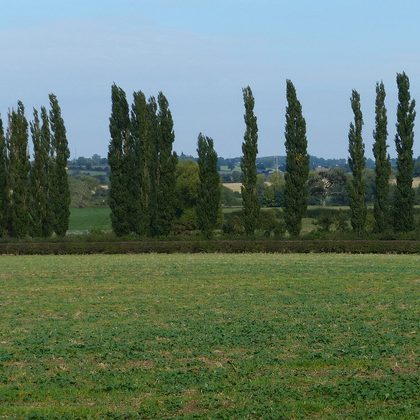
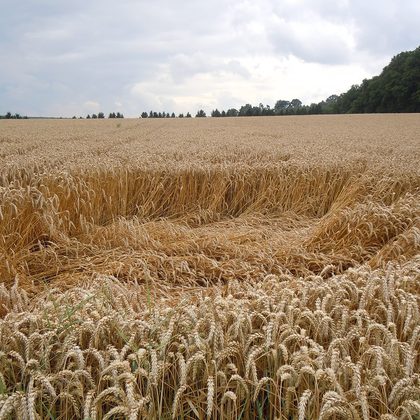
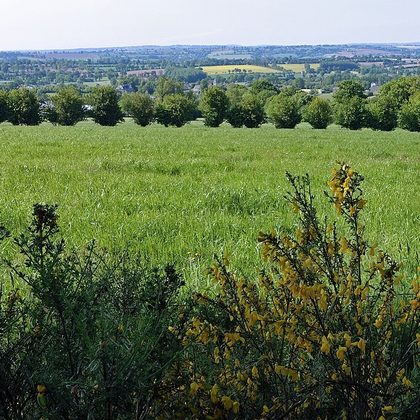
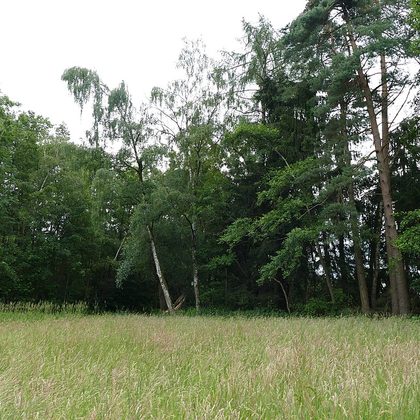
Lowland deciduous woodland, especially gallery forest along rivers and streams: oak, elm and poplar stands, old orchards, shelterbelts and lines of tall trees between fields. It nests in open woodland, at a wood edge or in an isolated clump of trees, usually close to running water, and hunts out over the surrounding farmland, dry grassland and rough field margins, taking lizards, large insects and small birds, often close to or on the ground.
Where the bird is most at home, classified with EUNIS — the European standard for habitats.

Range and movements
Breeds from north-eastern Greece and the Balkans east through Bulgaria, Romania, Moldova, Ukraine and southern Russia to the Caucasus, Turkey and northern Iran; BirdLife puts the European population at some 3,200 to 7,700 pairs, with the largest numbers in European Russia, Greece and Turkey. The whole species leaves in autumn and winters in north-east Africa, from Chad and Sudan to Ethiopia, which is why the breeding range is European and the winter range is not. Spring return runs up the eastern Mediterranean, where flocks over Israel can total tens of thousands, and autumn passage crosses the Bosphorus from mid-August to early October, peaking in the second half of September. West of the Balkans it is only a vagrant, and neither the Dutch nor the Spanish observer can expect it at home.
- Breeding (summer)
- Winter
- Passage
- Migration direction
- dark = core range, pale = thinly spread
Where and when to look
Two windows are worth travelling for. Late April and the first half of May in north-eastern Greece, in the Evros valley, around Dadia and in the Nestos delta, when returning birds come through in loose parties and pairs settle into the riverine woods; and the second half of September on the Asian side of the Bosphorus at Çamlıca in Istanbul, from mid-morning once the thermals build, when tens or hundreds cross together. Watch the shape of the flock rather than the individual bird: Levant Sparrowhawks travel and soar in groups, which migrating Eurasian Sparrowhawks do not.
Conservation status
Not globally threatened (IUCN: Least Concern), with a stable global population, although observers report lower numbers at several migration watchpoints. The main pressures are the clearance of riverine woodland, old orchards and field trees for intensive arable farming, the drying out of small watercourses in the breeding range, and illegal shooting of migrating raptors around the eastern Mediterranean. Pesticides that reduce lizards and large insects hit a hawk that takes much of its food on the ground harder than they hit a pure bird-catcher.