All species › Passerines › Swallows and martins › Brown-throated martin
Brown-throated martin | Riparia paludicola
Vale oeverzwaluw | Avión paludícola africano
Within the map area this small brown martin lives in Morocco alone, along the river plains of the Atlantic coast. It is a shade smaller than the sand martin and lacks the one mark that names that bird: the sharp breast band. Anyone watching a sand martin on the Souss or the Massa that somehow looks wrong should think of this species.

Voice
Softer and drier than sand martin, and far less rasping. Over the water it keeps up a thin continuous twitter of short chr-chr-chrit notes, which turns into a low conversational babble once a party settles. The alarm is a short hard chrrt. Colonies are small and the sound does not carry: at a Moroccan cut bank you hear the birds only once you are close.
No freely licensed recording is available for this species yet.
Identification
A small, uniformly dull brown martin with short broad wings and a short, barely notched tail. Throat and upper breast are dingy grey-brown and shade into the pale off-white belly without any border at all: no band, no clean edge, just a gradual lightening. The rump is brown like the back, the bill small and black, the legs brown. The whole bird looks duller and sandier than a sand martin, and in flight the striking things are how small it is and how short the tail. Flight is low, jerky and fluttering, often less than a metre above the water. Sexes alike; juveniles show pale feather edges on rump and wing coverts.
Confusion species
Everything turns on the throat. Sand martin has a white throat with a sharply drawn brown band below it; in brown-throated martin the throat itself is brown and there is no band. So do not ask whether a band is visible — on a juvenile or worn sand martin it can be faint and broken — but whether there is a pale throat above the breast. If there is not, the bird is settled. Pale crag martin, which may hunt the same Moroccan rivers, is clearly larger and heavier, has a square-cut tail with a row of small white spots, and keeps to cliffs and buildings rather than sandy banks. House martin always gives itself away by the white rump. Behaviour helps: brown-throated martin hangs low and restlessly over the water, while the crag martins sail along a rock face.
Habitat
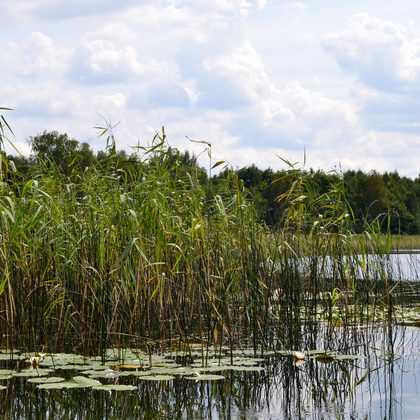
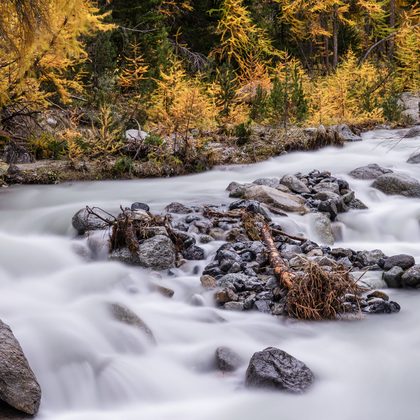
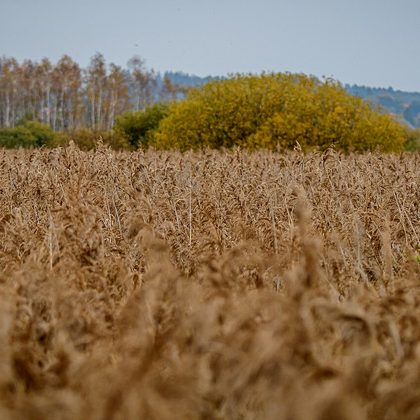
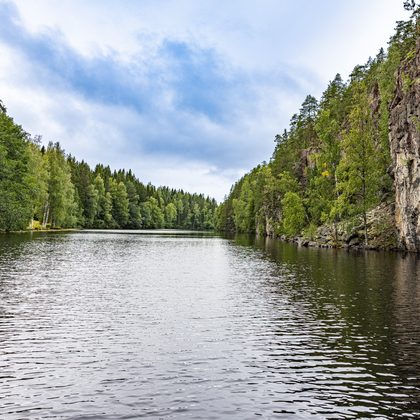
Sand and loam banks of lowland rivers, estuaries and lagoons, with open water, reed and irrigated fields to hunt over. The nest is a self-dug tunnel thirty to sixty centimetres long in a steep bank, usually in loose colonies of a few dozen pairs — far smaller than a sand martin colony. Where the bank is too low it will dig into an earth bund or the side of a ditch. It stays close to water; dry cut faces away from a river are of no use to it.
Where the bird is most at home, classified with EUNIS — the European standard for habitats.
Range and movements
Within the map area Morocco only, and there almost entirely in the Atlantic river plains: the lower courses and mouths of the Souss, the Massa, the Tensift, the Oum er-Rbia, the Sebou and the Loukkos. The birds are resident and outside the breeding season wander no further than from one estuary to the next. Beyond that this is an African species, from Senegal and Ethiopia to South Africa and Madagascar; the Asian birds are now counted as a separate species, which leaves the Moroccan population a long way from the rest of the range.
- Resident
- Winter
- Passage
- Migration direction
- dark = core range, pale = thinly spread
Where and when to look
The mouth of the Oued Souss at Agadir and the valley of the Oued Massa, early in the morning, from a bund or a bridge. Pick out the smallest martins fluttering just above the water and hold one in the binoculars until it turns towards you: one look then tells you whether there is a pale throat or not. Afterwards walk the cut bank and count the holes; the tunnels sit lower and closer together than in a northern colony.
Conservation status
Not globally threatened and common across its African range. The Moroccan population is small and confined to a handful of river systems, and those are exactly the places under pressure: sand extraction from the beds, the fixing and armouring of banks, water abstraction for horticulture and a run of dry years remove both the nesting faces and the insects over the water. Where an estuary is managed as a reserve, as at the Souss and the Massa, the species holds on.