All species › Passerines › Larks › Calandra lark
Calandra lark | Melanocorypha calandra
Kalanderleeuwerik | Calandria común
Europe's heaviest lark and the voice of the southern cereal plains: a thickset bird with a heavy bill and a black patch on each side of the neck, hanging over the fields in a maddeningly slow song flight and working half its neighbours' repertoire into its own song.

Voice
The song is a loud, fast, jangling stream of grating and whistled motifs, denser and harder than a Skylark's and shot through with mimicry: Quail, Stone-curlew, Lapwing, Bee-eater and even sheep bells turn up in it. It sings in a wide, slow song flight on strikingly deliberate, flapping wingbeats, or from a clod, a stone or a wire. The call is a dry, rolling, nasal chirrrp or a hard klitra that carries across the plain the moment a flock lifts. Song starts in late January and runs into June.
No freely licensed recording is available for this species yet.
Identification
Large and heavily built, with a big head, a short tail and a thick pale bill whose culmen is obviously curved. A bold black patch sits on each side of the lower neck, on old males so broad that it nearly forms a half-collar; above it a white throat, a pale supercilium and a dark loral stripe. Upperparts coarsely scaled brown, breast buff with vague streaks, belly white. The clinching view comes in flight: broad, triangular wings with a sooty-black underwing and a broad white trailing edge, and white sides to the tail. The flight is heavy and almost starling-like, quite unlike the hesitant flutter of a Skylark.
Confusion species
The confusion that matters is Bimaculated Lark — see its own species page, where the same difference is set out from the other side. That species lacks any white trailing edge to the wing, shows a greyish rather than sooty underwing, and has a dark tail with narrow white tips instead of white sides; its supercilium is crisper and flares behind the eye. A Calandra Lark without a white trailing edge does not exist, so that mark settles the case. Skylark is far smaller and lighter, thin-billed, with white outer tail feathers and no black neck patch. Short-toed and Lesser Short-toed Larks weigh barely a quarter as much and show at most a small dark smudge on the neck side.
Habitat
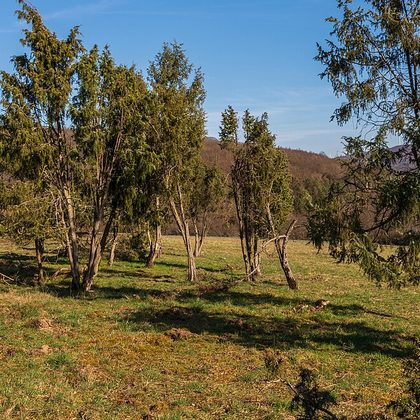
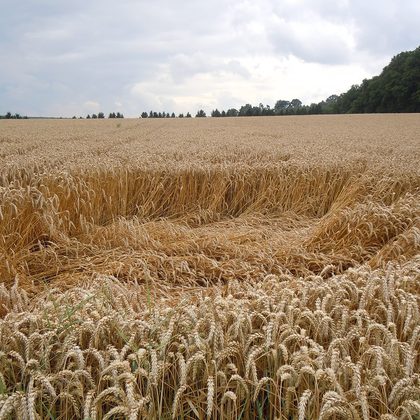
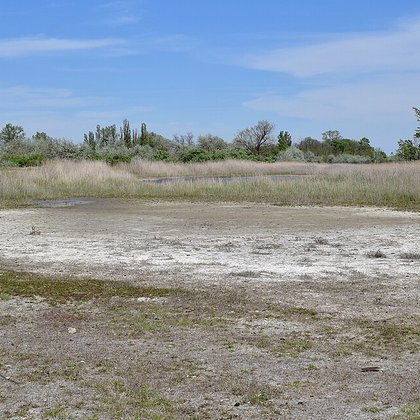
Large-scale, treeless, dry open country: unirrigated winter cereal, fallow, thistle fields and stubble, stony pseudo-steppe, and towards the east of the region also saline steppe around inland lakes. It wants space and a clear horizon, and ignores small, fragmented fields. The nest is a scrape on the ground under a tussock of corn or a low shrub, and the bird feeds by walking between the stems.
Where the bird is most at home, classified with EUNIS — the European standard for habitats.
Range and movements
From Portugal and Morocco east through the Mediterranean, the Balkans, Turkey and the Middle East into Central Asia. Spain holds by far the largest share of the European population, concentrated in Extremadura, Castile, Aragón and La Mancha; it also breeds on Sardinia and Sicily, in southern Italy, Greece, Bulgaria and Romania, with a small remnant in the Crau in southern France. North Africa holds good numbers from Morocco to Libya. In Britain and the Netherlands it is a vagrant, with a handful of accepted records, most of them in spring on islands and headlands.
- Resident
- Breeding (summer)
- Winter
- Passage
- Migration direction
- dark = core range, pale = thinly spread
Where and when to look
In April, drive a farm track across the Spanish secano at sunrise and switch the engine off: a singing Calandra Lark hangs over almost every field, and you will hear them long before you see them. Then find a flock on the ground and wait until it flushes — only then do you get the black underwing with its white trailing edge, and that is the mark that closes the case. In winter they sit in tight flocks of hundreds on stubble and along dirt roads.
Conservation status
Not globally threatened (LC), but going downhill fast in Europe. In Spain the species has lost tens of percent since the late 1990s through the switch from dry cereal to irrigated crops, the spread of intensive olive and almond plantations, the loss of fallow from the rotation and early mechanised harvesting that destroys nests. In France only a handful of pairs remain in the Crau, and it is thinning out in Italy and Greece too. Keeping it depends on keeping the extensive secano: fallow in the rotation, late harvest, no irrigation and no afforestation of the plain.