All species › Passerines › Larks › Dupont's lark
Dupont's lark | Chersophilus duponti
Duponts leeuwerik | Alondra ricotí
The bird you hear and do not see. Dupont's Lark sings from low shrub-steppe on the Spanish plateaux in the last dark hour before sunrise and is untraceable an hour later: it runs away silently between the bushes instead of flying. Anyone looking for it by daylight will walk past it ten times. It is also the most threatened steppe bird in Spain, and Spain holds almost the entire world population.

Voice
The only practical field mark. The song is a short, wistful, nasal phrase of a second or two: a few soft introductory notes followed by a drawn-out, upslurred, faintly whining ending, choo-choo-cherreee. It sounds lonely and slightly plaintive and carries remarkably far over bare ground. The Spanish name ricotí imitates that phrase. It sings from the ground among the bushes, where it stays invisible, and also in a high nocturnal song flight. The window is narrow: from roughly an hour before sunrise until shortly after, and to a lesser extent at dusk, peaking from February to May. By day it is all but silent.
No freely licensed recording is available for this species yet.
Identification
A lark that suggests a pipit or a small rail rather than a Skylark. Slim, long-legged and strikingly upright, with a short tail and a long, thin, clearly decurved bill with an orange-tinged base — no other European lark has such a bill. The head shows a broad creamy supercilium and a dark eye-stripe, finely streaked cheeks, and no crest at all. Upperparts sandy to greyish brown with dark feather centres; breast creamy white with crisp dark streaks continuing onto the flanks; belly unmarked white. The legs are long and pale. In flight — rare, and usually short — it shows narrow, pointed wings, white outer tail feathers and a surprisingly pale overall impression. It walks and runs with the body held horizontal and the head drawn in, and disappears behind the first bush.
Confusion species
Not really confusable with anything, provided the bill is seen. Crested and Thekla's Larks are shorter-legged, crested, and have a short straight-to-convex bill, and they walk away in the open rather than hiding. Skylark has a short crest, a white trailing edge to the wing and a much shorter, conical bill. Short-toed Lark is smaller, with a stout seed-eating bill and a dark neck patch. Tawny Pipit is slimmer, unstreaked below and has a thin, straight pipit bill. Behaviour counts as much as plumage here: a lark that ducks and runs between the shrubs of an open steppe and only reappears on top of a bush after a long wait is almost always this species.
Habitat
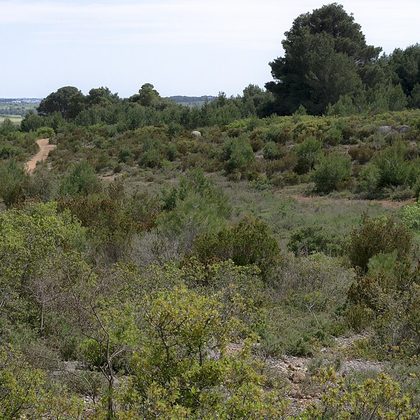
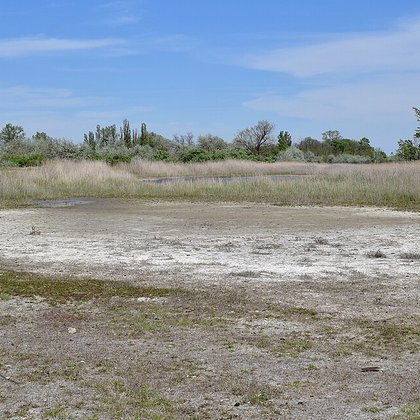
Flat to gently sloping shrub-steppe: a low, open shrub layer twenty to fifty centimetres high — thyme, broom, wormwood, saltbushes — with plenty of bare ground between the bushes, on gypsum, limestone and marl soils. In Spain chiefly on cold, windswept plateaux between nine hundred and thirteen hundred metres, and in the salt steppe of the Ebro valley. In North Africa in comparable wormwood and saltbush semi-desert, and further east in sandy desert steppe. Scrub taller than half a metre, or scrub that closes over, is useless to it, and so is ploughed ground: it needs the bare runways between the bushes in order to run and to feed.
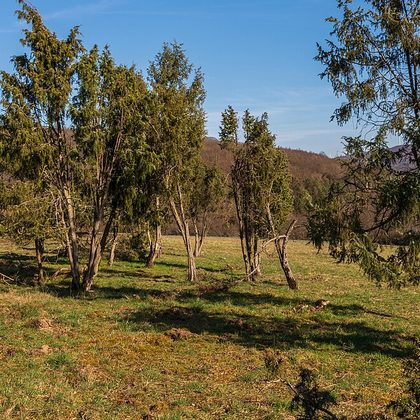
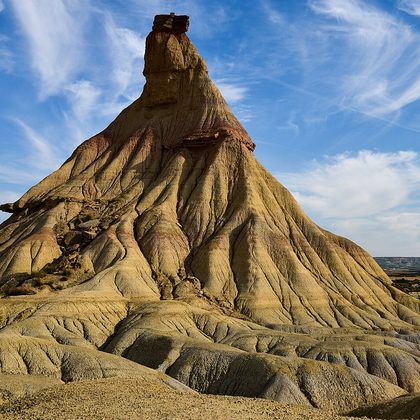
Where the bird is most at home, classified with EUNIS — the European standard for habitats.
Range and movements
Spain and North Africa, from Morocco east through Algeria, Tunisia and Libya to the western desert of Egypt; the entire world range lies inside the area covered by this guide. In Spain the centre of gravity is the plateaux of Soria, Zaragoza and Guadalajara, with further nuclei in Teruel, Burgos, Valladolid, Navarre, Albacete, Murcia and Almería. It is resident, only the highest and coldest plateaux emptying downhill in winter. It has gone as a breeding bird in Portugal, and it is hardly ever recorded away from its breeding ground.
- Winter
- Passage
- dark = core range, pale = thinly spread
Where and when to look
Get up in the dark. Drive out to a plateau with low scrub, park at a farm track, stay on that track and wait through the last hour before sunrise. Search with your ears first: the short whining ending carries hundreds of metres across the plain. Only as the light comes will you have a chance of a silhouette on top of a bush, and usually for a few seconds. Keep to the tracks, do not walk into the vegetation and do not use playback: this is a fragile species in small, isolated populations, and disturbance in the breeding season is not acceptable. February to May is the season, and a windless morning is a condition.
Conservation status
Vulnerable (VU) on the IUCN Red List, and rated a grade stricter still at national level. The most recent Spanish national survey arrived at roughly three thousand singing males, spread over more than two hundred small nuclei that have become separated from one another, many of them holding fewer than ten males; numbers are falling by a few per cent a year and nuclei that drop below a workable size wink out. The causes are all spatial: shrub-steppe ploughed up or planted with trees, wind and solar farms with their access roads and cabling placed on exactly the same flat, apparently empty ground, new farm tracks and quarrying, and steppe closing over where extensive sheep grazing has ended. Conservation needs large unbroken plains of low scrub, continued extensive grazing, and infrastructure kept out of the surviving nuclei.