All species › Passerines › Larks › Mediterranean short-toed lark
Mediterranean short-toed lark | Alaudala rufescens
Kleine kortteenleeuwerik | Terrera marismeña
The lark of salt and gravel: saltpans, saline flats and the bare lava plains of the eastern Canaries. Smaller, greyer and stubbier-billed than the Greater Short-toed Lark, and so exactly the colour of the ground that the hardest part is seeing it at all.

Voice
The call is a dry, rolling prrrit or chirrick, which also runs through the song and is the quickest way to separate it from its larger relative. The song is richer, more varied and more sustained than that of the Greater Short-toed Lark, full of mimicry, and is delivered in a climbing spiral or a high circling flight, sometimes from a low bush or from the ground. The season runs from February into June, and from January in the Canaries.
No freely licensed recording is available for this species yet.
Identification
Small, compact and dull sandy-grey, short-tailed, with a strikingly short, blunt, conical bill. The decisive mark is on the breast: a band of fine, crisp dark streaks right across the upper breast and onto the flanks — never a clean white breast. There is no dark patch on the side of the neck. Upperparts are brown to greyish-brown with broader dark streaks, and the finely streaked crown can be raised into a small peak when the bird is excited. The tertials are shorter than in the Greater Short-toed Lark, so three or more primary tips show on the closed wing. A narrow pale supercilium and a broad pale eye-ring give the face an open, startled look. Sexes alike; juveniles are spotted below.
Confusion species
Greater Short-toed Lark is the counterpart — its own page sets out the same difference from the other side. It is slightly larger, with a clean unstreaked white breast carrying a small dark patch at the side of the neck, a longer and more pointed bill, and much longer tertials that leave only one or two primary tips showing; western birds often have a rufous crown. Voice decides fastest: a dry rolling prrrit here, a short hard tick there. Crested Lark is much bigger and coarser, with a genuine spiky crest and buff tail sides. In the east of the region Turkestan Short-toed Lark is all but identical, and there it is geography rather than plumage that settles the question.
Habitat
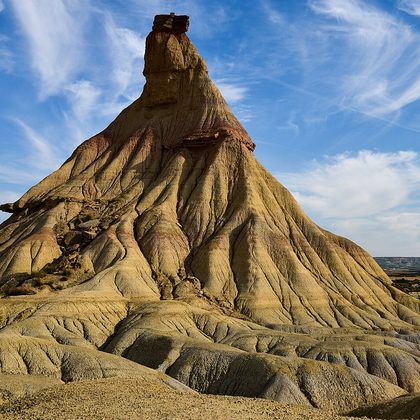
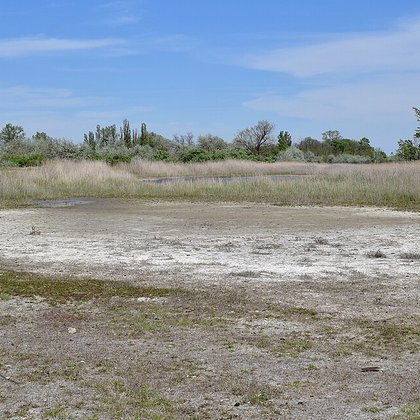
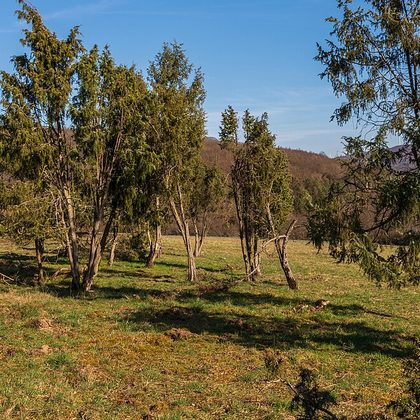
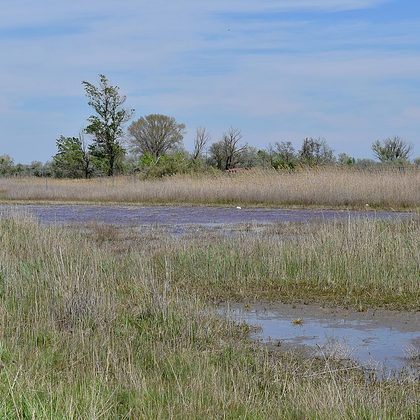
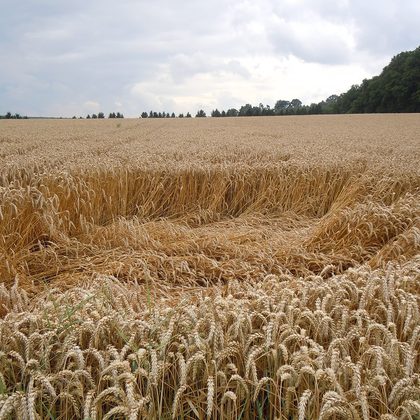
Drier and barer ground than the Greater Short-toed Lark will use: salt crusts and saline flats, the margins of saltpans and inland salt marsh, esparto steppe, gravel plains, and the bare malpaís and wind-blown sand of the eastern Canary Islands. Also stubble, fallow and waste ground, as long as the vegetation stays low and thin. It nests on the ground in a scrape among short dense grass or under a salt-tolerant plant.
Where the bird is most at home, classified with EUNIS — the European standard for habitats.
Range and movements
A species of the wider Mediterranean: eastern and southern Spain, the Canary Islands, North Africa from Morocco to the Nile delta, and from southern Turkey and the Levant to western Iraq. Its entire range therefore lies inside the area this guide covers. Western birds are resident; North African populations wander more widely. North of the Mediterranean it is a major rarity, with a scatter of records reaching Britain and Finland.
- Resident
- Winter
- Passage
- dark = core range, pale = thinly spread
Where and when to look
Look for it in winter or early spring on Fuerteventura or Lanzarote: drive out onto a gravel plain, stand still and wait for something to move — the bird is exactly the colour of the ground and usually gives itself away by its rolling prrrit before you see it. On the mainland the saline flats of Almería, Murcia and the Ebro valley are the best bet. Once you have it in the glass, look at the breast first: fine streaks across the whole upper breast and no dark neck patch.
Conservation status
Not globally threatened (LC), but the Spanish mainland population is fragile and has fallen back in many districts. The problem is always the same one: the saline flats and stony waste ground the bird depends on are turned into irrigated fields, greenhouses, solar farms or industrial estate, or they close over once grazing stops. On the Canaries it holds on across the bare plains, though building, off-road driving and irrigation nibble at the edges there too.