All species › Passerines › Larks › Turkestan short-toed lark
Turkestan short-toed lark | Alaudala heinei
Turkestaanse kortteenleeuwerik | Terrera turquestana
The eastern counterpart of the Mediterranean Short-toed Lark, from the Ukrainian steppe and the Anatolian salt flats east to Kazakhstan and Mongolia. It has been treated as a separate species since 2020, which at a stroke made it one of the hardest names on the Western Palearctic list: a bird that looks exactly like its western twin but lives thousands of kilometres away.

Voice
It sings mostly in flight, but also from a low perch or from the ground: a varied, melodious and long-sustained song that readily works in the calls of other birds. The usual call is a rolling prrrit or chirrick. The voice differs clearly from that of Greater Short-toed Lark and is the most reliable way to separate the two in the field — between Turkestan and Mediterranean Short-toed Lark, by contrast, sound is of little help.
No freely licensed recording is available for this species yet.
Identification
Small, short-tailed and sandy to warm rufous-brown, with broad dark streaks above that become finer towards the rump. The breast is white with a band of fine, distinct streaking; the flanks carry a faint rufous to cinnamon wash. There is no dark patch on the side of the neck. The bill is short and broad-based, horn-grey with a yellowish base to the lower mandible. Note the long wings with a fairly long primary projection, the rather short tail and the short hind claw. The small crown crest is raised only in excitement, and a narrow white supercilium sits above a broad pale eye-ring. Sexes alike; juveniles spotted below.
Confusion species
It is barely separable in the field from Mediterranean Short-toed Lark, which averages slightly paler and greyer with a slightly shorter primary projection; since the two ranges hardly meet, in practice it is where you are standing that decides. See the Mediterranean Short-toed Lark page, where the same pair is treated from the other side. Greater Short-toed Lark, which breeds alongside it, is larger, with a clean unstreaked breast and a dark neck patch, a longer primary projection, a smaller bill and a completely different voice. Asian Short-toed Lark (Alaudala cheleensis) further east is a shade larger and paler above, with more pointed wing tips and more white in the tail.
Habitat
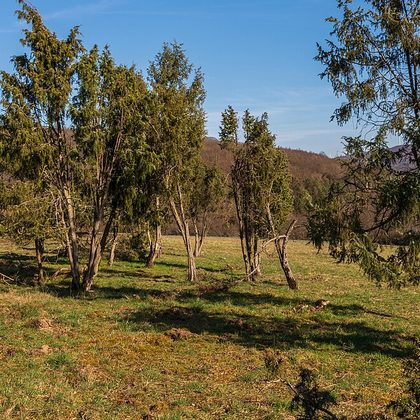
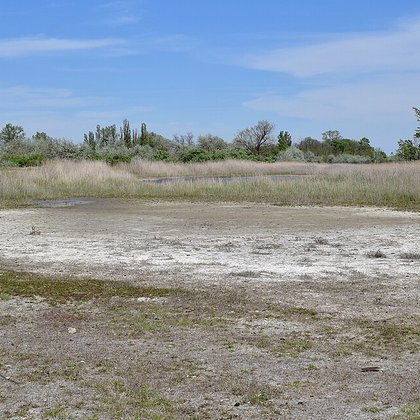
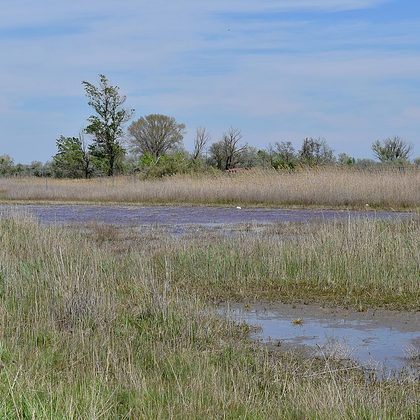
Open, half-bare plains with patchy grass and low scrub: dry steppe, salt steppe and saline meadows around inland lakes such as Tuz Gölü, sandy semi-desert and bare gravel flats. It feeds by walking over the open ground between the tussocks, and nests there too, in a scrape in the soil.
Where the bird is most at home, classified with EUNIS — the European standard for habitats.

Range and movements
From north-eastern Romania and southern Ukraine east through southern Russia and Kazakhstan to south-central Mongolia, and south through eastern and central Turkey, Transcaucasia and northern Iran to Iraq and southern Afghanistan. Within the area of this guide it is therefore an ordinary steppe breeding bird, but a large part of its range lies well beyond it. Northern birds winter in the Middle East and north-west India; Turkish birds are largely resident.
- Resident
- Winter
- Passage
- dark = core range, pale = thinly spread
Where and when to look
There is no shortcut: you have to go to the steppe. The easiest option is central Anatolia in May — the bare salt flats around Tuz Gölü, where the birds hang singing over the plain and feed among the salt-tolerant plants. In north-west Europe the species is an exceptional visitor and hardly ever safe on plumage alone; older records of 'Lesser Short-toed Lark' cannot all be assigned to one species or the other now that the pair has been split. Sound recordings, and where possible feathers for DNA, matter more here than photographs.
Conservation status
The IUCN assessed the species separately after the split and places it in the least concern category: the range is very large and numbers are high. The steppes it lives on are nonetheless under pressure from conversion to arable, from irrigation and from the shrinking of the salt lakes of Central Asia. Because it has only recently been counted apart, trend figures are almost non-existent; most of what is published under 'Lesser Short-toed Lark' refers to the western birds.