All species › Passerines › Leaf warblers › Canary Islands chiffchaff
Canary Islands chiffchaff | Phylloscopus canariensis
Canarische tjiftjaf | Mosquitero canario
From El Hierro to Gran Canaria this is the commonest small bird of every garden, every laurel wood and every barranco — and at the same time the hardest species in this guide to claim, because on plumage it is barely separable from common chiffchaff. It has been treated as a separate species since 1996, on the strength of genetic work and of the song. It is absent from Lanzarote and Fuerteventura: the eastern form has not been seen since 1986.

Voice
The song starts in December and runs into June: a short, hurried, slightly grating phrase of about a second, with varying notes and a falling end, repeated endlessly from a mid-height branch or a garden wall. A soft grunting note often comes first. The contact call is an upslurred tsu-eet, heard all year. When disturbed, a dry rapid rattle. In laurel forest the damp closed space amplifies the sound, so the song seems far bigger than the bird.
No freely licensed recording is available for this species yet.
Identification
A chiffchaff with everything a shade different. The upperparts are darker and browner, without the olive-green wash of a fresh common chiffchaff; the underparts are off-white with a warm buff-brown suffusion across breast sides and flanks instead of lemon yellow. The bill is longer and heavier, the wing point shorter — the primaries project only a little beyond the tail coverts — and the tail is proportionally longer, which gives the bird a more drawn-out, less rounded rear. Legs black, eye-ring narrow and pale, supercilium short and diffuse. Sexes alike. Do not look for it in one feature: it is the sum, and on a photograph with no place name nobody becomes sure of it.
Confusion species
The song settles it. Common chiffchaff counts out tirelessly and evenly, chiff-chaff-chiff-chaff, with a metronomic regularity; the Canary Islands chiffchaff does exactly the opposite. Its phrase is shorter, faster, harsher and more jumbled, a hurried run of three to six different notes that seems to tumble downwards — more an exclamation than a count, and never twice the same. The call differs too: where common chiffchaff gives a clean monosyllabic hweet, here you hear a fuller, slightly hoarser and often faintly disyllabic tsu-eet. That matters, because from October to March northern common chiffchaffs winter in the same gardens; silent birds are best left alone. Willow warbler is a scarce migrant on the islands, with pale legs and a longer wing point. Do not confuse it either with African blue tit, which has a boldly blue and yellow head, or with a young Atlantic canary, which carries a thick conical bill.
Habitat
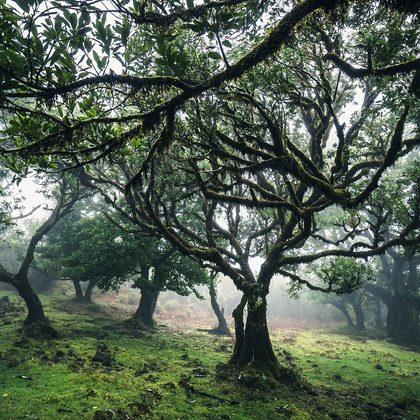
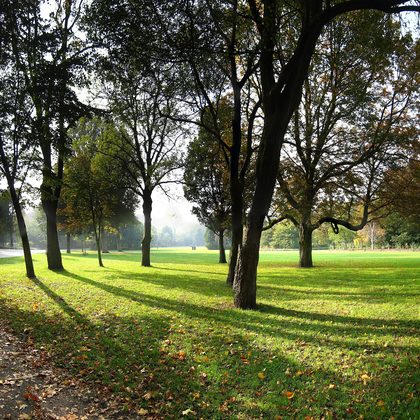
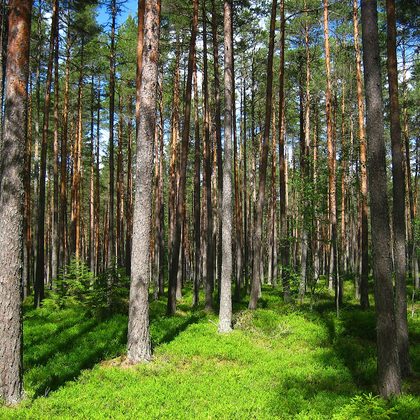
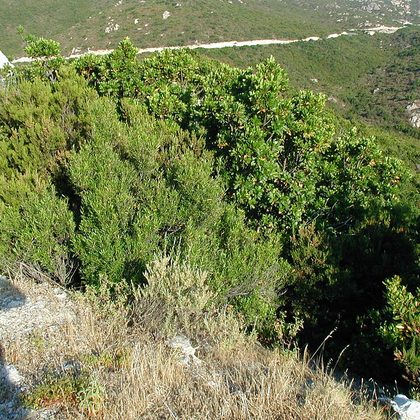
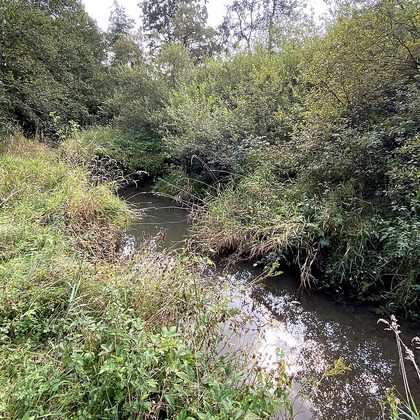
Almost anything green: laurel forest and tree-heath woodland on the northern slopes, Canary pine forest, gardens and town parks, market gardens and banana plantations, tall maquis, and above all the barrancos with their willows, tamarisks and reed fringes. It ranges from sea level up into the broom scrub above two thousand metres in the Cañadas del Teide. Only the driest spurge and cactus-spurge fields of the southern coasts are left alone. The nest is a domed structure with a side entrance, low in dense coastal scrub or high in a laurel tree.
Where the bird is most at home, classified with EUNIS — the European standard for habitats.
Range and movements
The five western Canary Islands: El Hierro, La Palma, La Gomera, Tenerife and Gran Canaria, where it is among the most numerous breeding birds. Lanzarote and Fuerteventura held a separate eastern form; it has not been recorded since 1986 and is regarded as extinct, so the species is now missing there. Outside the archipelago it does not occur, apart from the odd vagrant. It does not migrate and barely even crosses between islands.
- Resident
Where and when to look
Any hotel garden on Tenerife or Gran Canaria produces it within ten minutes, but for the song go to Anaga, the Monte del Agua or the Barranco de los Cernícalos in February or March: birds then sing every hundred metres and you hear at once how little regularity there is in it. Afterwards take your time over one bird feeding low in the scrub and watch the long bill and the short wing point. If you meet a silent chiffchaff in winter, log it as 'chiffchaff sp.' — that is honest, and on the islands entirely usual.
Conservation status
Not globally threatened and common to very common on the five western islands, with a stable population. It takes readily to gardens, parks and plantations and is therefore less vulnerable than most island birds. The cautionary example, though, lies next door: the birds of Lanzarote and Fuerteventura disappeared during the twentieth century, most likely through the loss of scrub and copses on those dry islands and through persistent drought. Keeping the laurel forest and the vegetated barrancos intact is the main measure for the rest of the population.