All species › Passerines › Leaf warblers › Mountain chiffchaff
Mountain chiffchaff | Phylloscopus sindianus
Bergtjiftjaf | Mosquitero montano
Mountain Chiffchaff is the chiffchaff of high mountains: within the area of this book a bird of the krummholz and willow scrub above the treeline in the Caucasus, and eastwards from the Elburz to the Himalaya. It looks like a chiffchaff with the green taken out; on voice it is unmistakably a species of its own.

Voice
The song resembles Chiffchaff's and is at the same time clearly separable from it. It is faster, harder and far more monotonous: a hurried run of short, sharp syllables almost all at the same pitch, chilp-chilp-chelp-chilp-chelp-chilp, without the unhurried, uneven alternation between a high and a low note that makes Chiffchaff so recognisable. Where Chiffchaff seems to be counting, Mountain Chiffchaff simply reels off. Phrases are longer, the tempo higher, and the pitch on average higher and broader in band. The call is the second and quickest character: a soft, flat to slightly descending, plaintive pseew or seeoo, thinner and sadder than the cheerful, rising hweet of Chiffchaff. Song runs from the return in April into July and peaks in the first half of June, when the snow has only just gone at these altitudes.
No freely licensed recording is available for this species yet.
Identification
Shape, size and behaviour are those of a Chiffchaff, but all the green and yellow has gone. The upperparts are warm grey-brown to sooty brown with no olive cast; the underparts are off-white with distinctly ochre, buff-brown flanks and breast sides. The supercilium is narrow, pale buff and diffuse, above a dark brown cheek, so the face reads brown and closed rather than green and open. Bill and legs are dark, the bill noticeably fine. The only colour in the plumage is under the wing, where the coverts glow pale yellow. The Caucasian form lorenzii is warmer and darker brown than eastern birds. The tail is dipped as in Chiffchaff but less emphatically. Sexes alike.
Confusion species
Common Chiffchaff is the yardstick and breeds in the same western Caucasian valleys, though lower down: it always shows olive-green tones in the mantle and wing edgings and yellow on the breast sides, where Mountain Chiffchaff is purely brown and ochre. Harder still is Siberian Chiffchaff, the form tristis, which passes through the Caucasus in autumn and is likewise grey-brown and buff; that bird has a paler and more contrasting supercilium, colder brown upperparts, often a green tinge in wing and rump, and a very different high, plaintive call. Western and Eastern Bonelli's Warblers are far whiter below, with a yellow rump and a yellow-green wing panel. When in doubt the rule is the same as for any chiffchaff: wait for the song.
Habitat
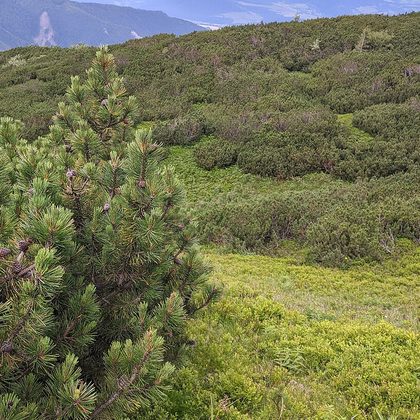
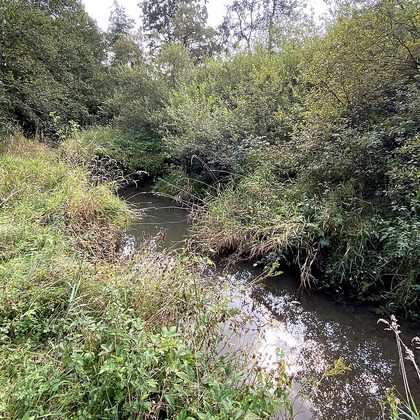
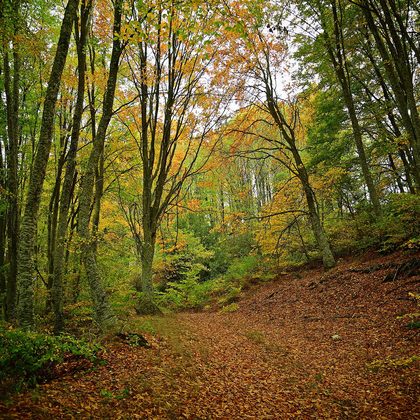
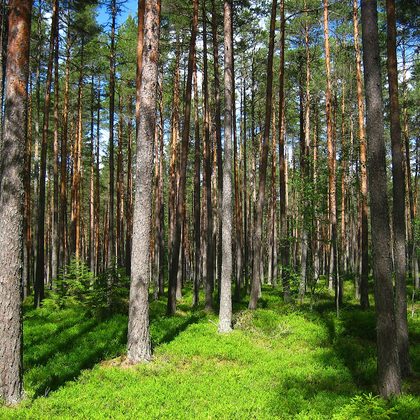
Subalpine krummholz and scrub between about 1,700 and 2,500 metres, locally higher: stunted birch with rhododendron at the upper forest edge, willow scrub along streams and snowmelt gullies, juniper thickets, and the thin margins of spruce and pine forest just below the treeline. Dense closed forest is avoided; this is a bird of the transition where woodland breaks into scrub. Outside the breeding season it drops to lower valleys, gardens and riverside thickets. Further east, beyond the area of this book, it uses the same structures in birch, willow, poplar and tamarisk well above 3,000 metres.
Where the bird is most at home, classified with EUNIS — the European standard for habitats.
Range and movements
Two widely separated blocks. Within the area of this book the subspecies lorenzii breeds in the Greater and Lesser Caucasus, in Georgia, Armenia, Azerbaijan and southern Russia, west into the Pontic mountains of north-east Turkey, and on into the Elburz of northern Iran. Most of the world range, however, lies outside the area: the nominate sindianus breeds in the Pamirs, the Tien Shan and the western Himalaya, into Pakistan, northern India and western China. The species is chiefly an altitudinal migrant, Caucasian birds dropping to the valleys of Transcaucasia and northern Iran in winter and eastern birds to the plains of Pakistan and northern India. It has never been recorded in north-west Europe.
- Breeding (summer)
- Passage
- dark = core range, pale = thinly spread
Where and when to look
The first half of June, in Georgia or Armenia, at the height where spruce or birch forest gives way to rhododendron and willow — Kazbegi, Svaneti, Lagodekhi, or the hills around Lake Sevan. Walk a stream upwards past the treeline and listen: the hurried, flat rattle stands out at once against the Chiffchaffs singing lower down the valley, which gives you both species for comparison in a single morning. The birds feed low in the willows and, unlike most leaf warblers, are easy to watch. Look for the ochre flanks and the complete absence of green.
Conservation status
Not threatened; the range is large and the species is common through most of it. In the Caucasus, though, the breeding zone is a narrow altitudinal belt, and warming is pushing that belt upward, so the available scrub will shrink in the longer run. Heavy sheep and cattle grazing thins the subalpine willow and rhododendron badly in places; where grazing stays moderate the bird is numerous.