All species › Passerines › Leaf warblers › Willow warbler
Willow warbler
Phylloscopus trochilus | Fitis | Mosquitero musical
The Willow Warbler is the Chiffchaff's twin and the commonest summer bird of young birch and willow scrub. Silent, it is a puzzle; singing, it produces one of the loveliest sounds of spring: a soft, descending phrase that fades away like a sigh.

Voice
The song is the definitive character and one of the purest sounds of the European spring: a phrase of two to three seconds that starts high and hesitantly with a few loose notes, swells, and then descends steadily to die away in a fuller, wistful closing flourish — see-see-swee-swee-swoi-swoi-swoo-swoo-swuu. Every phrase ends lower than it began, and that falling shape is exactly the opposite of the Chiffchaff's bouncing chiff-chaff. Five to ten seconds of silence separates one phrase from the next. The call is a soft, disyllabic, upslurred hoo-eet, weaker and more drawn out than the Chiffchaff's, and it carries through scrub all autumn. Song runs from mid-April into early July, at its densest in the last week of April and the first half of May, when birds sing almost continuously from sunrise until mid-morning; after mid-July it stops.
Recording: Zdeněk Vermouzek — CC BY-SA 4.0 · Wikimedia Commons
Identification
Slim and elongated, olive-green above with a sulphur wash on throat and breast, and a long, sharply defined yellowish-white supercilium running well behind the eye. The legs are pale — flesh, yellow-brown or orange-brown — and at any distance that is the first thing to register. The primary projection is long, about two-thirds the length of the tertials, so the wingtip reaches far down the tail base. The tail is not flicked downwards, at most swung sideways. Fresh autumn birds are strikingly yellow; northern birds of the form acredula are greyer and duller white below.
Confusion species
Chiffchaff is the only genuine confusion species, and four features settle it: leg colour (Willow Warbler pale flesh, Chiffchaff dark to black), primary projection (long in Willow Warbler, short and stubby in Chiffchaff), supercilium (long, yellow and crisp in Willow Warbler, short and diffuse over a dark eye-stripe in Chiffchaff) and behaviour (Chiffchaff constantly dips its tail downwards, Willow Warbler does not). The voice remains decisive: Willow Warbler gives a soft, disyllabic rising hoo-eet, Chiffchaff a monosyllabic, sharper hweet. Beware: a minority of Willow Warblers have dark legs. Wood Warbler is bigger, with a bright yellow throat against a snow-white belly and an even longer wingtip. Yellow-browed Warbler shows a bold wing bar.
Habitat
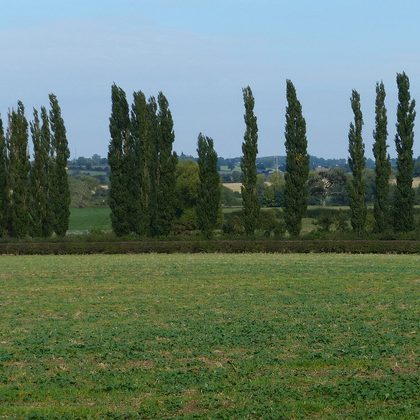
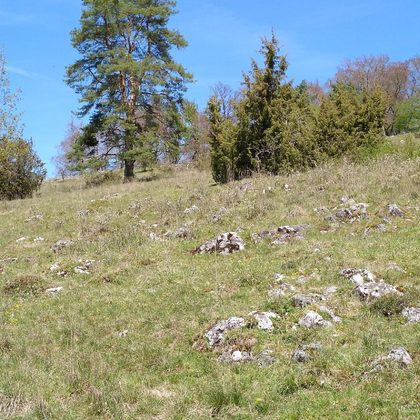
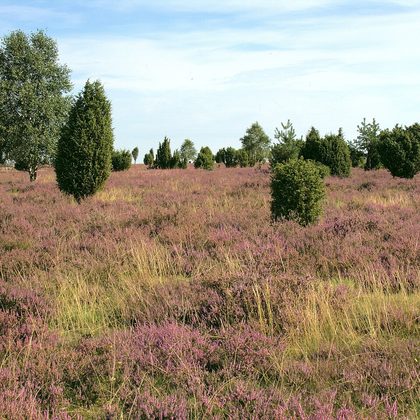
Young, open broadleaved woodland and above all structured scrub: birch regrowth on heathland, willow carr in dune slacks and along streams, clear-fells, young plantations, hedgebanks, rank woodland edges and marshy thickets. Unlike Chiffchaff it avoids tall closed-canopy wood. The nest is a domed ball on the ground in rough grass. On migration it turns up in almost any bush, including gardens, sea buckthorn and olive groves.
Where the bird is most at home, classified with EUNIS — the European standard for habitats.

Range and movements
Breeds from Ireland to eastern Siberia and winters entirely south of the Sahara. In the Netherlands it is one of the commonest breeding birds of dune, heath and stream valley, with tens of thousands of pairs; arrival begins in early April and the last birds pass through in mid-September. In Spain it breeds only very locally in the north, in the Cantabrian mountains and the Pyrenees, but in August and September huge numbers stream through the whole country on their way to Africa, filling every patch of scrub down to the ramblas of the south.
- Breeding (summer)
- Passage
- Migration direction
- dark = core range, pale = thinly spread
Where and when to look
The last week of April, in birch or willow scrub on a heath or in a damp dune slack, between sunrise and about nine. Deliberately pick out a bird feeding low, look at the legs first and the plumage second: with this pair, leg colour is read faster than anything else. In September a migrant thicket behind the foredune repays a visit, with Willow Warblers and Chiffchaffs feeding side by side so that primary projection can be compared directly.
Conservation status
Not threatened, with a very large world population. Within Europe, though, a clear divide runs through it: numbers are stable or rising in the north and east, while the species has declined since the 1980s in southern England, Belgium and parts of the Netherlands and Germany. Drying out of scrub, the loss of young regrowth to succession or to clearance, and conditions in the African wintering grounds are all cited as causes.