All species › Passerines › Leaf warblers › Wood warbler
Wood warbler
Phylloscopus sibilatrix | Fluiter | Mosquitero silbador
The Wood Warbler is the largest and the handsomest of our leaf warblers, and the only one tied entirely to mature closed broadleaved woodland. Stand under the beeches in mid-May and hear that accelerating trill roll away between the trunks, and you never forget it.

Voice
Wood Warbler has two entirely separate song types and mixes them freely. The first opens with a few loose ticking notes that follow each other faster and faster until they fuse into a shivering trill: sip … sip … sip-sip-sip-sip-sipsipsip-srrrrrrrrrr. It sounds exactly like a coin set spinning on a marble table top — separate taps at first, then a whirring rush that dies away. The whole phrase takes three to four seconds and is often delivered in a short display flight, wings quivering, from branch to branch. The second type stands apart: a series of four to eight identical, plaintive, drawn-out whistles, peeu … peeu … peeu … peeu, each sounding a little sadder than the last, with half a second of silence between them. The call is a soft, rather flat weet, and an alarmed bird gives a hard tik. Song runs from the last days of April into early July, peaks in the first two weeks of May, and continues all day, including the midday hours when the rest of the wood falls silent.
Recording: Benoît Van Hecke — CC BY-SA 4.0 · Wikimedia Commons
Identification
Large and elongated for a leaf warbler, with a short tail and very long wings: the primary projection about equals the length of the tertials and the wingtip falls well down the tail. The plumage is built in three bands that show at a distance: bright yellow-green above, vivid yellow on supercilium, throat and upper breast, and below that an abrupt snow white. The supercilium is long, broad and lemon, with a dark eye-stripe beneath it. Coverts and tertials are fringed green-yellow, giving the wing a warm glow; the legs are pale flesh to yellow-brown. Sexes alike.
Confusion species
Willow Warbler is smaller and far less contrasting: its yellow bleeds diffusely onto the flanks, while Wood Warbler shows a sharp border between yellow breast and white belly, and Wood Warbler has a longer primary projection and a shorter tail. Chiffchaff is compact, dark-legged and has no yellow throat. Western Bonelli's Warbler, in the Pyrenees and northern Spain, is grey-green with no yellow on throat or breast, has a yellow rump and a yellow-green wing panel, and a completely different rattling song. Yellow-browed Warbler is much smaller and shows two clear wing bars.
Habitat
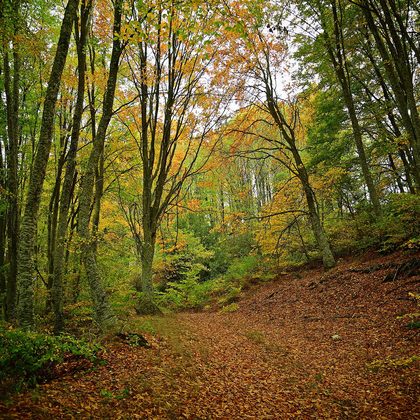
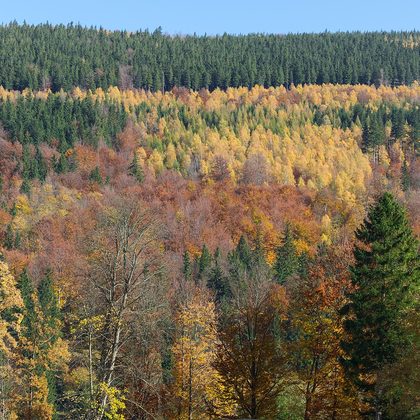
Mature, tall, closed broadleaved woodland with an open, almost bare floor: beech woods on slopes, old oak woods and beech-oak stands on poor sandy soils. The absence of a dense shrub layer is essential, because the bird sings and feeds in the free space between canopy and ground and builds its domed nest in the leaf litter. Slope woodland and stands of old, smooth-barked beech are preferred; young plantations and thickly overgrown edges are avoided.
Where the bird is most at home, classified with EUNIS — the European standard for habitats.
Range and movements
Breeds from northern Spain and the Pyrenees to the Urals and winters in the humid forests of equatorial Africa. In the Netherlands it is a scarce breeder of at most a few hundred pairs, concentrated on the Veluwe, in Drenthe, on the Utrechtse Heuvelrug and in the slope woods of southern Limburg, and much reduced over recent decades. In Spain it breeds only in the north, in the beech woods of Navarre, the Pyrenees and the Cantabrian mountains, and is otherwise chiefly a passage migrant filtering through the country in small numbers in August and September.
- Resident
- Breeding (summer)
- Passage
- Migration direction
- dark = core range, pale = thinly spread
Where and when to look
Mid-May, in an old beech wood with a bare floor, preferably on a slope; walk slowly and stop the moment you hear the first trill. Unlike most songbirds, this one does not require a dawn start: the Wood Warbler sings deep into the morning and even through the middle of the day. Look for the bird between eye level and about ten metres up, on a horizontal side branch, and listen for the plaintive peeu, which often comes from a different bird further off and so betrays a second territory. Southern Limburg and the old beech compartments of the Veluwe are the best places in the Netherlands.
Conservation status
Globally not threatened, but the European trend is clearly negative and the decline in north-west Europe is steep; in the Netherlands the species is red-listed. A thickening shrub layer driven by nitrogen deposition, the loss of old layered broadleaved woodland, drying soils and changes in the African wintering grounds are seen as the main causes. Strong year-to-year swings tied to caterpillar abundance are normal for the species.