All species › Gamebirds › Pheasants and partridges › Caucasian grouse
Caucasian grouse
Lyrurus mlokosiewiczi | Kaukasisch korhoen | Gallo lira caucásico
A grouse found nowhere but the Caucasus, tied to the narrow band between the last birches and the alpine turf. Its lek is nearly silent: no bubbling as in Black Grouse, but leaps in which the cock claps himself into the air.

Voice
The quietest display of any European grouse. The cock is all but mute, and what carries is mechanical: a thin whistling rush of the primaries as he springs half a metre straight up, turns in the air and briefly flashes the white underwing. Around that there is soft muttering and a hiss that is lost at ten metres. Hens give a cackling kok-kok-kok when alarmed. Five to a dozen cocks gather on south-facing slopes, exceptionally up to thirty, from late April into June, at first light and again at dusk.
No freely licensed recording is available for this species yet.
Identification
The cock is matt black without blue gloss, with a small red wattle, a long, deeply forked tail whose tips curve downwards and inwards, and a small white spot at the bend of the wing that shows only as he takes off. White undertail coverts and a white wing bar are entirely absent. The hen is grey-brown with fine, dense dark vermiculation, smaller and colder-toned than a greyhen, with a short forked tail. Hens measure 37–42 cm, cocks 50–55 cm.
Confusion species
Black Grouse is the only real pitfall, though the two ranges do not meet: Lyrurus tetrix is absent from the Caucasus, so the confusion is one of photographs rather than fieldwork. A blackcock is glossy blue-black, shows bright white undertail coverts and a broad white wing bar, and carries a lyre tail with the tips curling outwards; the Caucasian cock is matt black, lacks both white features, and holds his longer tail tips down. Females separate on size and pattern: the Caucasian hen is distinctly smaller and more finely vermiculated, the greyhen larger, more coarsely barred and with a white wing bar.
Habitat
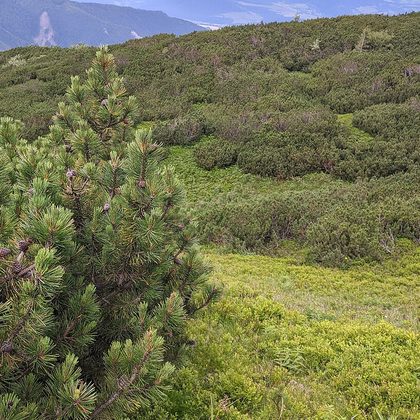
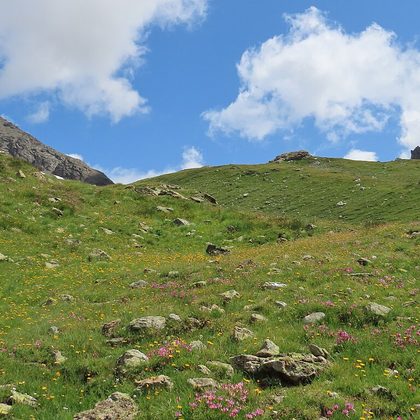
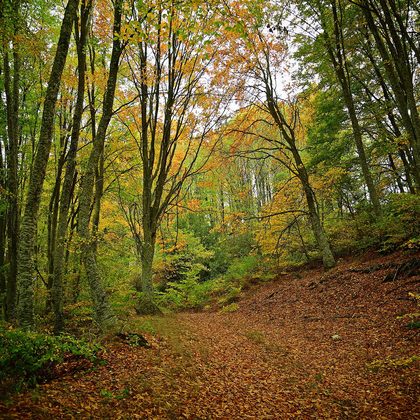
The treeline belt between roughly 1,500 and 3,000 m: subalpine and alpine meadow threaded with low rhododendron, juniper and wild rose, over stunted birch and the upper edge of the broadleaved forest. Cocks lek on short herb-rich slopes and hens nest in the scrub. In winter the birds drop to around 1,500 m and sometimes lower, living on birch buds and juniper berries.
Where the bird is most at home, classified with EUNIS — the European standard for habitats.
Range and movements
Endemic to the Caucasus, occurring in Russia's North Caucasus, Georgia, Azerbaijan and Armenia, in north-east Turkey along the Pontic range, and in small numbers in north-west Iran. The total range covers only a few tens of thousands of square kilometres and is heavily fragmented; the world population is put at a few tens of thousands of birds.
- Passage
- dark = core range, pale = thinly spread
Where and when to look
Kazbegi in Georgia is the standard site. In May or June walk up the road towards Gergeti or the track into the Sno valley well before sunrise, and scan the slopes above the last birches from a high vantage point. You are looking for black dots that suddenly jump half a metre: without a scope you will not pick them up. Arrive early, sit still, and do not work your way up the slope towards the birds.
Conservation status
Near Threatened and slowly declining. The main pressure is overgrazing of subalpine meadow by sheep and cattle, which strips out the herb layer where chicks find insects; add mowing during the breeding season, poaching, shepherds' dogs taking nests, and ski and road development inside the lek zone. Protected areas cover only part of the range.