All species › Passerines › Crows and jays › Daurian jackdaw
Daurian jackdaw | Coloeus dauuricus
Daurische kauw | Grajilla dáurica
The Daurian Jackdaw is the East Asian counterpart of the familiar Jackdaw: the same size, the same sociability, the same clipped voice, but adults wear a startling black-and-white suit. It breeds from southern eastern Siberia and Mongolia deep into China, and in western Europe it is about as rare as a bird gets — a handful of records in a century and a half, from Finland, Sweden, Denmark, France and the Netherlands.

Voice
Jackdaw-like but shorter and sharper: a clipped, high chak, given in series and with plenty of variation, plus a more drawn-out kyeh and kee-ya. A flock over a village or a field keeps up a running chatter. For a western European observer the voice is not a usable identification feature — the differences from Jackdaw are small and the risk of hearing what you expect is not.
No freely licensed recording is available for this species yet.
Identification
In build and size a jackdaw: compact, short-billed, with quick wingbeats and a brisk, upright walk. The adult plumage is unmistakable. Forehead, crown, lores, chin and throat are glossy black, as are mantle, wings and tail, while the neck, hindneck and the whole underside from breast to belly are creamy white, so that a broad pale collar wraps around the black head. The border between the black bib and the white body is sharp. The black runs back from the crown across the ear coverts, setting a dark patch in the middle of that white; behind and above it the neck is finely streaked silver. The eye is dark, close to black. Young birds look entirely different: largely dull black with a greyish cast and some white flecking on the breast, and after the first moult mostly black, developing fine silvery head streaking later in the winter.
Confusion species
Jackdaw is the only real confusion species, and with an adult there is no problem: Jackdaw has a grey nape worn like a hood around a black crown and an otherwise dark slate-grey body, while Daurian Jackdaw has creamy white neck, nape and underparts cut off sharply against a black bib. The eye settles it where the plumage does not: Jackdaw's is bright silvery-white to pale blue-grey, the Daurian's dark, almost black. The hard birds are dark juveniles and first-winters, which are largely black; then look for the dark eye, the glossy black throat contrasting with a slightly paler upper breast, the dark nape without a grey hood, and later in winter the fine silvery streaking on the head. Carrion Crow is much larger and heavier, plain black, with a thick curved bill and far slower wingbeats. Any pale-bellied jackdaw deserves a second look for another reason too: partially white Jackdaws occur, but their white is irregular and lacks the sharp, symmetrical border of the real thing.
Habitat
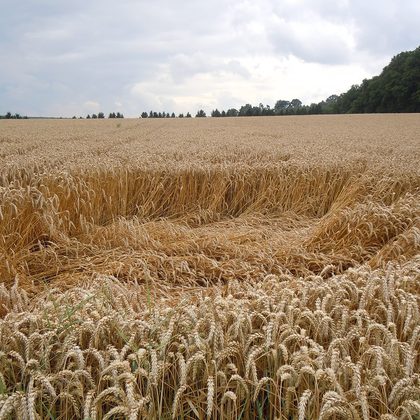
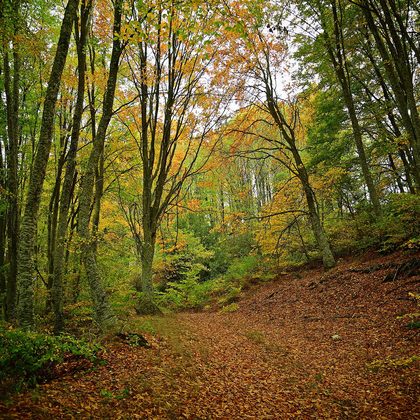
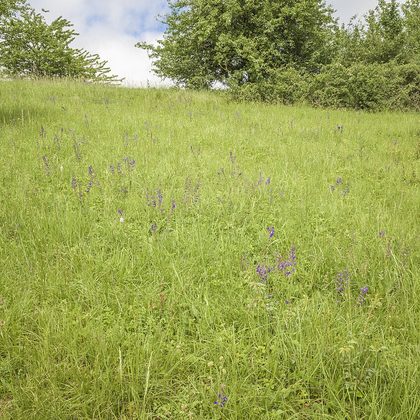
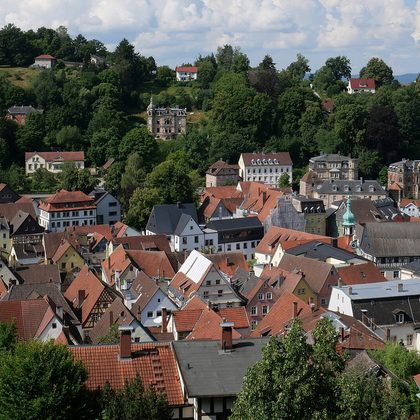
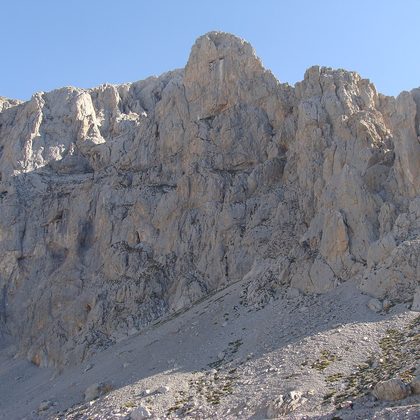
Open country with old trees or rock faces to nest in and wide, short-vegetated ground to feed on. It nests in tree holes, cliff crevices and cavities in buildings, and forages on arable fields, grassland, steppe and river valleys, often near villages and farms and often alongside other crows. Outside the breeding season it forms large, noisy flocks that roost communally.
Where the bird is most at home, classified with EUNIS — the European standard for habitats.
Range and movements
Breeds from southern eastern Siberia through Mongolia into much of China and south-eastern Tibet. Northern birds move out and winter further south in China; beyond that it is a scarce winter visitor to Korea, a rare but annual one to Japan and a vagrant to Taiwan. Westwards the range does not continue: within the area of this guide there is no breeding population, no wintering and no regular passage, only a scatter of single records — Finland in 1883, Sweden in 1985, the Netherlands in 1995 and 1997, France in 1995 and Denmark in 1997. That these fall almost entirely in spring is the strongest argument that they concern genuine vagrants: birds tracing back to escapes would turn up evenly through the year. Escapes cannot be ruled out in this species, and each record is weighed on its own.
Where and when to look
There is nothing to plan for in Europe; to see the species, go to East Asia, where it stands in mixed jackdaw and rook flocks on winter fields. Closer to home the useful habit is scanning: in autumn and spring, give every large jackdaw flock a few seconds for a bird with a white body or a conspicuously dark eye. It costs little, and it is exactly how the western European birds have been found.
Conservation status
Not threatened (IUCN: Least Concern), with a stable world population across a large East Asian range. For Europe it is no more than an extremely rare guest, so there is no European conservation task attached to it. The burden of proof on each record is heavy, though: the species is kept in Asia and turns up occasionally in the bird trade, so rarities committees weigh, case by case, whether a bird arrived under its own power or traces back to escaped birds.