All species › Passerines › Crows and jays › House crow
House crow | Corvus splendens
Huiskraai | Corneja india
The House Crow is the crow that travels by ship. A bird of South Asian towns by nature, it now stands in harbours from East Africa to the Red Sea — and stood for twenty years at Hook of Holland, where it came ashore in 1994 and has since been removed again.

Voice
A flat, nasal kaa-kaa, higher and drier than the grating caw of a Carrion Crow and without the hoarse undertone of a Rook, usually in short series of two or three. There is also a short rattling alarm, and a great deal of soft muttering and clicking within a flock. Where the species occurs it is audible all day, loudest around the roost trees at first and last light.
Recording: Vladimir Yu. Arkhipov — CC BY-SA 3.0 · Wikimedia Commons
Identification
A little smaller and a good deal slimmer than Carrion Crow, long-legged, with a long and fairly straight bill that curves only at the tip. The plumage is black with a green to purple gloss, but nape, hind-head, breast and upper belly are ash-grey to grey-brown. That grey lies like a shawl around the black face and cuts sharply against the black cap, the black chin and throat and the black wings. The forehead rises high and steep and the crown is flat, giving the head a more angular look than any crow of northern Europe. Juveniles are duller, the grey browner and less cleanly edged. In flight note the narrow, rather long wing, the fairly long tail with a rounded tip, and a lighter, quicker action than a Carrion Crow's.
Confusion species
Carrion Crow is larger and more compact, wholly black, with a heavier and more curved bill, a densely feathered bill base and a low, flat crown; nothing on it reads as a grey shawl. Rook is the same length but adults show a bare, greyish-white bill base, a clear peak to the rear crown and baggy thigh feathering. Jackdaw carries its grey at the other end: on Jackdaw the nape and hind-head are grey and the body dark, and the eye is pale grey, while on House Crow the grey covers nape, breast and belly and the eye is dark. The pitfall is distance or strong backlight; three things settle it then — the slim, long-legged build, the high flat forehead, and the long bill.
Habitat
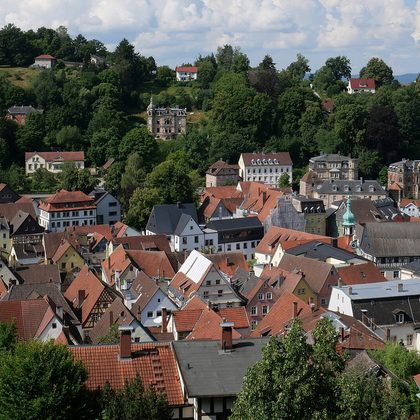
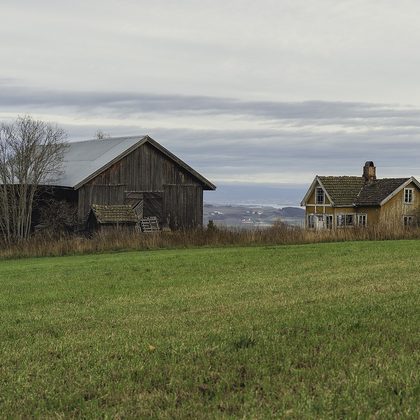
Towns, villages and above all harbours. Outside its own breeding range it is scarcely ever found away from people: it feeds in streets and markets, on tips, quays and fish quays, and further in gardens, parks and along the tideline. An omnivore, taking refuse, carrion, insects, fruit and grain, and eggs and nestlings of other birds besides. Nests in a stick nest in a street tree, a park or against a building, often with several pairs close together.
Where the bird is most at home, classified with EUNIS — the European standard for habitats.

Range and movements
Native to Pakistan, India, Nepal, Bangladesh, Sri Lanka, the Maldives and the coasts of Myanmar and southern Iran. Beyond that it turns up wherever seagoing ships call. It has bred at Aden since the nineteenth century, and from there it has worked its way along the whole Red Sea — Djibouti, the Egyptian ports, and the Saudi coast, where Jeddah holds tens of thousands. In Europe it amounts to small footholds in port cities and to single birds stepping off a ship; the best-known group sat at Hook of Holland.
- Resident
- Winter
- Passage
- Migration direction
- dark = core range, pale = thinly spread
Where and when to look
In north-west Europe you are too late. The reliable places are on the Red Sea — in Hurghada, Safaga or Aqaba it simply walks across the café terraces — and any South Asian city, where it is the commonest bird there is. Watch how it moves: quicker and lighter than the crows at home, closer to a large Jackdaw. Then look into the light for the border between the black throat and the grey breast; that line is crisper in life than most photographs suggest.
Conservation status
Not threatened globally (IUCN: Least Concern) and extremely numerous across South Asia, helped by towns, harbours and waste. Beyond that range it is controlled in many places, because it takes the eggs and young of other birds and is a nuisance in port cities. In the Netherlands a small population held on at Hook of Holland: the first birds arrived by ship in April 1994, the first pair bred in 1997 — the first breeding record for the species in Europe — and over almost twenty years the group grew to some thirty birds. After a court case a hunter was instructed to cut the group back; shooting ran from 2013 and 2014 onwards and by the end of 2015 nothing was left. The judgement was not an easy one. Here the birds did no demonstrable harm and were a familiar neighbour to many residents: nearly fourteen hundred of the town's ten thousand people signed against the shooting. Against that stands the damage the species has done elsewhere, and the fact that removing such a foothold is only feasible while it is small. The decision turned on that last point.