All species › Passerines › Larks › Dunn's lark
Dunn's lark | Eremalauda dunni
Dunns leeuwerik | Alondra de Dunn
The hardest of the desert larks: small, pale, featureless at first glance, and seldom where you look for it. It follows the rain, and a plain that was full of them last year can be entirely empty this one. To see it you have to learn two things — the heavy pale bill on that small round head, and the black tail with white sides.
No freely licensed photograph of a living wild bird of this species exists.
Voice
The song is a short, sweet, jingling little phrase with a faintly metallic ring, repeated over and over. It sings from the ground or from a low bush, and also in a slow, fluttering song flight in which it hangs high over the plain before sailing down again. The call is a short, dry chirrp, usually from a small party lifting and moving off. Song comes mainly in the weeks after rain, when the plain turns briefly green; in a dry year a whole area can stay silent all winter.
No freely licensed recording is available for this species yet.
Identification
A small, compact lark of 13–14 cm, with a big rounded head and a short tail — the proportions of a finch more than of a lark. The bill is short, deep-based and purely conical, pale pink to horn, and looks too heavy for the bird carrying it. Upperparts pale sandy with fine dark streaks on crown and mantle; underparts white with a light buff wash and fine streaking confined to the breast sides. The face is pale, with a narrow dark line behind the eye, a dark moustachial stripe framing the ear-coverts, and a pale ring around a large dark eye. The best mark shows as the bird flushes and lands: the tail is black with white outer feathers, and that black-and-white cuts sharply against the plain sandy rump. Legs pale pink. It runs in short quick steps, then stands stock still and vanishes into the ground colour.
Confusion species
This is the place to slow down. Bar-tailed lark is just as small and just as pale and walks the same plains, but it is plain sandy above with no streaking, has a blank, unmarked face with no eye-line or moustachial, a smaller and finer grey bill and — the decisive point — a rusty-orange tail with a broad black terminal band, not a black tail with white sides. Desert lark is bigger, greyer and darker, with a longer and more pointed bill, plain plumage, and a tail that is dark-tipped but has no white at the sides. Mediterranean short-toed lark is slimmer, longer-tailed and longer-legged, with a clearly streaked breast, a smaller bill and nothing like the same heavy head. Greater short-toed lark is larger, with a clean white breast bearing a small dark neck patch and much longer tertials. Temminck's lark, with its black-and-white face and two black horns, cannot be confused at all. When in doubt, wait until the bird flies: the tail settles it.
Habitat
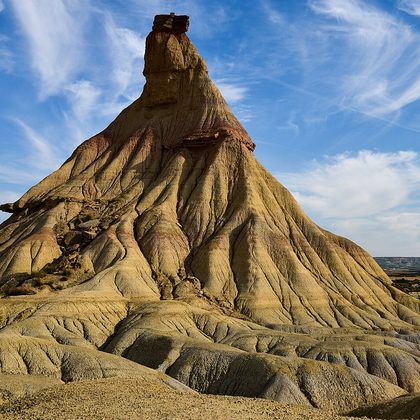
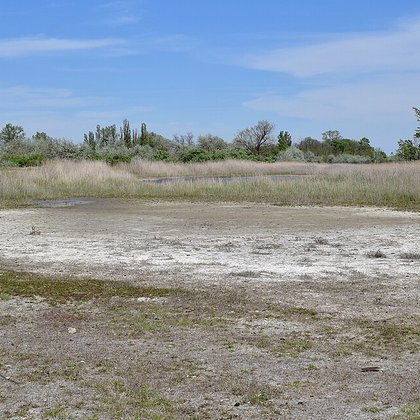
Flat sand and gravel plains with widely spaced low bushes and tussocks, wadi beds with acacia, and the transition from sandy plain to bare hamada; also the fringes of salt flats. It needs the combination: plenty of open bare ground to walk over, and enough low scrub to set seed and to shade the nest scrape. A completely bare plain is no use to it, and neither is closed cover.
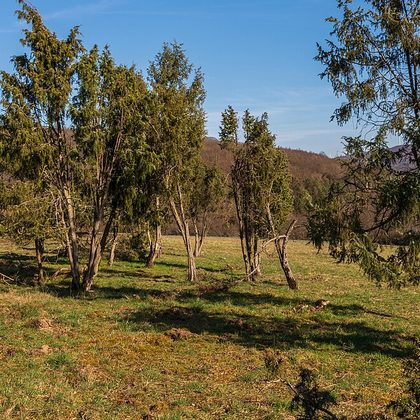
Where the bird is most at home, classified with EUNIS — the European standard for habitats.
Range and movements
There is a taxonomic catch here that decides the map. This guide follows AviList, which splits the genus in two: Eremalauda dunni is the Saharan bird, from Western Sahara, Mauritania and southern Morocco east through southern Algeria, Mali, Niger and Chad to Sudan, while the birds of the Negev, the Arava, Jordan and Arabia are placed with Arabian lark, Eremalauda eremodites. Older handbooks and most record databases still lump the two, which is why the species appears on plenty of lists as an Israeli breeder. Within the area of this guide the split means this: true Dunn's lark is a bird of the far south of Morocco and of Western Sahara, and what you see in the Negev or the Arava belongs to the other half. Both are wanderers with no regular migration.
- Resident
- Winter
- Passage
- dark = core range, pale = thinly spread
Where and when to look
The classic ground is the road from Dakhla to Aousserd in Western Sahara. Go after a wet winter, drive at walking pace and scan the flat stretches with widely spaced bushes; often the first sign is a small party lifting, and then that black-and-white tail is all you need. On the ground it is harder: the bird runs a few steps, freezes and is lost in the substrate. At first light, sit quietly by a water point or a damp hollow and wait — that pays off more often than searching does. And do not settle for the first pale lark you see: always check bill and tail.
Conservation status
Not threatened (LC). The range runs across the whole southern Sahara and is vast, but density is low everywhere and the birds shift with the rain, so nobody really knows how many there are. Counting is barely possible: an area can be empty for three years and full in the fourth. The pressures are the same as for the other seed-eating desert birds — overgrazing that strips the low shrub layer and with it the seed supply, the drying out of wadis, and growing off-road traffic — but on the scale of the whole Sahara they do not yet weigh heavily enough to put the species in trouble.