All species › Passerines › Crows and jays › Eurasian jackdaw
Eurasian jackdaw
Coloeus monedula | Kauw | Grajilla occidental
The Jackdaw is the smallest crow in the Netherlands and the most urban: it nests in chimneys, church towers and tree holes, walks briskly and upright across lawns, and keeps the same partner for life. Its bright kyak over a village square is part of the sound of Europe.

Voice
The voice is at least as diagnostic as the plumage: a short, clear, metallic kyak or chak, much higher and more cheerful than the cawing of Crow and Rook, often in quick series and with great variation. Flocks wheeling round a tower produce a sustained, excited chatter with a shriller kyaa-r mixed in. At a dusk roost the chorus of hundreds swells into a rolling, almost bell-like murmur.
Recording: Joost van Bruggen — CC BY-SA 4.0 · Wikimedia Commons
Identification
Clearly smaller and more compact than Carrion Crow or Rook, with a short, stout, straight-cut bill — pliers rather than a dagger. The plumage is dull black with a grey nape and rear crown worn like a hood around the black cap; in good light the body reads as dark slate-grey rather than black. The clinching feature is the eye: on adults a bright silvery-white to pale blue-grey, visible from a long way off. Birds in their first summer have a duller grey-brown eye and less contrasting nape. In flight it is fast and agile, with notably quick wingbeats and a short, stocky silhouette; flocks love to tumble and roll around towers.
Confusion species
Carrion Crow is much larger and heavier, uniformly glossy black without a grey nape, with a thick curved bill and a dark eye; its wingbeats are slower and its call a deep, grating kraah. Rook is about Carrion Crow size, with a pointed conical bill, a bare greyish-white bill base on adults, a steep forehead, shaggy trousers and a purple gloss; its call is higher and more plaintive than the crow's. Young Rooks still have feathered bill bases and so look more crow-like, but keep the pointed bill and peaked crown. Jackdaws often sit right inside Rook and Starling flocks: look for the size difference, the grey nape and the pale eye.
Habitat
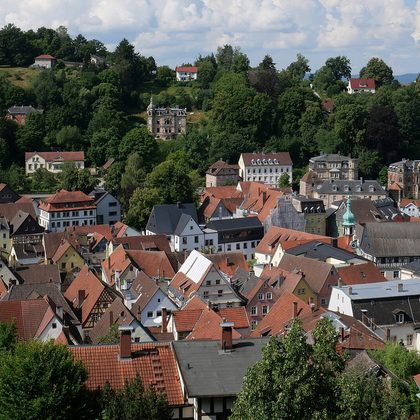
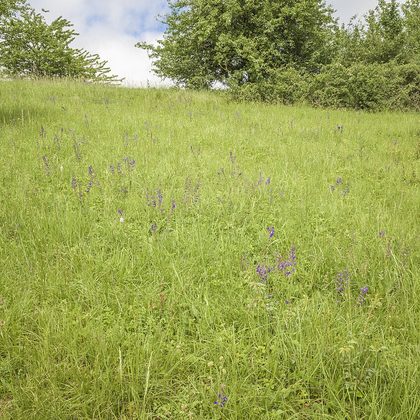
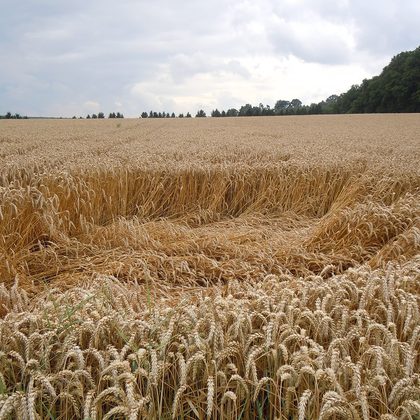
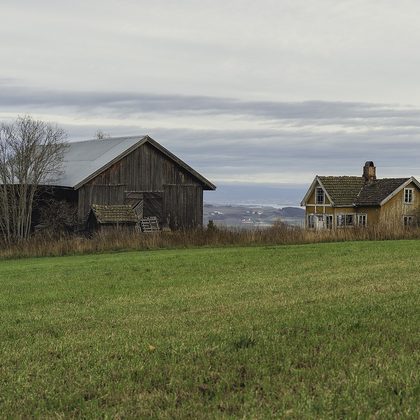
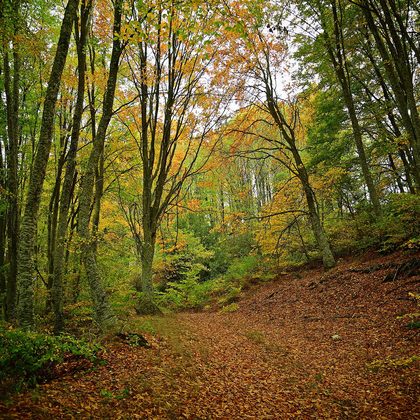
Wherever cavities and short grass meet: villages and towns with old buildings, church towers, chimneys and castles, plus old parks, farmyards, pollard willow rows, mature beech woods with woodpecker holes, and sea cliffs. It feeds on short grassland, playing fields, arable land and among livestock, taking worms, leatherjackets, insects, seed and human scraps. Outside the breeding season it roosts communally in large trees or woodland, often with Rooks.
Where the bird is most at home, classified with EUNIS — the European standard for habitats.
Range and movements
Widespread across almost all of Europe, north-west Africa and western Asia. In the Netherlands it is a common resident of town and countryside, with additional birds from north-eastern Europe in winter; numbers have been stable to slightly increasing in recent decades. In Spain it breeds throughout the country in church towers, cliffs and old buildings, with concentrations on the Meseta and in Andalusia, often sharing the same monuments with Kestrels and swifts.
- Resident
- Breeding (summer)
- Winter
- Passage
- dark = core range, pale = thinly spread
Where and when to look
All year, but at its finest at dusk on a winter evening at a communal roost: Jackdaws and Rooks gather in waves over a copse or park wood and the sky fills with tumbling birds. In spring an old church tower or a row of pollard willows is the place to watch pairs: Jackdaws sit tight against one another, preen each other's necks and stay together for years.
Conservation status
Not threatened (IUCN: Least Concern) and stable to increasing across Europe, the species profiting from buildings as nest sites. Locally there is pressure: capping chimneys and restoring towers costs nest holes, and in the countryside food is scarcer as short-grazed, insect-rich grassland disappears. In a few countries the Jackdaw is still shot as a pest species.