All species › Passerines › Crows and jays › Eurasian nutcracker
Eurasian nutcracker | Nucifraga caryocatactes
Notenkraker | Cascanueces común
The Nutcracker is a chocolate-brown bird over which someone has flicked white drops with a fine brush. It is best known for what it carries in its head: in a single autumn it buries tens of thousands of seeds in thousands of small caches spread over a whole mountainside, and digs them out again months later under half a metre of snow.

Voice
A hard, dry rolling krrraaah krrraaah, drawn out and rattling, like a wooden ratchet being turned; it carries far across a valley and is usually the first sign that a Nutcracker is about. There are also short harsh calls and, close to, a soft and surprisingly varied subsong of squeaks, clicks and a little mimicry. Heard all year, mostly from a bare treetop above the wood, and loudest in late spring.
Recording: Zdeněk Vermouzek — CC BY-SA 4.0 · Wikimedia Commons
Identification
About the size of a Jay but shorter-tailed and more compact, with broad rounded wings and a heavy, straight bill that tapers to a wedge. The whole body is warm chocolate-brown, sprinkled with sharply drawn white drops, densest on breast and flanks. Crown and hind-head stay plain dark brown — no drops there — and wings and tail are black with a green gloss. Two clean white areas show below: a broad white 'trousers' patch under the base of the tail and a white terminal band across the tail, most obvious as the bird flies off or closes its wings. The flight is heavy and undulating, with short glides, and the short tail gives it an almost front-heavy outline. Juveniles are duller, the drops less crisp.
Confusion species
Jay is the only real candidate: the same size, often the same wood and the same flappy flight, but pink-bodied with a blue wing panel, a white rump against a black tail and a streaked crown. On Nutcracker the white sits under the tail and along its tip instead, and the body is brown with white drops. At range or against the sky the outline can also suggest Carrion Crow or Rook, but those are far larger, wholly dark and much steadier on the wing. Anyone who sees a spotted bird and thinks Starling need not hesitate long at this size — the Nutcracker is nearly twice as long and far heavier-billed. Two subspecies look different in the field: the European bird has a short, thick bill for cracking hazelnuts, the Siberian one a longer and noticeably thinner bill for prising seeds out of cones.
Habitat
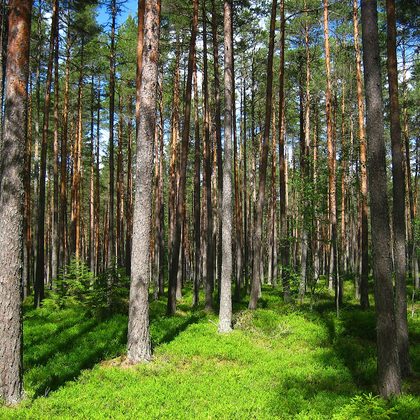
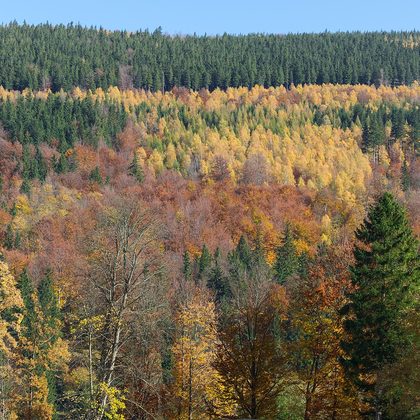
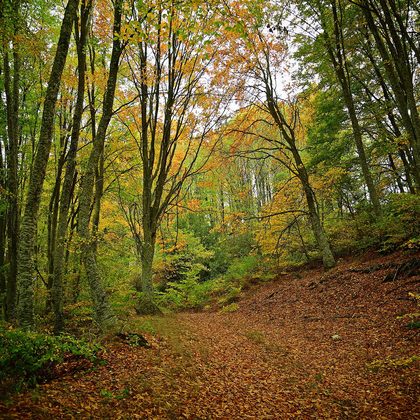
Coniferous and mixed forest in the mountains and across the northern taiga, favouring old stands with seed-bearing trees: Arolla pine in the Alps and Carpathians, Siberian pine further east. Where hazel grows along the edge of broadleaved and mixed woodland it uses that just as readily, and in irruption years it turns up in gardens and parks beneath a nut tree. It feeds by hacking and prising at cones and nuts, and takes beetles, caterpillars and the occasional egg or nestling besides. It breeds early, from March, in a solid nest set high against a spruce trunk — the young are largely raised on seed from the previous autumn's stores.
Where the bird is most at home, classified with EUNIS — the European standard for habitats.
Range and movements
Breeds in the mountains of central and south-eastern Europe — Alps, Jura, Black Forest, Bavarian Forest, Carpathians, Balkans — and further in Scandinavia, the Baltic states and Russia, in an unbroken belt reaching north-east China and Japan. It is a great rarity in Britain and Ireland, arriving only in irruption years, when the Siberian cone crop fails and the Siberian subspecies moves west in August and September. Such years are rare and unpredictable: 1968 was the largest, with over three hundred birds recorded across Britain and Ireland, and decades can pass with almost nothing. In Spain the species is absent; the nearest breeders sit in the French Alps and the Jura.
- Resident
- Breeding (summer)
- Winter
- Passage
- Migration direction
- dark = core range, pale = thinly spread
Where and when to look
Go to an Arolla pine forest in the Alps in September or October, above fifteen hundred metres, and settle where you can see over the tops. In those weeks the birds work all day: they take a cone apart, fill the throat with a handful of seeds and fly them hundreds of metres to a clearing or a rock edge, where the seeds go in under moss and grit. Come back in March and you will see the same birds, snow up to their bellies, digging out those exact places again.
Conservation status
Not threatened (IUCN: Least Concern) and stable in Europe, with the largest numbers in Romania, Switzerland and Bulgaria. Where things go wrong they go wrong in one way: the species hangs on old forest with seed-bearing trees, and on hazel along the woodland edge. Where Arolla pine forest is felled or fails to regenerate, the bird goes with it — and with it goes the animal that plants that forest, since the caches it never recovers are where the next generation of pines starts.